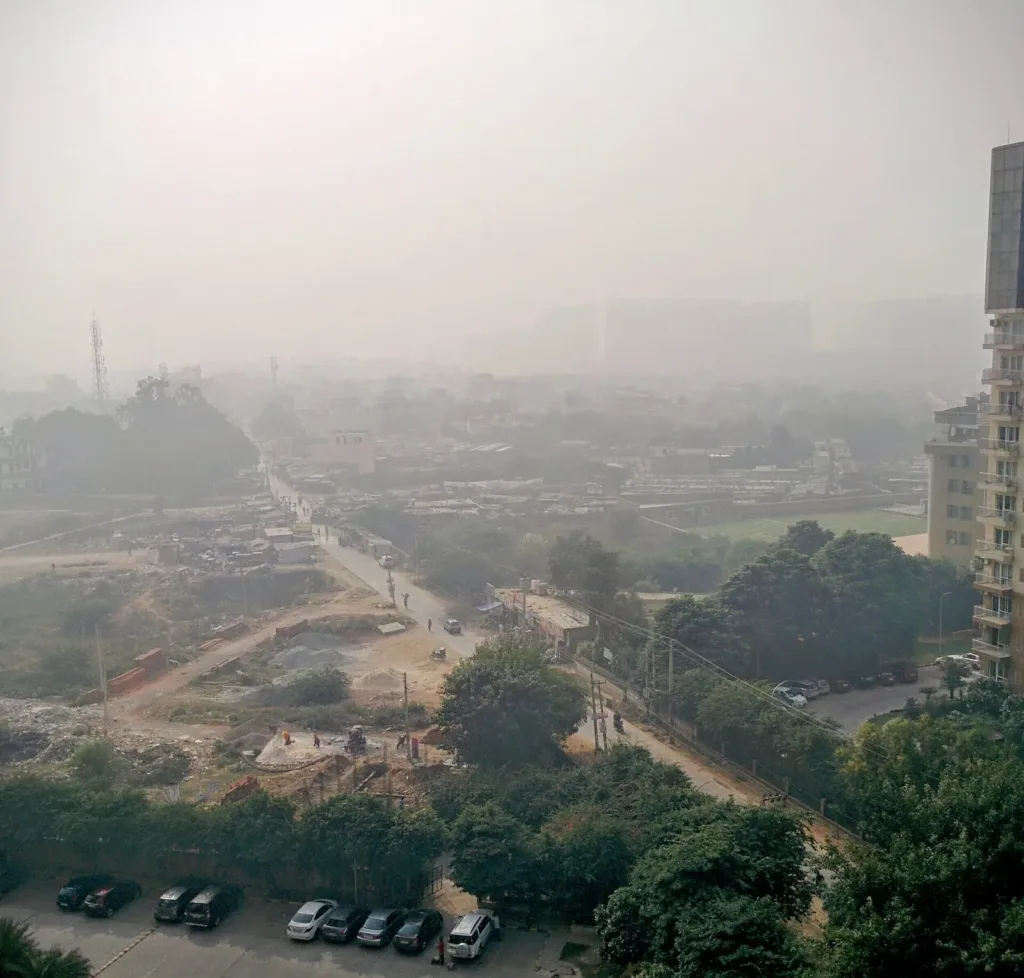
Representative image. Saurabh Kumar, CC BY-SA 4.0, Wikimedia Commons

हिन्दी में सारांश Summary in Hindi
- गुरुग्राम के उपायुक्त उत्तम सिंह ने 3 नवंबर 2026 को आदेश दिया: 5 से 20 नवंबर तक धूल उड़ाने वाला निर्माण और तोड़फोड़ बंद रहेगा।
- गुरुग्राम में हरियाणा सरकार और निजी दफ्तरों में 50% से ज्यादा कर्मचारी दफ्तर नहीं आएंगे, बाकी घर से काम करेंगे।
- CPCB के मुताबिक 3 नवंबर को गुरुग्राम का AQI 305 और मानेसर का 309 रहा, यानी 'बहुत खराब'।
বাংলায় সারাংশ Summary in Bangla
- গুরুগ্রামের ডেপুটি কমিশনার উত্তম সিং 3 নভেম্বর 2026 নির্দেশ দিয়েছেন: 5 থেকে 20 নভেম্বর ধুলো ওড়ানো নির্মাণ ও ভাঙার কাজ বন্ধ থাকবে।
- ফিসে আসবেন না, বাকিরা বাড়ি থেকে কাজ করবেন।
- র্থাৎ 'খুব খারাপ'।
Why it matters
For 16 days, at least half the staff of Haryana government and private offices in Gurugram will be working from home on any given day, and road, flyover and pipeline work in the district will pause. Builders who ignore dust rules face sealing and fines, as 10 sites have already found. The air in Gurugram and Manesar is now in the band CPCB links to respiratory illness on prolonged exposure.
Gurugram work from home rules start on Thursday, 5 November 2026, under a district order. Gurugram Deputy Commissioner Uttam Singh has ordered Haryana government and private offices in the district to keep no more than half their staff at the workplace, and has stopped dust-raising construction and demolition work, both until 20 November. He issued the orders on Tuesday, 3 November, to carry out directions from the Commission for Air Quality Management (CAQM), the body that sets pollution rules for the National Capital Region (NCR), Hindustan Times reported. The Times of India reported the same details.
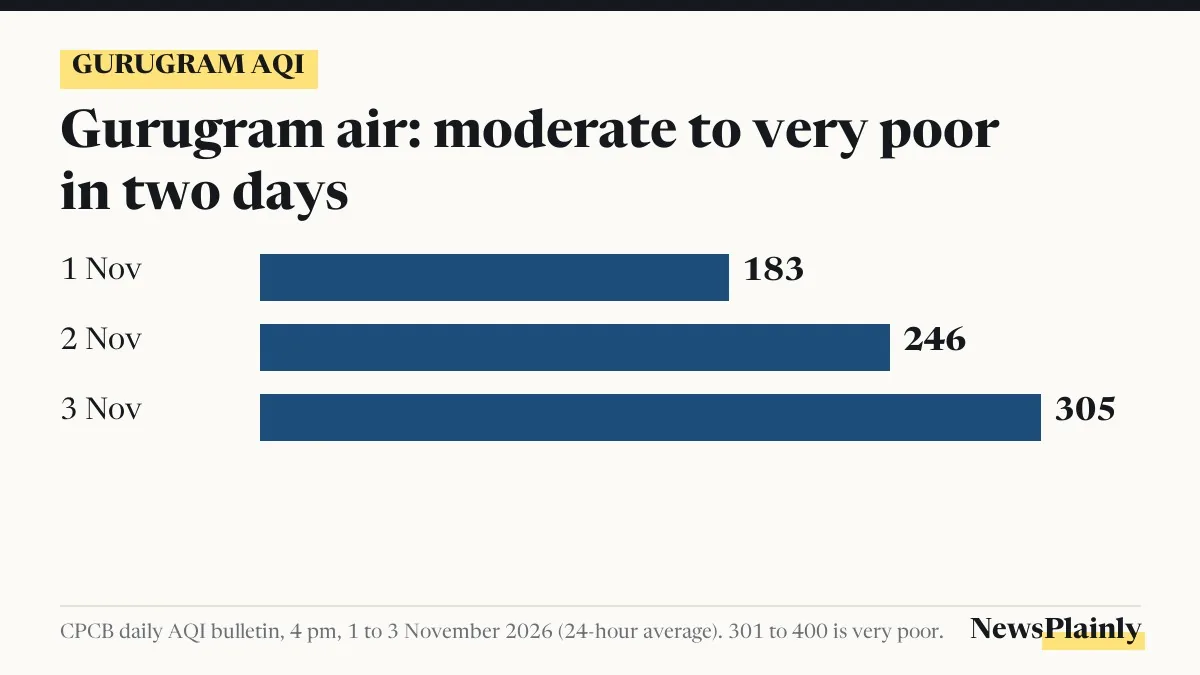
The order came on the day Gurugram’s air slipped into the “very poor” band. The Central Pollution Control Board (CPCB) bulletin for 4 pm on 3 November put Gurugram’s Air Quality Index (AQI) at 305 and nearby Manesar’s at 309.
What the Gurugram construction ban stops from 5 November
The Gurugram construction ban covers the whole district. All dust-raising demolition and outdoor construction stays suspended from 5 to 20 November, according to both reports. That includes public works that run in a line across the city: highways, roads, flyovers, overbridges and pipelines. Road and flyover projects are not on the exempt list.
Some projects can carry on. Here is how the order sorts them, as Hindustan Times and the Times of India described it.
| Part of the order | What it says |
|---|---|
| Stopped, 5 to 20 November | Dust-raising demolition and outdoor construction across Gurugram district, including highways, roads, flyovers, overbridges and pipelines |
| Exempt projects | Railways, Metro, airports, inter-state bus terminals, hospitals, water supply and sanitation, national security and defence, and projects of national importance |
| Condition on exempt projects | Must keep up dust control and follow the Construction and Demolition Waste Management Rules (Hindustan Times) |
| Offices | Haryana government and private offices: at most 50% of staff in person, the rest work from home |
| Left out of the office rule | Industrial units and essential services where working from home is not practical |
| Who checks | Sub-divisional magistrates (SDMs) and Haryana State Pollution Control Board officials, with daily inspections |
| Penalty route | Action under the Commission for Air Quality Management Act, 2021 |
The Times of India called it a 15-day ban. Counting both 5 November and 20 November, the period is 16 days, which is how Hindustan Times put it.
Gurugram work from home: who has to cut office attendance
The office rule applies to Haryana government departments and private offices in Gurugram district. No more than 50% of an office’s staff should attend in person on any day, and the rest are to work from home, the reports said. How the split is made, by rota, team or alternate days, is left to each office in the reports read; neither gave a format.
Factories and essential services are left out where remote work does not fit the job. Someone who works on a shop floor in Manesar or in a hospital is not expected to stay home under this rule. A software firm or a back office in Cyber City is.
The two reports did not mention central government offices, banks under central rules or schools, so this article does not say how the order treats them. Staff should check with their own employer for the roster that applies to them.
Gurugram AQI turns very poor, CPCB data shows
CPCB publishes a daily bulletin at 4 pm with each city’s AQI averaged over the previous 24 hours. On a 0 to 500 scale, 301 to 400 is “very poor”, which the board links to respiratory illness on prolonged exposure. Over three days, the Gurugram AQI climbed from the “moderate” band into “very poor”.
| City | 1 November | 2 November | 3 November |
|---|---|---|---|
| Gurugram | 183 (moderate) | 246 (poor) | 305 (very poor) |
| Manesar | 166 (moderate) | 211 (poor) | 309 (very poor) |
| Delhi | 261 (poor) | 324 (very poor) | 350 (very poor) |
That is a rise of 122 points in two days for Gurugram and 143 for Manesar, NewsPlainly’s calculation from the CPCB figures. Hindustan Times said this was Gurugram’s first “very poor” day this season. All four of the city’s monitoring stations reported to the 3 November bulletin, which named PM10 (particles up to 10 micrometres across) and PM2.5 (finer particles up to 2.5 micrometres) as the main pollutants.
The Tribune on 4 November called Gurugram’s air “severe”, citing the private website aqi.in, which uses its own scale. On the official CPCB scale, severe starts at 401, and neither Gurugram nor Manesar was there on 3 November.
HSPCB seals 10 construction sites under GRAP Stage 2
Enforcement had already begun before the new order. The Haryana State Pollution Control Board (HSPCB) sealed 10 construction sites in Gurugram for breaking dust rules under Stage 2 of the Graded Response Action Plan (GRAP), the set of pollution curbs that tighten in stages as the air gets worse, Dainik Jagran reported on 4 November.
HSPCB inspectors found none of the required dust controls at those sites, the paper said: no closed-circuit TV (CCTV) cameras or dust sensors, no anti-smog guns or sprinklers, and no barricading. Harish Sharma, the HSPCB regional officer for Gurugram North, told Dainik Jagran that the builders would also be fined and that inspections would continue. The report did not name the sites or give the fine amounts.
GRAP Stage 2 has been in force across Delhi-NCR since 2 November, when Delhi’s air first turned very poor this season. Under it, building sites must keep dust controls running, Dainik Jagran noted, and those controls are what the sealed sites lacked. From 5 November, dust-raising work at sites outside the exempt groups has to stop altogether.
How the Gurugram order fits the NCR-wide rule
The Gurugram order is the district’s way of carrying out a CAQM order issued on 30 October for the whole region. That order paused dust-raising construction across NCR from 5 to 20 November and asked offices in Delhi and five nearby districts, Gurugram, Faridabad, Sonipat, Ghaziabad and Gautam Buddha Nagar (Noida), to work with half their staff at most. NewsPlainly covered the NCR construction ban and its exemptions when it was announced.
What the district order adds to the Gurugram work from home and construction rules is enforcement on the ground. It names the SDMs and HSPCB officials as the people who will check sites and offices every day in Gurugram, and it ties violations to the CAQM Act. For residents in Faridabad, Noida or Ghaziabad, the CAQM rule is the same, though this article has not checked each district’s own order.
The curbs are a precaution set for the two weeks when, CAQM said in its 30 October order, NCR pollution has tended to peak in past years. The reports give 20 November as the last day.
Frequently asked questions
Is work from home mandatory in Gurugram?
Haryana government and private offices in Gurugram district must keep in-person attendance at 50% or less from 5 to 20 November 2026, with the rest working from home, according to the district order as reported by Hindustan Times and the Times of India.
Which construction work is allowed in Gurugram during the ban?
Railways, Metro, airports, inter-state bus terminals, hospitals, water supply and sanitation, defence and projects of national importance may continue, but must follow dust control rules. Roads, highways, flyovers and pipelines are not exempt.
What is Gurugram's AQI now?
CPCB's bulletin for 4 pm on 3 November 2026 gave Gurugram an AQI of 305 and Manesar 309, both in the very poor band (301 to 400).
Who will check that offices and sites follow the order?
Sub-divisional magistrates and Haryana State Pollution Control Board officials are to carry out daily inspections, and violations can be acted on under the CAQM Act, 2021.