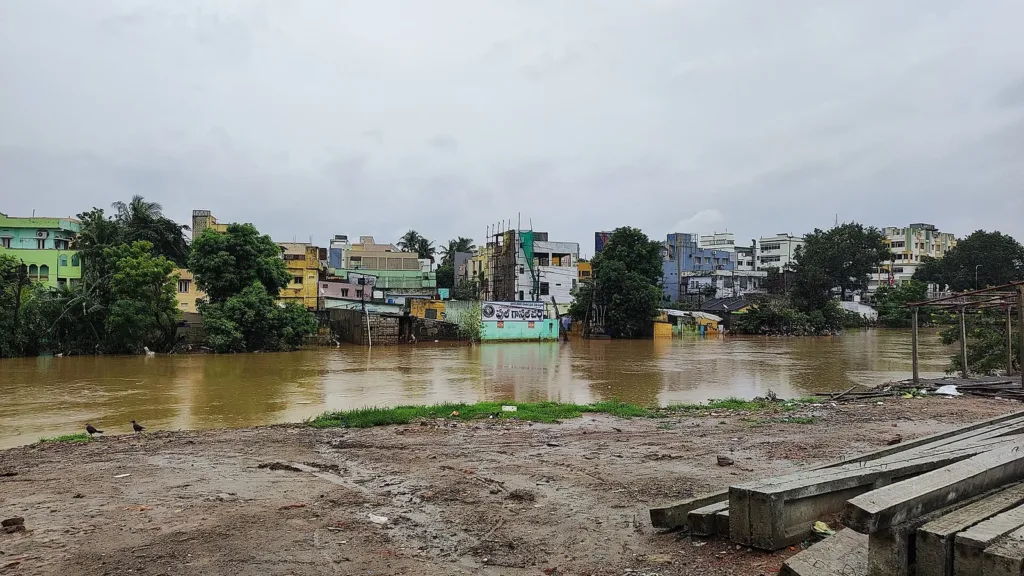
Representative image. Sripathroy, CC0, Wikimedia Commons

Why it matters
For farmers in Krishna, Bapatla and Nandyal, the paddy, cotton and maize losses come a week after Cyclone Arnab, which Naidu said damaged about 3.52 lakh hectares of farm crops. The rain is not over: the IMD expects heavy to very heavy rain at isolated places in coastal Andhra Pradesh on 4 November and flagged a flash flood risk in six districts.
Cyclone Murasu damage in Andhra Pradesh includes at least two deaths, standing crops hit on 52,459 hectares and a preliminary loss of ₹344 crore, the Andhra Pradesh State Disaster Management Authority (APSDMA) said on Tuesday, 3 November 2026. Both deaths were in Bapatla district. The storm crossed the coast near Ongole early that morning and had weakened to a cyclonic storm by the afternoon, the India Meteorological Department (IMD) said.
APSDMA managing director Prakhar Jain told The Hindu that a 25-year-old man in Chinnaganjam and a 65-year-old woman in Karamchedu died when buildings collapsed on them. He said 12,230 people were staying in relief centres in Guntur, Bapatla and Palnadu, which The Hindu described as the worst-affected districts. NewsPlainly covered the landfall itself in its earlier report on Murasu reaching the coast near Ongole; this report covers what has been counted since.
Cyclone Murasu damage so far: deaths, crops and houses
The Cyclone Murasu damage figures released on 3 November are preliminary. Chief Minister N. Chandrababu Naidu said estimates for Murasu were still being prepared, PTI reported. Jain gave the main numbers to both The Hindu and the Press Trust of India (PTI): the ₹344 crore estimate, crops damaged across 52,459 hectares and 312 houses damaged. He told The Hindu the losses were smaller than those from Cyclone Arnab, which struck the state the week before. Naidu said Arnab had damaged about 3.52 lakh hectares of farm crops, PTI reported.
Paddy, cotton and maize took the worst of the crop damage, and Krishna, Bapatla and Nandyal were the worst-hit districts for farm losses, Deccan Herald reported, citing officials. The Times of India reported a lower figure, more than 31,000 hectares; the APSDMA’s 52,459 is the official preliminary estimate. Officials said the cyclone’s impact was above normal in 132 mandals spread over 15 districts, according to the PTI report.
Cyclone Murasu’s wind and rain also brought down 2,750 electricity poles and damaged transmission lines and substations, officials told PTI, with Prakasam and Bapatla hit most. The state is watching 814 minor irrigation tanks and has put 776 of them on high alert, Jain said. Some fishing boats were wrecked in Prakasam district.
The government said it had opened 171 relief camps, handed out 14,810 food packets and moved 3,066 pregnant women and 1,008 nursing mothers to hospitals as a precaution, PTI reported. Eleven National Disaster Response Force (NDRF) teams and 13 State Disaster Response Force (SDRF) teams were working on relief, and the fire department sent 185 teams to clear fallen trees and pump out water.
Where the heaviest rain fell
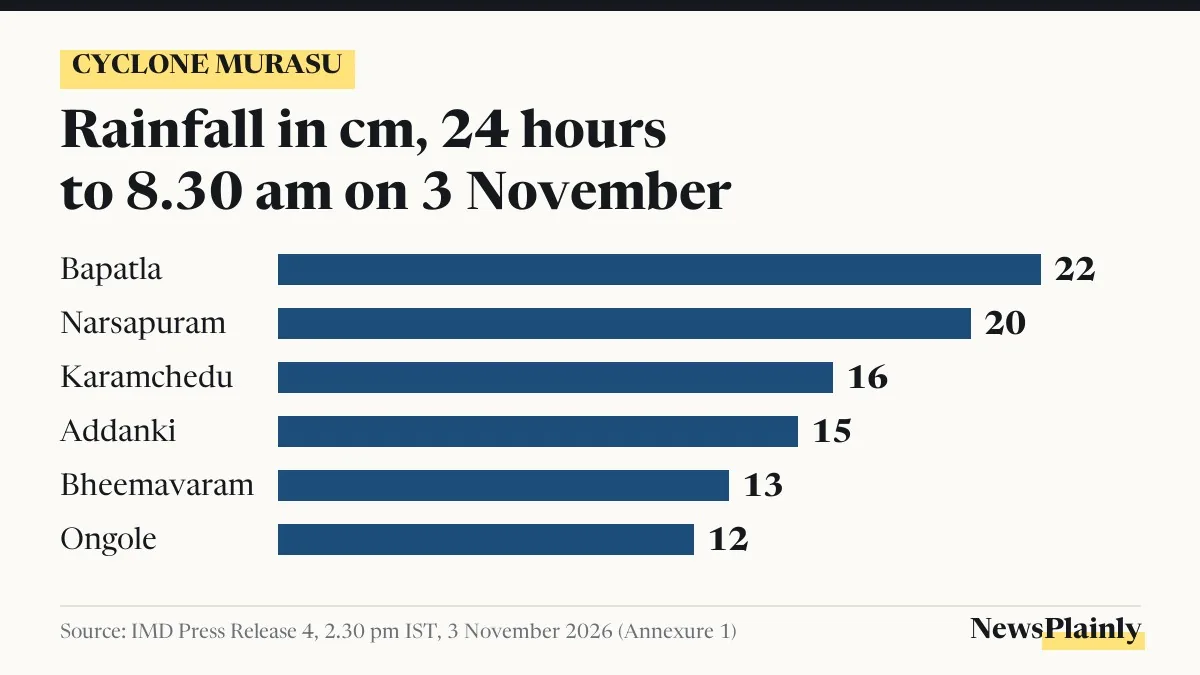
The IMD’s rainfall list for the 24 hours to 8.30 am on 3 November shows how concentrated the rain was. Bapatla town recorded 22 cm and Narsapuram in West Godavari 20 cm. Karamchedu, the Bapatla village where one of the two deaths took place, had 16 cm, Addanki 15 cm and Bheemavaram 13 cm. Racherla, Palakoderu and Ongole each had 12 cm.
The rain kept coming after Cyclone Murasu moved inland. Between 8.30 am and 9 pm on 3 November, Marripalem in Palnadu district recorded 263.75 mm, Ganapavaram 246.7 mm and Konanki in Bapatla 213.25 mm, The Hindu reported. Officials expected heavy inflow into the Budameru rivulet in NTR district (the district around Vijayawada), which flooded Vijayawada in 2024, and moved people from low-lying areas to relief centres.
The Andhra Pradesh cyclone also reached Odisha. The state shifted more than 1.65 lakh people to safety and kept 592 shelters open in its southern districts, the Indian Express reported, with PTI. Andhra Pradesh and Odisha both declared holidays for educational institutions in several districts, the same report said, without listing them all.
IMD bulletin: what the warnings say for 3 and 4 November
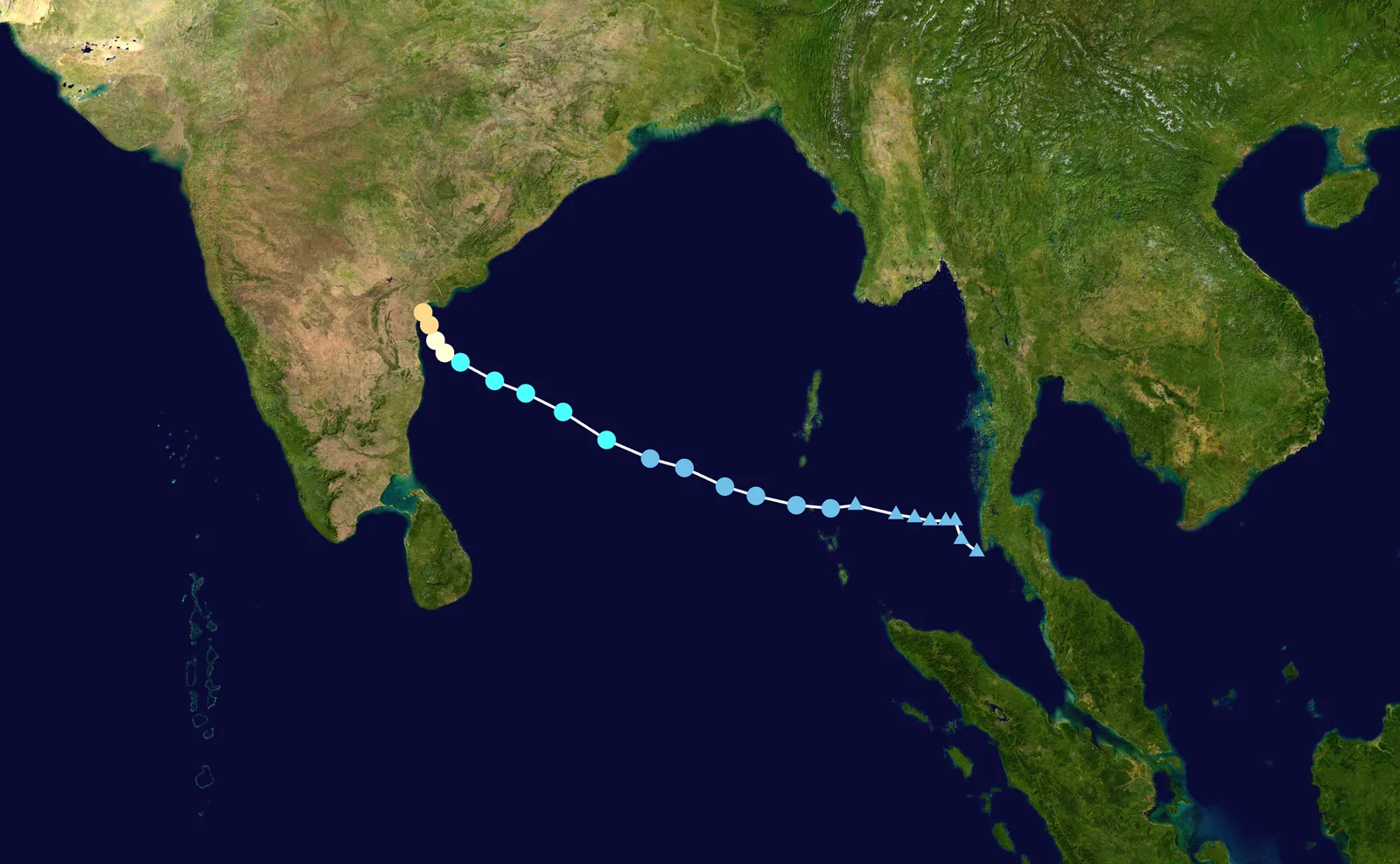
The IMD’s latest cyclone release, Press Release 4 issued at 2.30 pm on 3 November, puts the crossing between 3.30 am and 5.30 am that day, near Ongole, with winds of 100 to 110 kmph gusting to 120 kmph. Our earlier report gave about 1 am, when the landfall process began; the IMD’s crossing window is the official time. By 2.30 pm the system was a cyclonic storm 40 km west-northwest of Bapatla, with winds of 80 to 90 kmph, the Indian Express reported from the IMD’s afternoon update.
The IMD bulletin forecast that Cyclone Murasu would weaken into a deep depression by midnight on 3 November and into a depression by 5.30 am on 4 November, while moving north-northwest. These are forecasts. The IMD said its next release would come at 2.30 pm on 4 November. NewsPlainly put the warnings from that release and the IMD’s all-India release of 1.30 pm on 3 November into one table.
| Area | 3 November | 4 November |
|---|---|---|
| Coastal Andhra Pradesh | Heavy to very heavy rain at a few places, extremely heavy at isolated places | Heavy to very heavy rain at isolated places |
| Krishna, Bapatla, Prakasam, Nellore, Guntur, Eluru, NTR, Palnadu, West Godavari | Gale winds easing to 55 to 65 kmph, gusting to 75, by midnight | Winds falling further |
| Telangana | Extremely heavy rain at isolated places in eastern Telangana | Isolated heavy rain in northeast Telangana |
| Chhattisgarh | Isolated heavy rain | Isolated heavy rain; fairly widespread to widespread rain on 4 and 5 November |
| Rayalaseema, south Odisha, north Tamil Nadu | Heavy rain at isolated places | No cyclone rain warning in the 2.30 pm release |
| Sea off Andhra Pradesh | Fishermen told not to go out | Fishing warning runs till the morning of 4 November |
The same release flags a moderate flash flood risk in some watersheds of Bapatla, Eluru, Guntur, Krishna, NTR and Palnadu districts. For 4 November, the Times of India, citing the IMD, reported heavy to very heavy rain likely in Krishna, NTR and Eluru, and heavy rain in Prakasam, Bapatla, Guntur, Palnadu and both Godavari districts. In Chhattisgarh, Raipur had heavy rain on Tuesday evening and the weather office has put 15 districts on a yellow alert for Wednesday, Dainik Bhaskar reported.
Trains cancelled and the 14-hour halt of the Alleppey Express
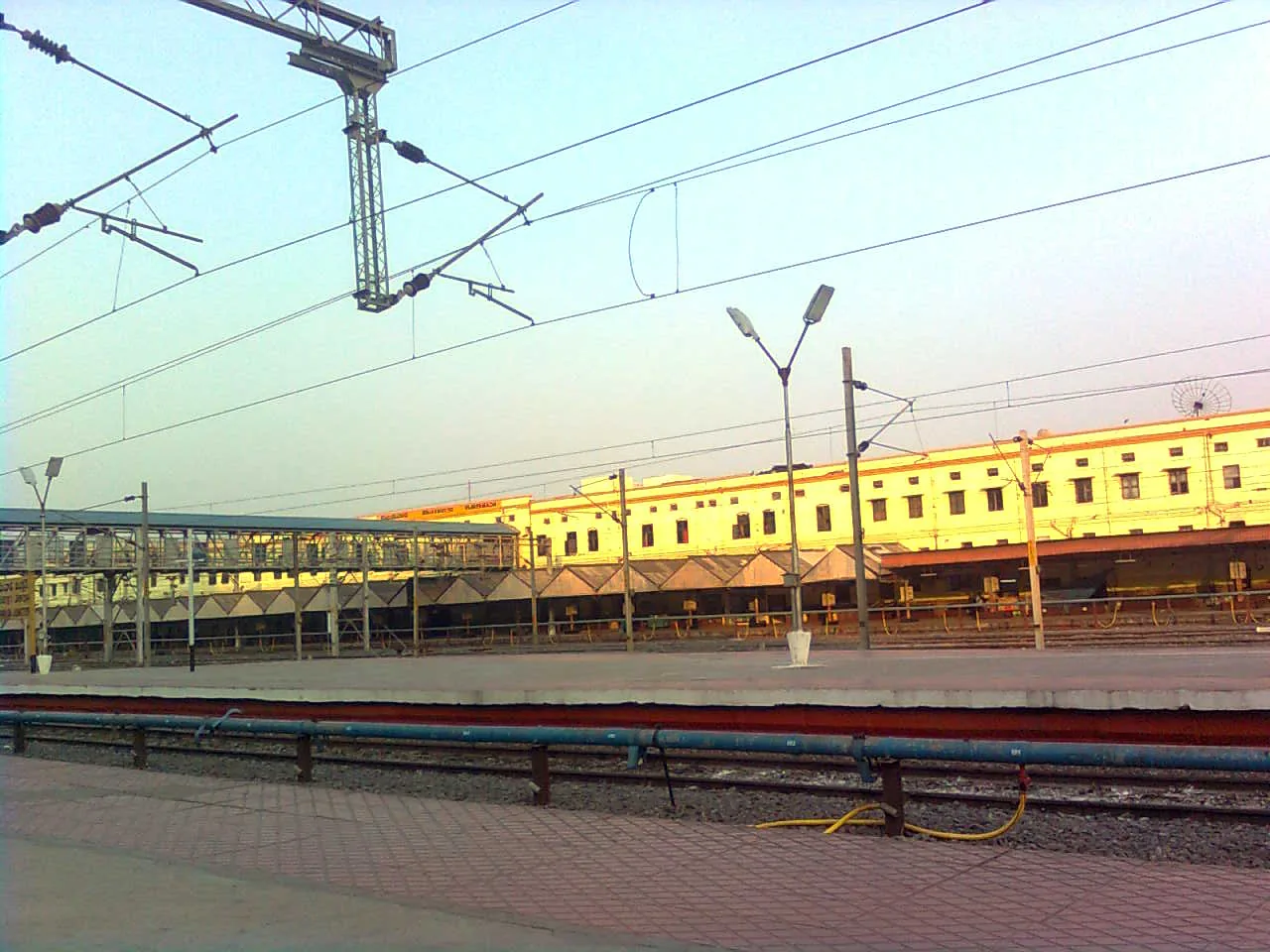
Because of Cyclone Murasu, more than 35 trains were cancelled, 14 diverted and eight rescheduled, PTI and The Hindu reported. The Vijayawada division of South Coast Railway suspended train movement on the Vijayawada, Ongole and Gudur section during the storm, The Hindu reported from the division’s bulletins. Cancellations on 3 November included the 12712 Chennai Central to Vijayawada train, the 12743 Gudur to Vijayawada train and several local passenger trains around Nellore, Ongole, Tenali and Narasapur. Another 29 long-distance trains were held, or regulated, at stations along the route.
One of them was the 13352 Alappuzha to Dhanbad Express, which left on 2 November and stood at Kavali station for about 14 hours, Dainik Jagran reported. The train ran out of water and its pantry car could not cook, so railway officials asked local voluntary groups for help, and they brought breakfast, lunch and drinking water. The train moved again at 3.15 pm on Tuesday and was expected in Dhanbad late on Wednesday instead of 10.50 am, the paper said. With trains cancelled on the route, passengers were advised to check running status on official channels such as the railways’ National Train Enquiry System (NTES) app, The Hindu reported.
Andhra Pradesh cyclone help numbers and advice
The Andhra Pradesh government’s WhatsApp number for cyclone problems, such as fallen trees, power cuts, collapsed walls and waterlogging, is 9552300009, the Times of India reported. The IMD’s advice for coastal Andhra Pradesh still applies while the rain lasts: stay indoors in affected areas, keep away from weak buildings and roads that often flood, and follow local traffic advisories.
Naidu briefed Union Home Minister Amit Shah on the damage. Shah said on X that NDRF and SDRF teams were on the ground. The APSDMA figures remain a first estimate of the Andhra Pradesh cyclone losses.
Frequently asked questions
How many people died in Cyclone Murasu?
At least two, both in Bapatla district: a 25-year-old man in Chinnaganjam and a 65-year-old woman in Karamchedu, after buildings collapsed, APSDMA managing director Prakhar Jain told The Hindu on 3 November.
How much crop damage did Cyclone Murasu cause?
Standing crops on 52,459 hectares were damaged, according to the APSDMA's preliminary estimate, with total losses put at ₹344 crore. Paddy, cotton and maize were hit hardest.
Which trains were cancelled because of Cyclone Murasu?
More than 35 trains were cancelled on 3 November, including the 12712 Chennai Central to Vijayawada and 12743 Gudur to Vijayawada trains, with 14 diverted and eight rescheduled. Check NTES for current running status.
Is Cyclone Murasu still a cyclone?
The IMD said it weakened into a cyclonic storm by the afternoon of 3 November and forecast it to become a deep depression by midnight and a depression by 5.30 am on 4 November.