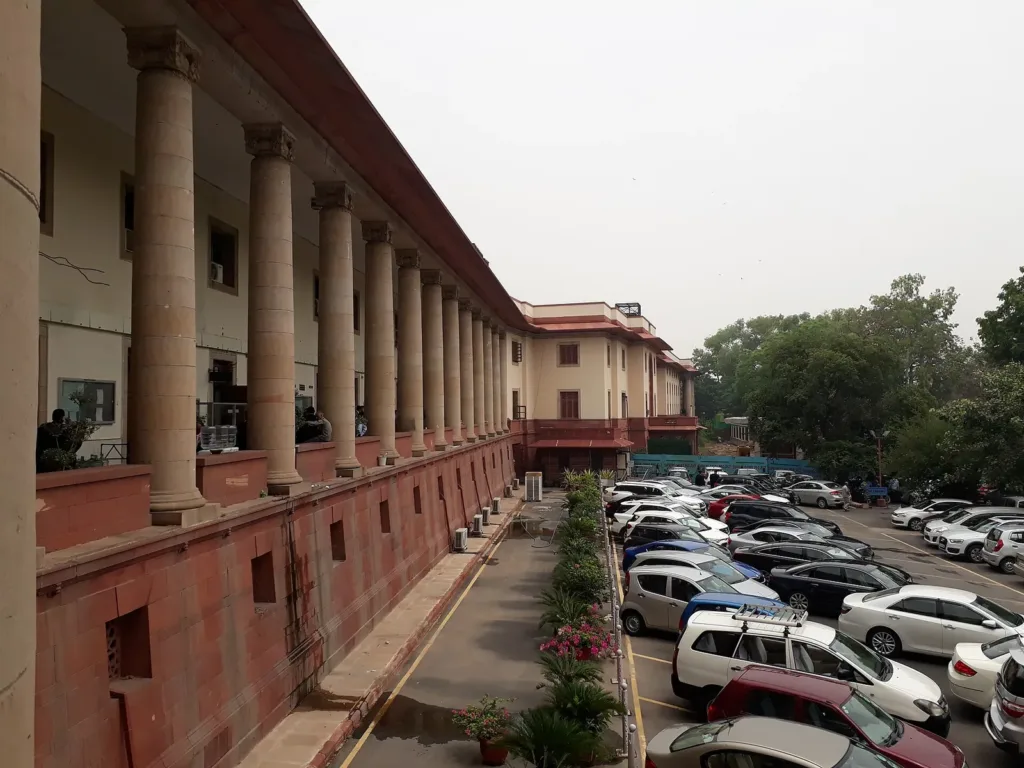
Representative image. Pinakpani, CC BY-SA 4.0, Wikimedia Commons

Why it matters
The clause decides whether a voter, candidate or citizen can take a CEC or Election Commissioner to court personally over an official act, even after that person retires. The outcome of these cases will settle how far the people who run India's elections can be held answerable in court, and how far they are shielded from lawsuits.
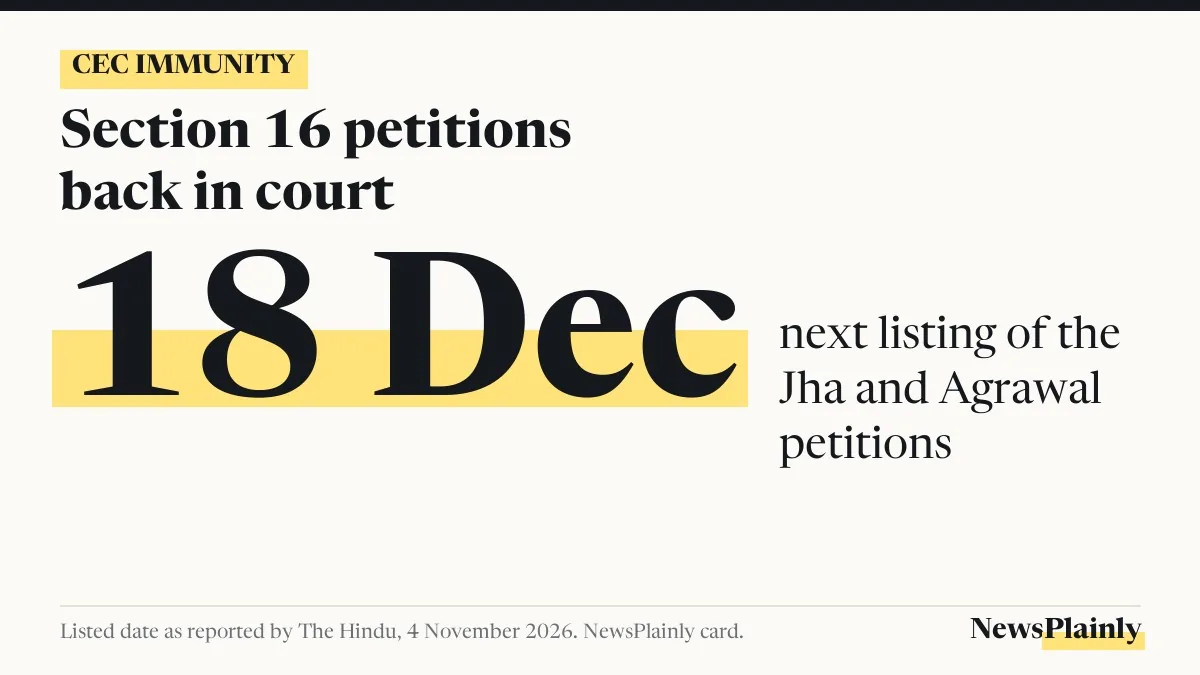
The Supreme Court on Wednesday, 4 November 2026, asked the Centre and the Election Commission (EC) to respond to petitions against CEC immunity, the legal shield that Section 16 of a 2023 law gives the Chief Election Commissioner (CEC) and the other Election Commissioners (ECs). A bench headed by Chief Justice of India Surya Kant issued notice on pleas filed by Rashtriya Janata Dal (RJD) MP Manoj Jha and advocate Arun Kumar Agrawal, The Hindu reported, and listed them for 18 December.
The court has not ruled on the provision. It has only asked the government and the poll body for their replies.
What the Supreme Court did on 4 November
India Today reported that the bench included Justices Joymalya Bagchi and V Mohana, and that the notice came while the court was hearing a separate set of petitions on the Special Intensive Revision (SIR) of electoral rolls. The SIR matter returns on 19 November, according to the same report.
Agrawal was represented by advocate Neha Rathi and Jha by advocate Tanya Srivastava, according to The Hindu. Both petitions ask the court to strike down Section 16 of the Chief Election Commissioner and Other Election Commissioners (Appointment, Conditions of Service and Term of Office) Act, 2023.
These are not the first challenges. On 13 October 2026, the same bench issued notice on a petition by the Association for Democratic Reforms (ADR), an election watchdog, and tagged it with an earlier plea by the NGO Lok Prahari, The New Indian Express reported with inputs from the Press Trust of India (PTI) news agency. When the court first took up the Lok Prahari plea, it declined to put Section 16 on hold, the paper said. None of the reports read says the court has since paused the provision, so Section 16 remains in force.
What Section 16 says, part by part
The clause is short. It says that no court shall entertain or continue any civil or criminal proceedings against “any person who is or was” a CEC or an EC for anything done or said “when, or in the course of acting or purporting to act” in official duty. The words “is or was” mean the bar covers former office holders too, so it lasts after they retire.
| Part of the clause | What it covers | What the petitioners argue |
|---|---|---|
| “No court shall entertain or continue” | New cases and cases already running | It shuts out constitutional courts and judicial review |
| “Civil or criminal proceedings” | Civil suits and criminal cases alike | It bars even corruption and forgery cases |
| “Is or was” CEC or EC | Serving and former members | The protection lasts for life |
| “Purporting to act” in official duty | Acts claimed to be official | It can cover acts outside lawful authority or in bad faith |
Why the petitioners call CEC immunity too wide
The petitions say Section 16 goes beyond what is needed to keep the Election Commission independent, and fails the test of proportionality. In their reading, it removes a citizen’s right to a remedy and a fair investigation, which they link to Articles 14 and 21 of the Constitution (equality before law, and life and personal liberty). They also say it interferes with judicial review, which the Supreme Court treats as part of the Constitution’s basic structure, The Hindu reported.
Agrawal’s plea, as quoted by the Times of India, gives three examples of people it says would be left with no remedy: a voter whose name is wrongly deleted from the roll, a candidate hurt by an act done in bad faith, and any citizen hit by corruption in the Commission. It says frivolous complaints could be filtered in less drastic ways, such as checks by a court before a case goes ahead.
The petitioners also compare the clause with other offices. Under Article 361, the President and Governors cannot face criminal cases while in office, and civil cases are allowed after notice, they said, according to The Hindu. Judges of the higher courts, they added, have no absolute immunity either. They point out that the EC ran elections for decades without any such blanket shield.
The other side: protection for the poll body
On the government’s side, the position on record in the material read is the clause’s own framing. The Rajya Sabha notice of amendments dated 11 December 2023 lists it as a new clause 15A, moved in the name of Arjun Ram Meghwal, under the margin heading “Protection of Chief Election Commissioner and other Election Commissioners”. It now appears in the Act as Section 16.
The court asked the Centre and the EC for their replies on 4 November. None of the reports read for this article (The Hindu, India Today, the Times of India and Dainik Bhaskar) carries a reply from either of them. Their replies, once filed, are where the defence of the provision will be set out.
The petitions come while opposition parties in the INDIA bloc (Indian National Developmental Inclusive Alliance) run a campaign against CEC Gyanesh Kumar, including a symbolic impeachment protest in Delhi.
How the 2023 law and its immunity clause came about
The immunity was not in the bill when the government first brought it to Parliament. The government’s amendment adding it was listed on 11 December 2023, a day before the Rajya Sabha passed the bill. The timeline below is built from the Rajya Sabha amendment list, the bill record kept by PRS Legislative Research, an independent research group that tracks Parliament, and the court reports.
- March 2023: The Supreme Court ruled that the CEC and ECs should be chosen by a committee of the Prime Minister, the Leader of Opposition in the Lok Sabha and the Chief Justice of India, until Parliament made a law.
- 10 August 2023: The bill was introduced in the Rajya Sabha. Its selection committee was the Prime Minister, a Union Cabinet Minister and the Leader of Opposition, with no Chief Justice.
- 11 December 2023: The Rajya Sabha amendment list with the immunity clause was issued. It also carried an amendment notice from Manoj Jha to put the Chief Justice of India in place of the Cabinet Minister on the selection panel.
- 12 and 21 December 2023: The Rajya Sabha and then the Lok Sabha passed the bill. It replaced the 1991 law on Election Commissioners’ service conditions.
- 13 October 2026: Notice on the ADR petition, tagged with the Lok Prahari plea.
- 4 November 2026: Notice on the Jha and Agrawal petitions.
- 18 December 2026: The petitions are listed for hearing, The Hindu reported.
Dainik Bhaskar, in its explainer, said the 1991 law had no special provision barring every civil and criminal case over an official decision. The petitioners make the same point: until 2023, Parliament had not given Election Commissioners blanket immunity.
What the 18 December hearing can and cannot settle
Issuing notice is an early step: the court has asked for replies and has given no view yet on whether Section 16 is valid, Dainik Bhaskar noted. Until the court rules, CEC immunity stays as Parliament wrote it.
The Hindu reported the 18 December date but not a deadline for the Centre and the EC to file their replies. The reports read also do not say whether the Jha and Agrawal petitions will be heard together with the ADR and Lok Prahari cases.
The record so far sets out two positions: the government’s stated aim of protecting the Commission’s members, written into the clause’s heading, and the petitioners’ claim that voters and candidates lose every legal route against those members’ official acts.
Frequently asked questions
What is Section 16 of the CEC and ECs Act, 2023?
It says no court can entertain or continue civil or criminal proceedings against a person who is or was a CEC or EC for anything done or said in the course of official duty. It was added to the bill by a government amendment listed on 11 December 2023.
Has the Supreme Court struck down CEC immunity?
No. On 4 November 2026 it only issued notice and asked the Centre and the Election Commission to respond. The provision remains in force.
Who has challenged the immunity clause?
RJD MP Manoj Jha and advocate Arun Kumar Agrawal filed the petitions heard on 4 November. The Association for Democratic Reforms and the NGO Lok Prahari have filed earlier challenges.
When is the next hearing?
The petitions are listed for 18 December 2026, according to The Hindu.