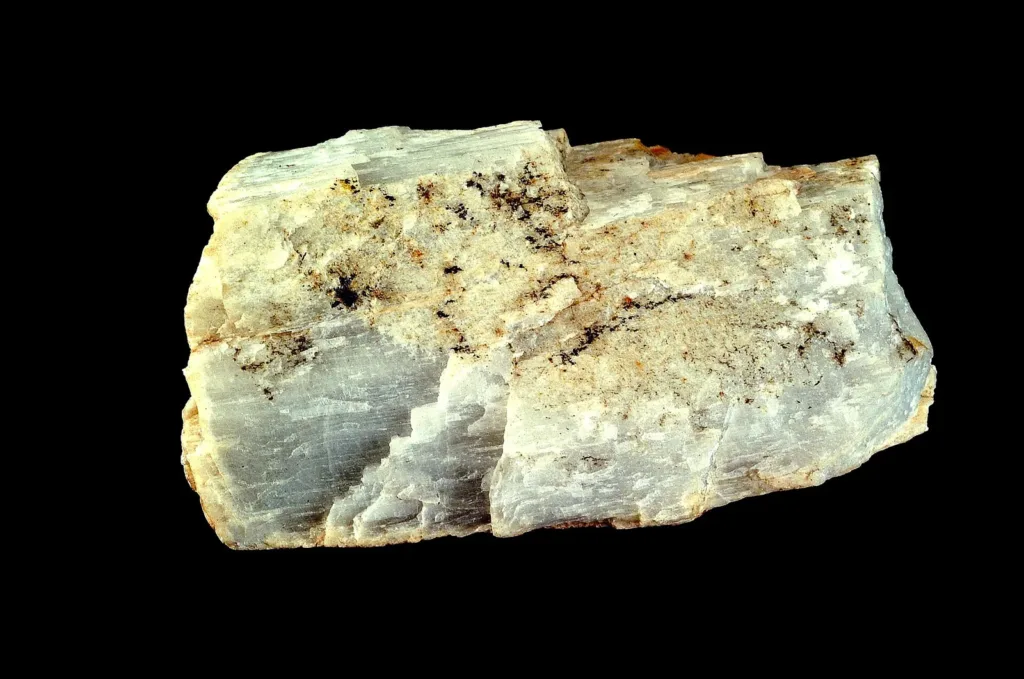
Representative image. Shannon Heinle, CC0, Wikimedia Commons

Why it matters
The government's release links lithium and nickel to electric vehicles, battery storage, electronics and defence, and says India relies heavily on imports of their refined forms. The scheme puts public money into building that refining at home, but it covers only four plants and pays at most 30%, so the companies chosen will still fund at least 70% of their eligible investment.
The Union Cabinet on Wednesday, 4 November 2026, approved a ₹2,814 crore critical mineral scheme that will pay part of the cost of building four plants in India to refine lithium and nickel. Information and Broadcasting Minister Ashwini Vaishnaw announced the decision at the Cabinet briefing in New Delhi, the news agency ANI reported. The money will be spent over five years, from 2026-27 to 2030-31.
The official name is the Capex Support Scheme to Promote Critical Mineral Processing. Capex means capital expenditure, the spending on buildings and machinery needed to set up a plant. According to the government’s release, issued through the Press Information Bureau (PIB), the capex support scheme will cover 30% of a plant’s eligible investment, up to a fixed ceiling for each company selected.
The same Cabinet meeting also cleared a separate ₹14,500 crore grant for grid-scale power storage, which NewsPlainly covered in its report on the energy storage scheme for 92 GWh. The two decisions overlap: the minerals release lists battery energy storage among the industries the new plants are meant to supply.
What the critical mineral scheme pays for
The release lists four plants. Two are for lithium processing, each with a minimum capacity of 30 kilotonnes (kt), and two are for nickel processing, each with a minimum capacity of 50 kt. A kilotonne is 1,000 tonnes. The plants will turn lithium and nickel ores, or partly processed material, into high-purity compounds. Cobalt is expected to come out of the nickel plants as a by-product.
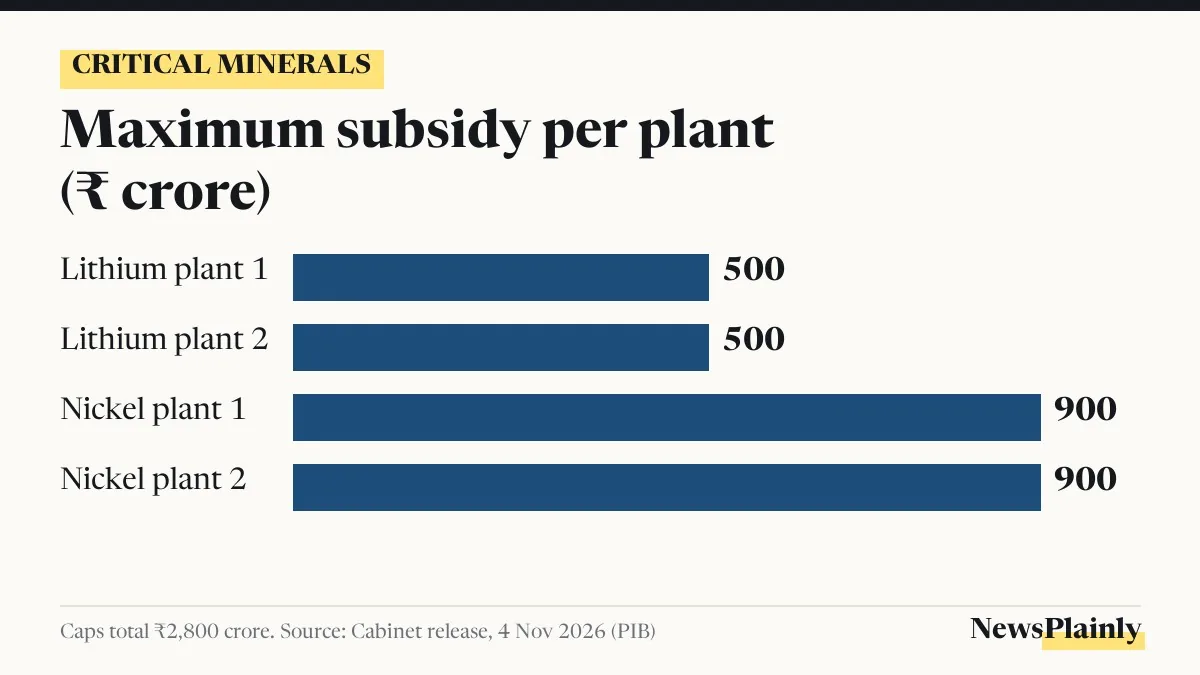
The 30% subsidy has a ceiling. A lithium plant can get at most ₹500 crore, and a nickel plant at most ₹900 crore. The release names electric vehicles, battery energy storage systems (BESS), electronics, defence and speciality steel as the industries the plants are meant to supply.
The table below sets out the support plant by plant. The last column is NewsPlainly’s own calculation: it shows how large a project’s eligible investment must be before the 30% subsidy hits the ceiling.
| Mineral | Plants and minimum size | Subsidy | Cap per company | Investment at which the cap is reached |
|---|---|---|---|---|
| Lithium | 2 plants, at least 30 kt each | 30% of eligible investment | ₹500 crore | about ₹1,667 crore (₹500 crore ÷ 0.30) |
| Nickel (cobalt as by-product) | 2 plants, at least 50 kt each | 30% of eligible investment | ₹900 crore | ₹3,000 crore (₹900 crore ÷ 0.30) |
| Total | 4 plants | ₹2,800 crore if all four reach the cap | Scheme outlay: ₹2,814 crore |
Two things follow from the arithmetic. First, if all four companies claim the full ceiling, the payouts add up to ₹2,800 crore, ₹14 crore less than the outlay; the release does not say what the remaining amount covers. Second, a lithium project spending more than about ₹1,667 crore, or a nickel project spending more than ₹3,000 crore, will still get only the capped amount, so the effective support on a bigger plant falls below 30%.
Who can get the money, and how they will be chosen
The release describes a two-stage contest. In the first stage, applications are checked for technical qualification. Only companies that pass go on to the second stage, a financial bid. For each mineral, two winners will be picked on a least-cost basis, meaning the bidders who ask for the smallest capex support from the government.
Under the critical mineral scheme, the subsidy will not be paid in one go. It will be released in three tranches, each tied to the company reaching a set milestone. The release does not list those milestones, and it does not give a date for inviting applications or name the body that will run the bidding.
Here is the timeline as far as the release and the reporting read go:
- September 2026: Mines Secretary Keshav Chandra said at an event of the Federation of Indian Mineral Industries (FIMI), an industry body, that the government would set up a scheme for domestic processing of lithium and nickel, The Hindu reported.
- 4 November 2026: the Cabinet approved the ₹2,814 crore scheme.
- 2026-27 to 2030-31: the scheme period, according to the release. Payments come in three milestone-linked tranches inside this window.
Why India imports lithium and nickel today
The government’s release says the processing of critical minerals is concentrated in a few places in the world. That, it says, leaves supply chains open to geopolitical disruption, price swings and possible supply restrictions, with effects on national security and on meeting decarbonisation targets. India, the release adds, depends heavily on imports for refined intermediates and high-purity materials because its own beneficiation (the first stage of upgrading raw ore) and processing of lithium, nickel and cobalt is still at an early stage.
The release also names the hurdles that have kept commercial-scale plants from coming up: high capital needs, limited access to suitable technology and difficulty getting raw material. The critical mineral scheme’s 30% capital subsidy is aimed at the first of these.
News reports put numbers on the dependence. Indian Express reported that India is almost 100% import-dependent for some key critical minerals, including cobalt, lithium, nickel, rare earth elements and silicon, and that China controls 90% of global critical mineral processing. India Today reported that China holds more than 90% of global processing capacity for certain minerals, including rare earths and battery-grade graphite.
Lithium processing and nickel processing: where the plants may come up
The release does not say where the four plants will be built. Indian Express reported that the government has already identified four states for critical mineral processing parks: Andhra Pradesh, Odisha, Gujarat and Maharashtra. According to that report, Odisha is being considered for nickel processing because of its nickel reserves and its location in eastern India, which could help it handle nickel imported from Indonesia and other countries. Maharashtra is set to focus on lithium processing, and Gujarat and Andhra Pradesh on rare earths.
These are plans reported by the newspaper, not part of the Cabinet decision, and the scheme’s winners will be chosen through bidding.
How the capex support scheme fits other critical minerals plans
The capex support scheme is one piece of a wider push. Indian Express reported that the government is also working on a policy for stockpiling critical minerals, a strategic reserve to keep supplies going during disruptions. Under the National Critical Mineral Mission (NCMM), it reported, a National Critical Mineral Stockpile Programme is proposed, with ₹500 crore set aside over the mission period from 2024-25 to 2030-31.
The release presents the scheme as part of the Atmanirbhar Bharat (self-reliant India) goal of building processing capacity inside the country. Whether the four plants get built, and on what schedule, depends on the bidding and the milestones that the release says will govern the payments.
Frequently asked questions
What is the Capex Support Scheme to Promote Critical Mineral Processing?
A ₹2,814 crore scheme approved by the Union Cabinet on 4 November 2026. It pays 30% of the eligible investment for two lithium and two nickel processing plants over 2026-27 to 2030-31.
How much can one company get under the critical mineral scheme?
At most ₹500 crore for a lithium plant and ₹900 crore for a nickel plant. By NewsPlainly's calculation, those caps are reached at an eligible investment of about ₹1,667 crore and ₹3,000 crore.
How will companies be selected?
Applications are first checked for technical qualification. Qualified bidders then compete on how little subsidy they ask for, and two winners are chosen for each mineral.
Why does India need lithium and nickel processing?
The release says India relies heavily on imports of refined forms of lithium, nickel and cobalt. Indian Express reported India is almost 100% import-dependent for these and that China controls 90% of global processing.