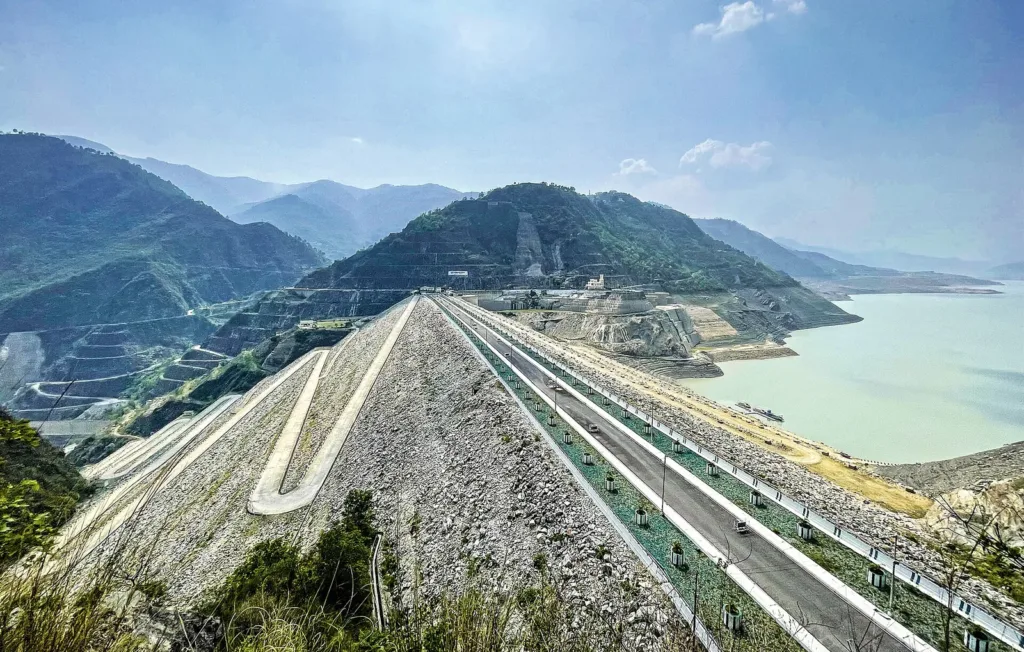
Representative image. Dr Vikramjit Kakati, CC BY-SA 4.0, Wikimedia Commons

Why it matters
Storage decides whether surplus midday solar power can be used after sunset instead of being curtailed. The release says the grant is meant to make storage projects financially viable and support round-the-clock power supply. The 40% local content rule and the lithium and nickel plants are meant to make more of the battery supply chain in India rather than import it.
The Union Cabinet on Wednesday, 4 November 2026, approved an energy storage scheme that sets aside ₹14,500 crore to help build 92 gigawatt-hours (GWh) of new storage for India’s power grid between 2026-27 and 2030-31. Information and Broadcasting Minister Ashwini Vaishnaw announced it at the Cabinet briefing in New Delhi, along with a separate ₹2,814 crore scheme to process lithium and nickel inside the country.
The money is viability gap funding (VGF): a government grant that covers part of a project’s cost so that it can sell its service at a price buyers will accept. The government’s release, issued through the Press Information Bureau (PIB), says the support will improve the financial viability of these projects and estimates their total investment at ₹97,600 crore.
What the energy storage scheme pays for
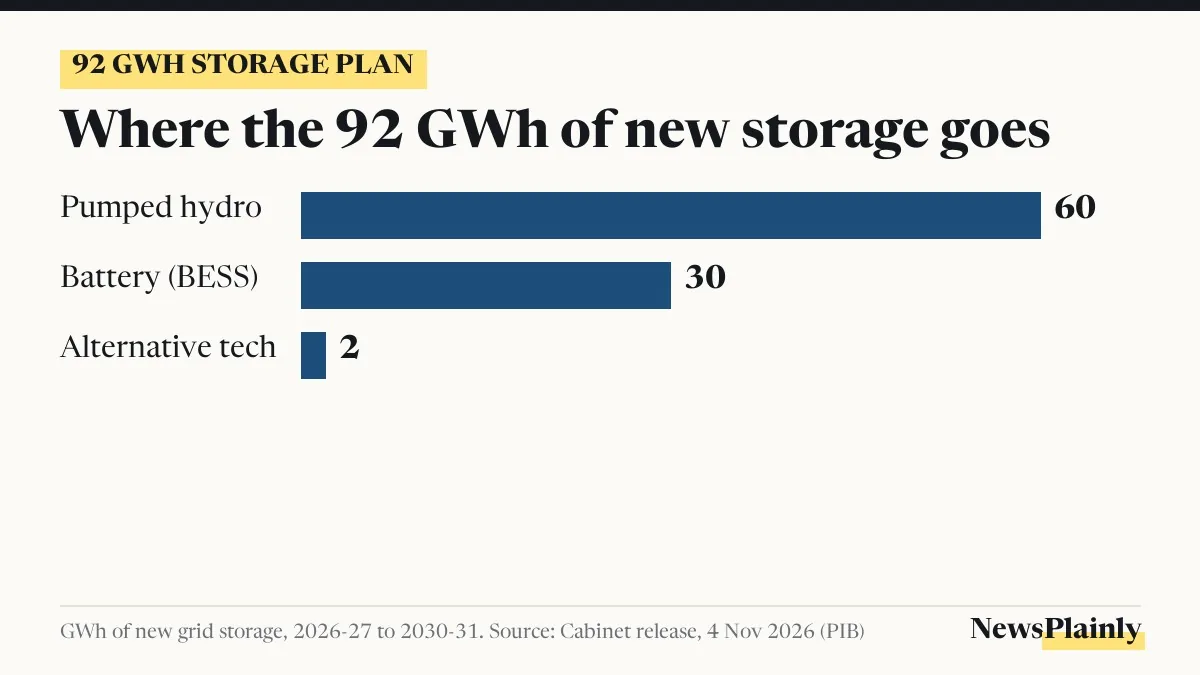
The 92 GWh is split three ways, according to the release. Pumped hydro storage gets the largest share, 60 GWh. Battery energy storage systems (BESS) get 30 GWh, and 2 GWh is kept for newer, alternative storage technologies.
Pumped hydro works like a giant rechargeable water tank. When there is surplus power, it pumps water up to a higher reservoir; when demand peaks, the water flows back down through turbines to make electricity. A BESS does the same job with large banks of batteries that store power chemically and release it later. Indian Express noted that lithium iron phosphate batteries dominate grid storage today because their costs have fallen.
Under the energy storage scheme, capacity will be handed out through tariff-based competitive bidding, where bidders compete on the tariff they will charge. Public and private electricity distribution companies (discoms, the firms that sell power to homes and businesses) can get the grant for battery and pumped hydro projects. Projects using alternative technologies can be run by any public or private company. Battery projects must also meet a minimum domestic content requirement of 40%, a rule the release says is meant to encourage battery manufacturing in India.
“In 92 GWh, 30 GWh will be battery storage scheme and 60 GWh will be pump storage,” Vaishnaw said at the briefing, according to the news agency ANI. He added that the scheme would be run “in collaboration with state governments, ensuring that it is distributed across the country,” Upstox reported.
What the viability gap funding buys per GWh: our calculation
A GWh is a measure of stored energy: one GWh is 10 lakh units (kilowatt-hours) of electricity, the same unit on a household bill. So 92 GWh, fully charged, holds about 9.2 crore units. The table below divides the release’s figures to show the size of the support. These are NewsPlainly’s calculations from the official numbers, not figures the government gave.
| Measure | Inputs | Result |
|---|---|---|
| Grant per GWh, all three technologies averaged | ₹14,500 crore ÷ 92 GWh | about ₹158 crore (about ₹15.8 lakh per MWh) |
| Expected investment per GWh | ₹97,600 crore ÷ 92 GWh | about ₹1,061 crore |
| Share of the investment covered by the grant | ₹14,500 crore ÷ ₹97,600 crore | about 15% |
| Today’s grid storage, implied by the 170% figure | 92 GWh ÷ 1.7 | about 54 GWh |
| Share of the 411 GWh needed by 2031-32 | 92 GWh ÷ 411 GWh | about 22% |
Two of these numbers stand out. The grant covers only about a seventh of the expected spending; the release does not say how the rest will be financed. And the release says the 92 GWh equals 170% of present grid-scale storage, which works out to roughly 54 GWh in place today. Adding the two gives about 146 GWh, against the 411 GWh that the release says this energy storage scheme should help the country reach by 2031-32.
For comparison, Indian Express reported that the Ministry of Power’s first battery VGF scheme ended up backing 13.8 GWh with ₹3,760 crore (about ₹272 crore per GWh), and a second scheme launched in June 2025 backs 30 GWh with ₹5,400 crore (₹180 crore per GWh). Those were battery energy storage schemes only, so the comparison is rough. Indian Express also reported that the first scheme was widened from 4 GWh to 13.8 GWh within the same budget after battery prices fell.
Why India needs grid-scale energy storage now
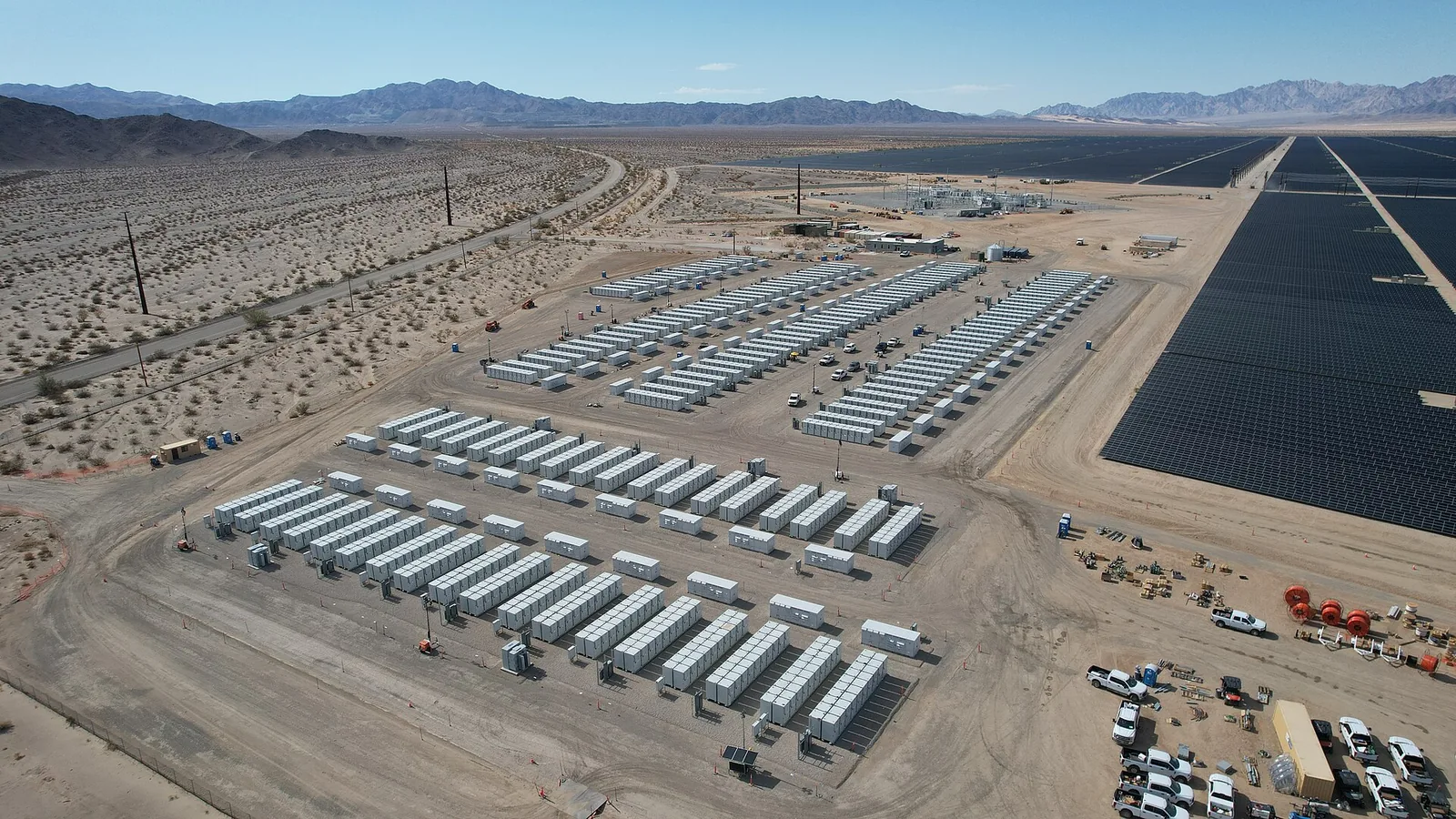
Solar plants produce most of their power around midday, and wind output rises and falls with the weather. When generation outruns demand, grid operators sometimes have to switch plants off. The Hindu, citing data compiled by the Centre for Research on Energy and Clean Air, reported that about 1,835 million units of renewable power were curtailed in July and August 2026 alone, including 1,462 million units of solar.
Grid-scale energy storage soaks up that surplus and gives it back after sunset. Vaishnaw also linked it to transmission costs. A solar plant with a 10 megawatt line, he said, never uses that line fully “because solar energy will not come at night”, according to ANI; with storage, the same line can carry power for more hours. He said non-fossil sources now make up close to 52% of power generation.
The new scheme builds on two existing ones. Indian Express reported that, as of July, the first battery scheme had awarded 12.7 GWh, with 6.54 GWh reaching financial closure and 0.5 GWh commissioned, and ₹168.04 crore of the grant paid out, based on what the ministry told Parliament. Under the second scheme, 25 GWh went to 15 states and 5 GWh to the state-run power producer NTPC. Readers following India’s clean power push may also want our earlier report on the 5 gigawatt farm solar target under the PM KUSUM 2.0 scheme for farmers.
Critical mineral processing: ₹2,814 crore for lithium and nickel
The second decision, on critical mineral processing, targets what goes inside batteries. The Capex Support Scheme to Promote Critical Mineral Processing has ₹2,814 crore over five years, from 2026-27 to 2030-31. The release says India still depends heavily on imports for refined, high-purity forms of lithium, nickel and cobalt because processing inside the country is at an early stage, and that worldwide processing is concentrated in a few places.
The scheme will pay a capital subsidy of 30% of eligible investment for four plants: two lithium processing plants with a minimum capacity of 30 kilotonnes (kt) each and two nickel plants of at least 50 kt each. Support is capped at ₹500 crore for each lithium plant and ₹900 crore for each nickel plant. Cobalt is expected to come out as a by-product of nickel processing.
Selection happens in two stages, a technical round and then a financial bid, and the two firms per mineral asking for the least support win. The money is paid in three instalments tied to milestones. By NewsPlainly’s arithmetic, the four caps add up to ₹2,800 crore, and at a 30% rate a lithium plant reaches its cap at about ₹1,667 crore of eligible investment, a nickel plant at ₹3,000 crore.
What happens before projects start
Both schemes are approvals, not finished projects. The grid-scale energy storage release did not give dates for the first bids or say how the 92 GWh will be shared among states. The minerals release did not say when applications will open. Earlier schemes show the gap between award and operation: of the 13.8 GWh backed under the first battery scheme, only 0.5 GWh was running by July, Indian Express reported.
Frequently asked questions
What is viability gap funding?
It is a government grant that pays part of a project's cost so the project can charge a price buyers accept. Here it totals ₹14,500 crore against an estimated investment of ₹97,600 crore.
What does 92 GWh of energy storage mean?
A GWh is 10 lakh units (kWh) of electricity. 92 GWh can hold about 9.2 crore units when fully charged: 60 GWh in pumped hydro, 30 GWh in batteries and 2 GWh in other technologies.
Who can get the energy storage grant?
Public and private electricity distribution companies for battery and pumped hydro projects, picked through tariff-based bidding. Alternative technology projects can be run by any public or private company.
How much will each lithium or nickel plant get?
A 30% capital subsidy, capped at ₹500 crore for each of two lithium plants and ₹900 crore for each of two nickel plants, paid in three milestone-linked instalments.