Representative image. Parth101104, CC BY-SA 4.0, Wikimedia Commons

Why it matters
Two-child rules decide who may stand for a panchayat or other local body seat in several states. The Supreme Court has now said their basis has gone, but until a larger bench rules, the bar stays in state law. It also touches a wider question the court raised: whether the state can make family size a condition for public office.
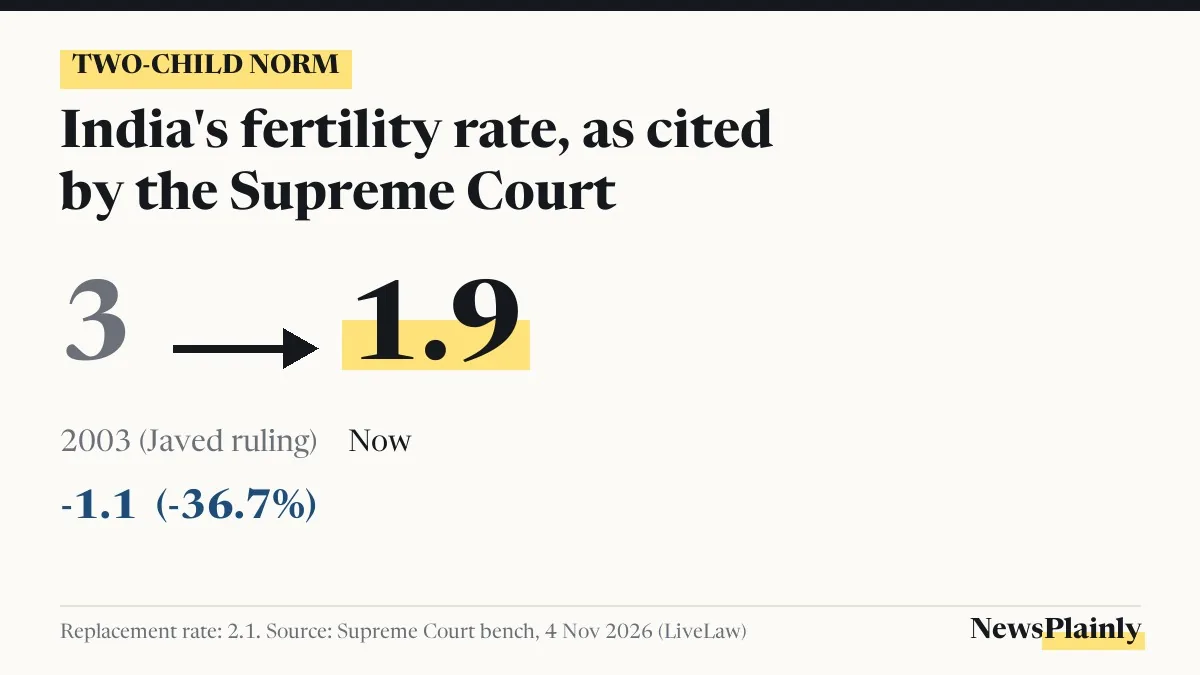
The Supreme Court said on Wednesday, 4 November 2026, that laws punishing people for having more than two children have lost their relevance, and it sent the question of the two-child norm for local body elections to a larger bench. A bench of Justices P.S. Narasimha and Alok Aradhe asked for a fresh look at Javed v State of Haryana, the 2003 judgment that upheld such a bar, pointing to India’s fertility rate falling from 3 to 1.9 since then, LiveLaw reported.
The ruling came on a plea by Mangala Bhimrao Ingle, a former sarpanch (elected head of a village council) of Kakoda gram panchayat in Maharashtra, who lost her post after the birth of her third child. The court did not strike down any state law. It referred the issue upward and, in its own words as quoted by LiveLaw and Bar and Bench, stayed the proceedings in her case.
What the Supreme Court said about the two-child norm
Justice Narasimha, who wrote the judgment, read out its main findings in court. The bench said it was of the “strong opinion” that two-child norm laws had lost their relevance because the fear of overpopulation behind them had “crumbled” with demographic change over the past few decades, according to LiveLaw, Indian Express and The Hindu.
The judges set out the numbers behind that view. When the Supreme Court upheld the two-child norm in 2003, India’s total fertility rate (the average number of children a woman has over her lifetime) was 3. It is now 1.9, the bench said. By NewsPlainly’s calculation, that is a fall of 1.1, or about 36.7 per cent. A rate of 2.1, called the replacement rate, is the level at which one generation fully replaces the one before it.
The bench said India’s population was not yet shrinking, but a fertility rate below replacement would soon mean an older population with a smaller share of people of working age. It warned that India would face serious consequences if it ignored these changes.
The court also questioned the reasoning used in Javed. Keeping such laws, it said, shuts “an entire class of citizens” out of political representation for reasons that have little to do with their ability to hold public office. It added that the rule forces people to choose between having children and taking part in democracy, which it said affects reproductive autonomy under Article 21 of the Constitution, the right to life and personal liberty.
Why the 2003 Javed ruling needs a larger bench
In Javed v State of Haryana, decided in 2003, a three-judge bench of the Supreme Court upheld the Haryana Panchayati Raj Act, 1994, which disqualified anyone with more than two living children from contesting panchayat elections, LiveLaw reported. Wednesday’s bench had two judges. It did not overrule Javed; it asked for a larger bench to reconsider it.
When it reserved judgment on 4 August 2026, the court had said it would consider whether Javed needed a fresh look by the same bench or by a larger one, LiveLaw reported. At an earlier hearing, the bench had called the policy useless, according to Bar and Bench. It then asked how many states still had such a rule.
The reports read do not say how many judges will sit on the larger bench or when it will hear the matter.

Which states still have two-child rules for local body polls
The court had asked advocate Rukmini Bobde, appointed amicus curiae (a lawyer who assists the court), and the petitioner’s lawyer, Pratik Bombarde, for a list of state laws that bar people with more than two children. LiveLaw and Indian Express reported what the compilation filed by Bobde showed. The table below is built only from those two reports; it is not a full list of every state.
| Position under the amicus compilation | Number of states | States named in reports |
|---|---|---|
| Repealed the two-child rule | 7 | Not named in the reports read |
| Never had such a rule | 15 | Not named in the reports read |
| Still have the rule | Not given | Assam, Goa, Gujarat, Maharashtra, Odisha and Uttarakhand are among them |
LiveLaw summed up the compilation as showing no uniform approach to the two-child norm across states.
How a third child cost a Maharashtra sarpanch her post
Ingle was elected sarpanch of Kakoda. A complaint later said she had become disqualified under Section 14(1)(j-1) of the Maharashtra Village Panchayats Act, 1959. That clause, Maharashtra’s version of the two-child norm, bars a person with more than two children from being a panchayat member or sarpanch, and it has applied since an amendment took effect on 13 September 2000, LiveLaw and Indian Express reported.
The Additional Collector of Buldhana disqualified her in October 2024, and the Additional Commissioner of Amravati division dismissed her appeal, Bar and Bench reported. In August 2025, the Bombay High Court upheld both orders. It held that the birth certificate relied on by the authorities was a public document and that she had not disproved the birth of a third child. She then moved the Supreme Court. The case is titled Mangala Bhimrao Ingle v The Additional Commissioner, Amravati Division and others.
What happens to the two-child norm laws now
The reports differ on how they describe the outcome for Ingle. LiveLaw wrote that the bench set aside her disqualification, and Times Now repeated that, citing LiveLaw. Bar and Bench reported that the court stayed the proceedings against her. The court’s own words, quoted by both LiveLaw and Bar and Bench, say the bench had been compelled to “stay the proceedings” and refer the matter to a larger bench. NewsPlainly could not open the written judgment on the Supreme Court website, so the exact order on her post is not confirmed here.
For everyone else, the legal position is unchanged for now. None of the reports read says the court struck down any state’s law, and Javed has not been overruled. State rules such as Maharashtra’s remain on the books until the larger bench decides or a state changes its own law. What Wednesday’s judgment adds is the bench’s view, now on record, that the basis of these laws no longer holds.
The two-child norm was not the only election rule before the Supreme Court on 4 November. It also ruled that only Parliament can change how seats reserved for Scheduled Castes and Scheduled Tribes are picked; read our report on the reserved seats rotation plea.
Timeline of the two-child norm case
- 1994: Haryana Panchayati Raj Act bars people with more than two living children from panchayat elections.
- 13 September 2000: Maharashtra’s two-child clause for panchayat members and sarpanches takes effect.
- 2003: A three-judge Supreme Court bench upholds the Haryana law in Javed v State of Haryana. India’s fertility rate is 3, the court said.
- October 2024: Buldhana’s Additional Collector disqualifies Ingle.
- August 2025: Bombay High Court upholds the disqualification.
- 4 August 2026: Supreme Court reserves judgment.
- 4 November 2026: Bench says the laws have lost relevance and refers Javed to a larger bench.
Frequently asked questions
Has the Supreme Court struck down the two-child norm?
No. On 4 November 2026 it said such laws have lost relevance and referred the 2003 Javed ruling to a larger bench. The reports read do not say any state law was struck down.
What fertility rate did the Supreme Court cite?
The bench said India's total fertility rate fell from 3 in 2003 to 1.9 now, below the replacement rate of 2.1.
Which states still have a two-child rule for local body elections?
An amicus compilation reported by LiveLaw and Indian Express named Assam, Goa, Gujarat, Maharashtra, Odisha and Uttarakhand among them. It said seven states have repealed the rule and 15 never had it.
What is Javed v State of Haryana?
A 2003 Supreme Court judgment in which a three-judge bench upheld the Haryana Panchayati Raj Act, 1994, which barred people with more than two living children from panchayat elections. A larger bench will now reconsider it.