Representative image. Pinakpani, CC BY-SA 4.0, Wikimedia Commons

Why it matters
Dealers and states still fighting over pre-GST surcharges now know the yardstick: the 1974 Kodar view that such a levy is part of sales tax. The ruling does not end their individual cases, which go back to a regular bench with the arguments on assessments still open.
The Supreme Court on Wednesday, 4 November 2026, closed a 27-year-old question on the sales tax surcharge that states levied on traders before GST, saying its 1974 ruling in S Kodar vs State of Kerala still holds. A seven-judge Constitution Bench headed by Chief Justice of India Surya Kant held that the question sent to it in 1999 had become academic once the Goods and Services Tax (GST) replaced the old state sales tax laws in 2017, LiveLaw and the Press Trust of India (PTI) reported.
The bench did not decide the issue afresh. It said the five-judge Kodar ruling, which treats an additional sales tax or sales tax surcharge worked out as a percentage of the sales tax payable as a higher rate of sales tax, continues to govern the question of what state legislatures can levy.
What the seven-judge bench decided on the sales tax surcharge
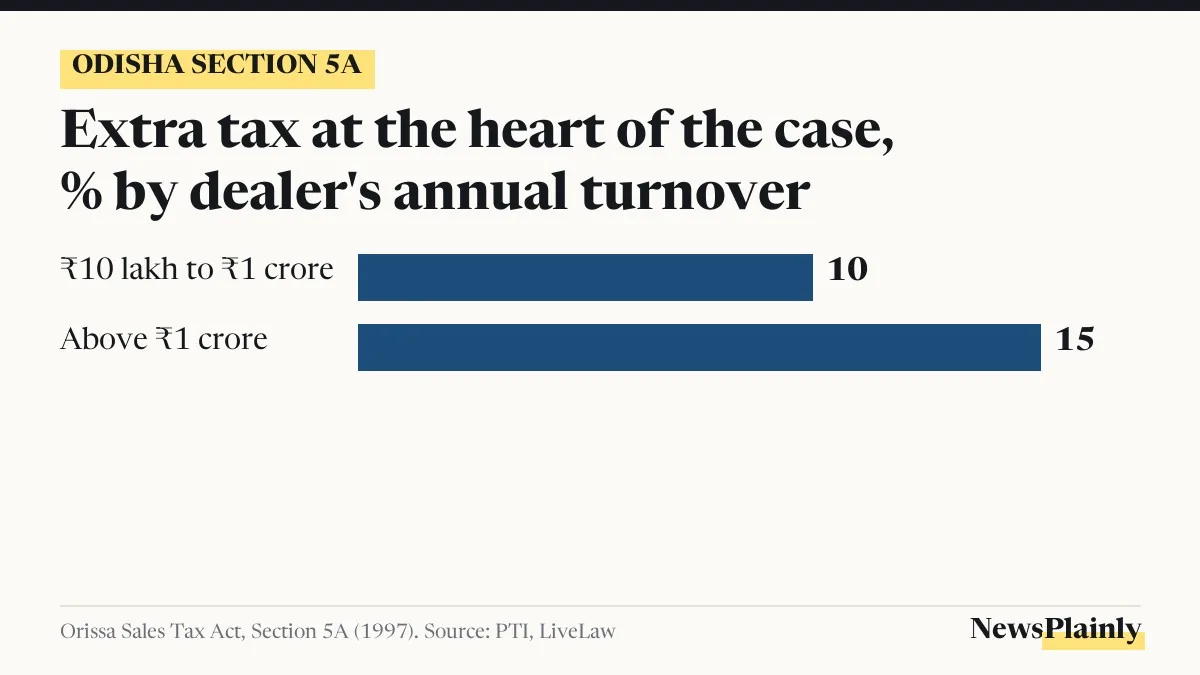
The bench was answering a reference that came out of Arjun Flour Mills vs State of Orissa, a challenge to Section 5A of the Orissa Sales Tax Act, 1947. That section, added in 1997, made dealers pay an additional tax of 10% if their annual turnover was between ₹10 lakh and ₹1 crore, and 15% if it was above ₹1 crore.
The traders argued that this additional sales tax was really a tax on income, which only Parliament can impose under Entry 82 of the Union List. Odisha relied on Entry 54 of the State List, which, as it stood before GST, let states tax the sale or purchase of goods.
According to LiveLaw’s report from the courtroom, the court said an additional tax or surcharge computed as a percentage of the sales tax payable is an increase in the sales tax rate and remains a tax on the sale or purchase of goods under Entry 54 as it then stood. “That decision continues to hold the field,” the Chief Justice said of Kodar, PTI reported. But the constitutional entry and the state laws behind these levies have since been replaced by the GST system, so the bench held that the question no longer needed an answer from seven judges.
The ruling was unanimous. PTI said the Chief Justice wrote the main judgment for himself and the other five judges, Justices S V N Bhatti, Joymalya Bagchi, N V Anjaria, Arun Palli and V Mohana, while Justice K V Viswanathan wrote a separate opinion agreeing with the result. In it, LiveLaw reported, he held that Kodar was correctly decided and is still good law. The detailed written judgment was still awaited when PTI filed its report.
What the 1974 Kodar ruling said about additional sales tax
In S Kodar vs State of Kerala, decided in 1974, a five-judge bench upheld the Tamil Nadu Additional Sales Tax Act, 1970. That law charged an extra sales tax on dealers whose annual turnover crossed ₹10 lakh, according to Supreme Court Observer. The dealer argued the levy was a tax on income. The court disagreed and held that the additional tax was really a tax on the sale of goods.
The doubt came later. In Hoechst Pharmaceuticals vs State of Bihar (1983), the court upheld a surcharge under the Bihar Finance Act, 1981, which bigger dealers paid on top of sales tax. But in India Cement vs State of Tamil Nadu (1990), a seven-judge bench struck down a cess and surcharge linked to mining royalty. The 1999 reference order saw a conflict in how these rulings judged the nature of an extra levy, and the Supreme Court sent the Arjun Flour Mills case to seven judges on 6 October 1999.
On Wednesday the bench said that clash no longer exists, and the Kodar ruling stands. LiveLaw reported the court as holding that India Cement never said a levy calculated as a percentage of another tax is beyond a state’s power for that reason alone. India Cement’s starting point, that royalty is a tax, was overruled by a nine-judge bench in Mineral Area Development Authority vs Steel Authority of India in 2024.
27 years of the additional sales tax case, in one timeline
| Year | What happened |
|---|---|
| 1970 | Tamil Nadu passes its Additional Sales Tax Act |
| 1974 | Five judges uphold it in S Kodar vs State of Kerala |
| 1983 | Hoechst Pharmaceuticals: Bihar’s surcharge on sales tax upheld |
| 1990 | India Cement: seven judges strike down a cess on mining royalty |
| 1997 | Odisha adds Section 5A: 10% or 15% extra tax by turnover |
| 6 October 1999 | Arjun Flour Mills case referred to seven judges |
| 2017 | GST regime comes in |
| 2024 | Nine judges overrule India Cement’s view that royalty is a tax |
| 22 September 2026 | Seven-judge bench hears the reference and reserves judgment |
| 4 November 2026 | Reference held academic; Kodar still holds |
At the hearing on 22 September, Solicitor General Tushar Mehta told the bench the issue had probably become academic after GST took over in 2017. He said very few cases might still be pending, “perhaps not even in three digits”, according to LiveLaw and Supreme Court Observer. The bench reserved its judgment on the additional sales tax question the same day.
What the order leaves open for pending sales tax surcharge cases
The PTI report carried by India Today and Hindustan Times focused on the headline result. LiveLaw’s courtroom account adds three points that matter for the businesses and states still fighting over old assessments.
- Two Punjab questions stay open. The bench did not decide whether a surcharge under the Punjab General Sales Tax Act, 1948 could be charged to industrial units that were otherwise exempt from sales tax. It also left open whether money from a cess under the Punjab Social Security Act, 2000 could go straight into the state’s social security fund without first passing through the Consolidated Fund of the State, as Article 266 of the Constitution provides.
- Individual disputes are not settled. All other arguments in the separate cases, including those on assessments and the relief each party wants, were left open.
- The cases go back to a regular bench. The court’s Registry was told to list the lead case and the connected ones before an appropriate regular bench, which will decide them in line with Wednesday’s observations.
In short, the constitutional question is closed, but a dealer or a state with a pending sales tax appeal from the pre-GST years will now argue its case before a smaller bench, with the Kodar ruling as the governing law on whether such a sales tax surcharge was within the state’s power. You can read the courtroom report on LiveLaw.
Why the Supreme Court said GST made the question academic
The dispute was about state laws made under the old Entry 54, which let states tax the sale or purchase of goods. According to LiveLaw’s report, the bench noted that both that constitutional entry and the state laws under which these levies were charged have since been substituted or replaced by the GST system. Odisha’s Section 5A belongs to that earlier system.
That is why the bench saw no point in a seven-judge ruling on a constitutional entry that no longer reads the same way. For readers following tax collections today, NewsPlainly’s report on October GST collection covers the latest monthly figures under the new system.
The reports read did not say how many cases are pending in total or how much money is involved. The full written judgment, once uploaded, will set out the court’s reasoning in detail.
Frequently asked questions
Can states levy an additional sales tax or surcharge?
Under the 1974 S Kodar ruling, which the Supreme Court said on 4 November 2026 still holds, a surcharge calculated as a percentage of sales tax is a higher sales tax rate and fell within the states' power under Entry 54 as it stood before GST.
What was the S Kodar vs State of Kerala case?
A 1974 five-judge ruling that upheld the Tamil Nadu Additional Sales Tax Act, 1970 on dealers with turnover above ₹10 lakh, rejecting the argument that it was a tax on income.
Why did the Supreme Court not answer the question?
The bench said the constitutional entry and state laws involved had been replaced by the GST system, so the question had become academic and did not need a seven-judge ruling.
Which judges were on the bench?
Chief Justice Surya Kant and Justices K V Viswanathan, S V N Bhatti, Joymalya Bagchi, N V Anjaria, Arun Palli and V Mohana, PTI reported. Justice Viswanathan wrote a separate concurring opinion.