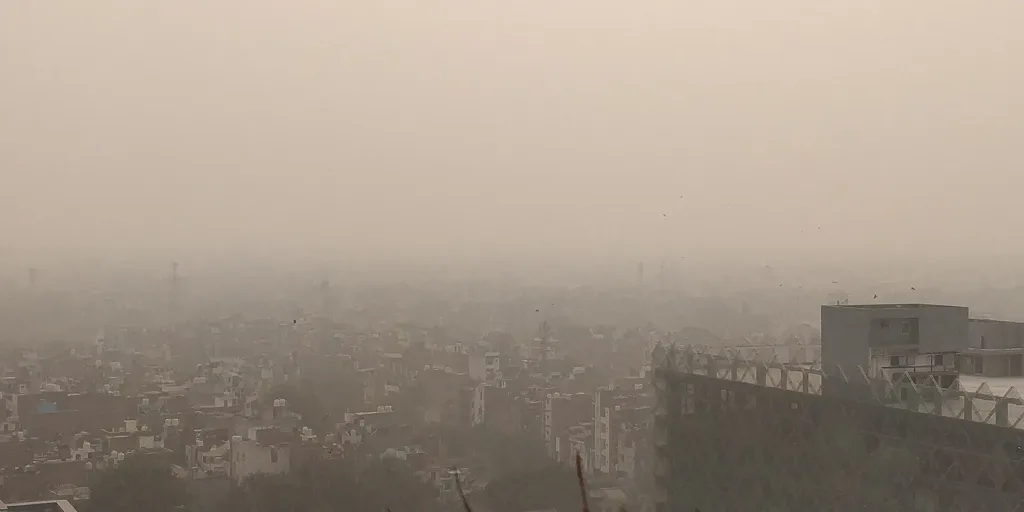
Representative image. Prami.ap90, CC BY-SA 4.0, Wikimedia Commons

हिन्दी में सारांश Summary in Hindi
- 2 नवंबर 2026 को CAQM ने दिल्ली-NCR में GRAP का दूसरा चरण तुरंत लागू किया।
- दिल्ली का AQI शाम 4 बजे 324 पर पहुंचा, जो इस सीज़न में पहली बार 'बहुत खराब' श्रेणी है।
- सड़कों की सफाई, ट्रैफिक जांच, उद्योगों की जांच और ढाबों पर कोयले या लकड़ी पर रोक जैसे कदम उठाने को कहा गया है।
বাংলায় সারাংশ Summary in Bangla
- বিলম্বে কার্যকর করেছে।
- দিল্লির AQI বিকেল ৪টায় ৩২৪ পৌঁছেছে, এই মরসুমে প্রথমবার 'খুব খারাপ' বিভাগে।
- রাস্তা পরিষ্কার, ট্রাফিক তল্লাশি, শিল্প পরিদর্শন আর তন্দুরে কয়লা বা কাঠ না পোড়ানোর মতো পদক্ষেপ চাওয়া হয়েছে।
Why it matters
Stage 2 changes what happens on the road, at the power plant and in the kitchen. Commuters may see more frequent metro and bus services and tighter checks on vehicles without a valid pollution certificate. Households with diesel generators are asked to limit their use. The order covers the whole NCR, so residents of Noida and Gurugram are under the same measures as Delhi.
GRAP Stage 2 is in force across Delhi-NCR from Monday, 2 November 2026. The Graded Response Action Plan (GRAP) is a set of pollution curbs that switch on in stages as the air gets worse. The Commission for Air Quality Management (CAQM), the body that sets pollution rules for the National Capital Region (NCR), invoked the stage across the region with immediate effect after Delhi’s air turned “very poor” for the first time this season, Hindustan Times reported.
The CAQM GRAP order covers the measures of both Stage 1 and Stage 2, according to Hindustan Times. Aaj Tak, a Hindi news channel, reported the same decision and said the formal order would be issued soon.
How fast Delhi’s air got worse
The air quality index (AQI) is a scale from 0 to 500 for the main pollutants, and higher means worse air. Hindustan Times gave Delhi’s readings for the last four days: 60 on Friday, 30 October, when heavy rain had washed pollutants away and given the capital its cleanest October day in four years; 117 on Saturday, in the moderate band; 261 on Sunday, in the poor band; and 324 at 4 pm on Monday, in the very poor band.
Under the Central Pollution Control Board (CPCB) scale, Aaj Tak reported, 301 to 400 is very poor and 401 to 500 is severe. PM2.5 (particles finer than 2.5 micrometres, which can reach the lungs and enter the bloodstream) remains the main pollutant in Delhi, Aaj Tak said.
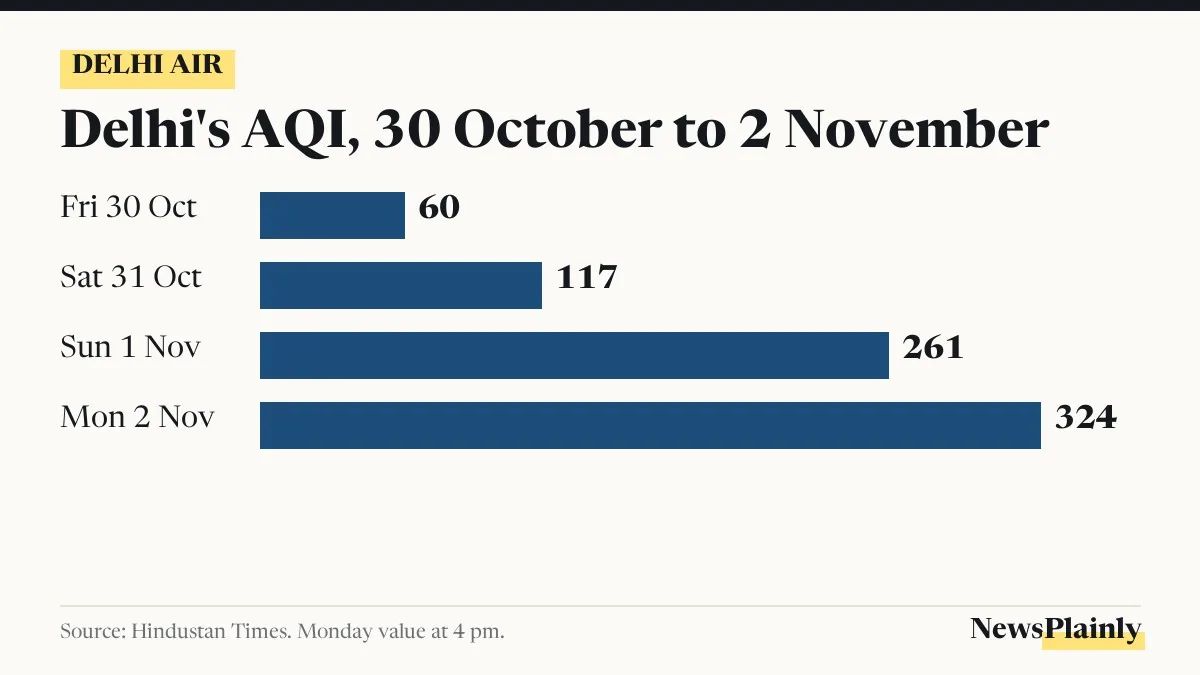
From 60 on Friday to 324 on Monday is 5.4 times the Friday reading, NewsPlainly’s calculation from those figures. Hindustan Times said the AQI had already touched 307 at 7.05 am on Monday, so the rise was under way before the afternoon. The Delhi AQI of 324 at 4 pm on Monday was the highest of the four days.
What GRAP Stage 2 asks each agency to do
The GRAP sub-committee reviewed the air quality situation together with forecasts from the India Meteorological Department (IMD) and the Indian Institute of Tropical Meteorology (IITM). The CAQM GRAP order directed all agencies to carry out the Stage 1 and Stage 2 measures across the NCR. Hindustan Times listed the main duties as follows.
| Who | What the order asks, as Hindustan Times reported |
|---|---|
| Civic agencies | Mechanical road cleaning, water sprinkling and anti-smog guns against dust; proper collection of garbage and construction waste; action against open burning of waste |
| Traffic police and transport officials | Deployment at busy roads and intersections; checks for valid pollution-under-control (PUC) certificates; action against visibly polluting vehicles; strict enforcement of rules on older diesel and petrol vehicles |
| Industry, brick kilns and power plants | Stricter inspections, and approved fuels only |
| Hotels, restaurants and roadside eateries | Asked not to use coal or firewood in tandoors, and to switch to electricity or gas |
| Diesel generator users | Use regulated except for specified emergency services, with uninterrupted power supply to reduce dependence on generators |
| Metro, bus and office commuters | More frequent metro, regional rapid transit (RRTS), CNG and electric bus services; offices encouraged to arrange shared transport |
Residents were advised to use public transport or carpool, keep vehicles serviced with valid PUC certificates, switch engines off at traffic signals, avoid burning garbage and limit the use of diesel generators. Hindustan Times reported that violations can be reported through the 311, Green Delhi and SAMEER apps.
What the monitors showed on Monday
Hindustan Times said 58 of Delhi’s 59 monitoring stations had data on Monday. Of these, 36 recorded very poor air, five were moderate, one (Jahangirpuri) was in the severe band at an AQI of 417, and the rest were poor.
Aaj Tak counted differently: 37 stations very poor, 17 poor, three severe and one moderate. It gave Jahangirpuri’s 4 pm reading as 436 and named Rohini (415) and Punjabi Bagh (413) as severe too. The two reports differ on the counts, but both name Jahangirpuri as the worst station.
How long the bad air may last
Navdeep Dahiya, a meteorologist, wrote on X that the smog season had begun and that no favourable weather was expected for seven to 10 days, Hindustan Times reported. Aaj Tak quoted a forecast for Delhi that puts the air in the very poor band from 3 to 5 November, with a slight improvement over the following six days, when it may reach the poor band. Hindustan Times reported that the CAQM expected unfavourable weather to keep air quality in the very poor category over the coming days. The forecast Aaj Tak quoted does not name its issuer in the text NewsPlainly read.
Neither report gives an end date for GRAP Stage 2. For the vehicle rules already in force, see our earlier article on the Delhi vehicle curbs.
Diwali and the green crackers order
These Delhi NCR pollution curbs sit alongside a separate order on firecrackers. The Supreme Court has separately allowed certified green crackers in Delhi-NCR on 7 and 8 November, with the full ban back from 9 November. Our earlier article on green crackers sets out those two burst windows. Hindustan Times said the CAQM’s advice to residents includes refraining from bursting firecrackers.
NewsPlainly has not opened the CAQM order itself. The two reports read differ on its status: Hindustan Times says it was issued on Monday, while Aaj Tak says the formal order would be issued soon. Check the order text before relying on the exact wording of any measure.
Frequently asked questions
What is GRAP Stage 2?
GRAP, the Graded Response Action Plan, is a set of pollution curbs that apply in stages as air quality worsens. Stage 2 asks authorities to step up dust control, traffic enforcement and other measures across the NCR, Hindustan Times reported.
Does Stage 2 apply in Noida and Gurugram?
Hindustan Times reported that the order covers the whole NCR, which includes Noida and Gurugram.
Where can residents report pollution violations?
The CAQM advised reporting through the 311, Green Delhi and SAMEER apps, Hindustan Times reported.