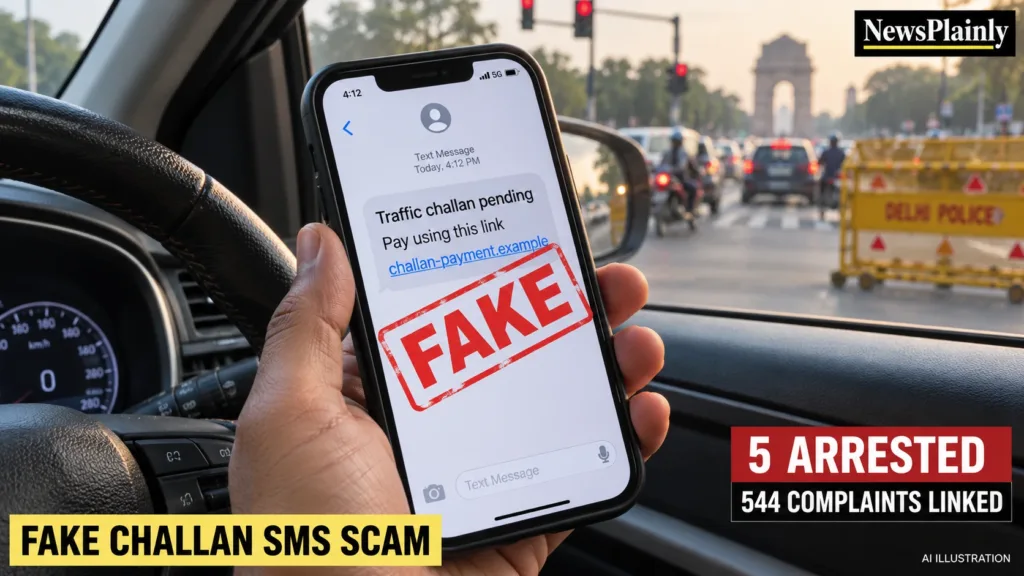
AI illustration, not a photo of a real message, person or place. The link shown is a placeholder. The figures are from this article: 5 people arrested and 544 complaints linked to the scam.
Why it matters
Fake challan messages copy payment links that look like government notices, and police in both cases told people to check a challan on the official portal or at a traffic police station before paying anything. In the Delhi case, a man lost ₹2.21 lakh after one click on a link in a challan SMS, police said. Anyone who installs a reward app shared in a messaging group should know that such an app can send texts from their own phone.
Delhi Police has arrested five people in a cyber fraud network that allegedly sent fake challan SMS messages and duped people of over ₹10 crore. An official told the Press Trust of India (PTI) on Sunday, 1 November 2026, that the arrests are linked to 544 complaints. The same day, Mint reported a separate fraud alert from Mangaluru City Police in Karnataka about challan messages that carry suspicious links.
How the fake challan SMS scam worked
According to the police account carried by PTI, the messages contained links that imitated challan payment pages, delivery verification and reward points. The case began when a man lost ₹2.21 lakh from his credit card after clicking a link in an SMS about a challan payment in November 2025.
The probe traced the messages to an application called Wingo Cash, which police said reached a user through a WhatsApp group. The officer said the app automatically sent nine to 12 phishing SMS messages each time a user redeemed a reward, and kept the phone screen locked for around 30 seconds. Users were paid ₹1 to ₹3 for each redemption, and about 3,300 such messages were traced.
Police said the money moved through what they called a network of mule bank accounts, meaning accounts used to pass on stolen money. About ₹2 crore went to more than 41,000 app users within three days, the officer said. The five arrested people were picked up in Mumbai, Lucknow, Delhi, Rajasthan and Punjab. Police seized 15 digital devices, 59 debit cards, five point-of-sale machines and eight QR-code (quick response code) scanners.
What the messages claim
Mint, citing Mangaluru City Police, described the pattern of fake challan SMS messages in its own words. The messages say the vehicle owner has pending traffic violations and must pay a fine. They reach people by SMS and WhatsApp, and they often carry a link or an APK (Android app installer) file that appears to belong to traffic enforcement. Mint quoted the police warning that people who click such links, or install the files, risk losing money.
Mint also said the Mangaluru police had reported eight cases of fake challan SMS fraud in the city this year, with collective losses of ₹44 lakh. Mint attributed those figures to media reports quoting the commissioner, and they cover one city only.
What the complaints add up to
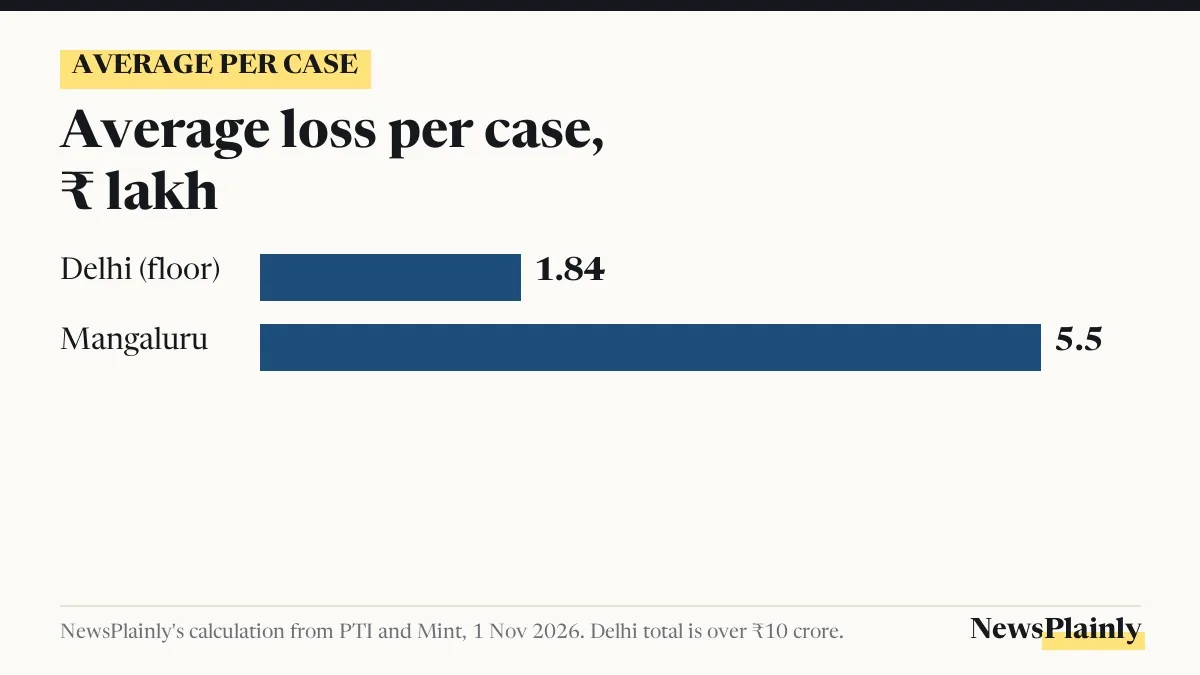
Police linked the Delhi network to 544 complaints involving over ₹10 crore. The two cases are separate, but both involve the same kind of e-challan scam: fake challan messages sent by SMS or WhatsApp. Police in both places describe a traffic challan fraud built on fake payment links, but the two totals cover different networks and periods, so they are not a single trend.
| Case | Complaints or cases | Money involved | Average per case |
|---|---|---|---|
| Delhi Police network | 544 complaints | Over ₹10 crore | About ₹1.84 lakh or more |
| Mangaluru City Police | 8 cases this year | ₹44 lakh | About ₹5.5 lakh |
The Delhi average is a floor, because the reported total is “over ₹10 crore”. Police gave totals rather than what each person lost, so the averages show the size of a typical case, not what any one victim lost.
How to check a challan before paying
Mangaluru City Police advised vehicle owners to check pending e-challans (electronic traffic fine notices) only on the government portal at echallan.parivahan.nic.in, and to pay only through authorised platforms. People should not share bank account, card or one-time password (OTP) details through any link that claims to be a challan payment. Police also warned against downloading APK files from unknown sources.
If a fake challan SMS or WhatsApp message arrives, police said the safest step is to contact or visit the nearest traffic police station to verify it. The number police gave for verification is 0824-2220823. For a challan notice that comes by post, police pointed to the Mangalore One or Karnataka One websites, or a visit to a police station, for payment.
The Mangaluru police commissioner, Sudheer Kumar Reddy, also warned that a web address starting with https does not prove that a site is genuine, because fraudsters can copy government websites closely. A link that looks official should not be trusted on its own, and the portal named by police is the place to check a challan. NewsPlainly has also reported a security audit of four vehicle data portals, in our vehicle data leak story.
Frequently asked questions
How do I check whether a challan message is genuine?
Police advise checking pending challans only on the government portal, echallan.parivahan.nic.in, and paying only through authorised platforms. If a message arrives by SMS or WhatsApp, contact or visit the nearest traffic police station to verify it.
Should I share my OTP or card details to pay a challan?
No. Police advise not to share bank account, card or one-time password (OTP) details through any link that claims to be a challan payment.
Is a link that starts with https safe?
Not necessarily. The Mangaluru police commissioner warned that a web address starting with https does not prove that a site is genuine.