AI illustration, not a photo of a real event or building. It shows the two independent MLCs moving to the BJP and the RJD objecting, as reported in this article.
Why it matters
The case tests the anti-defection rule for independents: under the Tenth Schedule, a legislator elected without a party can lose the seat by joining one. It also drew a public complaint from a JD(U) candidate against BJP leaders, inside Bihar's ruling alliance.
Two Bihar independent MLCs (members of the Legislative Council), Banshidhar Brajwasi and Rahul Raj, announced at the BJP office in Patna on Saturday, 31 October 2026 that they had joined the party, less than a week after both beat candidates of the Janata Dal (United), the BJP’s own ally, in the Legislative Council elections. Leader of the Opposition Tejashwi Yadav of the Rashtriya Janata Dal (RJD) has asked for both to be disqualified under the anti-defection law.
The BJP’s spokespeople described the move more narrowly, saying the two were only extending support to the party. That difference matters, because under the Constitution an independent legislator who joins a party after being elected can lose the seat.
Who the two Bihar independent MLCs are, and whom they beat
The Bihar Legislative Council is the upper house of the state legislature. The eight seats in this round were graduates’ and teachers’ constituencies, where only registered graduates or teachers vote. Polling was held on 23 October, and NewsPlainly reported the first MLC results on 28 October.
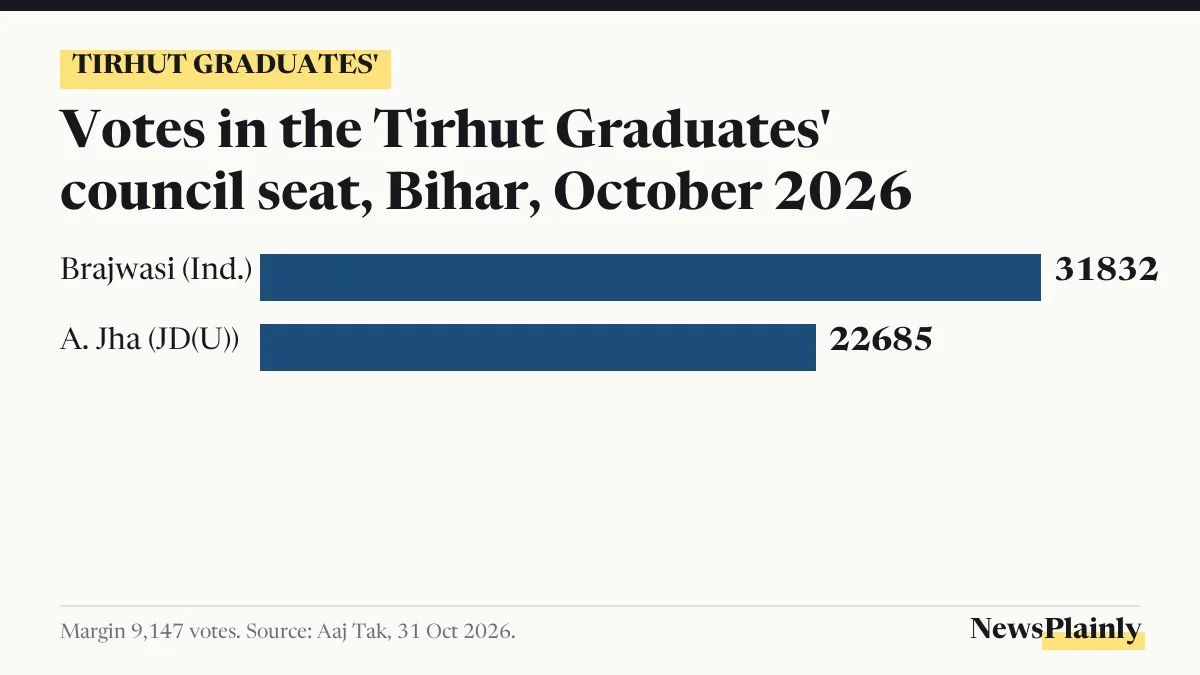
Brajwasi kept the Tirhut Graduates’ seat, defeating the JD(U)’s Abhishek Jha for the second time in a row, according to the Press Trust of India (PTI). Aaj Tak put the count at 31,832 votes to 22,685, a margin of 9,147.
Raj won the Saran Teachers’ seat. He took it from the sitting MLC, Afaq Ahmed, who was backed by Jan Suraaj, and beat the JD(U)’s Anand Pushkar, who was the candidate of the BJP-led National Democratic Alliance (NDA), PTI reported. A rebel from another NDA partner, Ram Pukar Sinha of the Rashtriya Lok Morcha, also contested.
Raj’s own history with the BJP is described differently in the reports. PTI said he had recently quit the party; Aaj Tak said the BJP had expelled him for six years after he decided to contest as an independent.
Joined or only backing the BJP: what each side said
Both men said they had joined. PTI reported that they were photographed outside the party office holding membership slips and that both expressed trust in Chief Minister Samrat Choudhary. Raj told PTI Videos he had left earlier because of “coalition compulsions”, that he had always been a BJP worker, and that he had taken membership again. Aaj Tak reported that BJP MP Rajiv Pratap Rudy was present when Raj met the chief minister.
Brajwasi said he decided after talking to the chief minister, who told him he could raise his constituency’s issues better from inside the party, according to PTI. Asked about past remarks seen as friendly to Tejashwi Yadav, he said his praise had been for policies, not for parties.
The BJP’s line was different. Party spokesperson Kuntal Krishna and MLA Manoj Sharma said in video statements that the two were extending support, out of trust in Prime Minister Narendra Modi, Chief Minister Choudhary and JD(U) president Nitish Kumar, PTI reported. Aaj Tak also reported that the BJP officially called it support.
Daily Jagran reported that the two were welcomed at a meeting of the BJP legislature party, and that with them the BJP’s strength in the 75-member Council goes from 24 to 26.
Why the RJD cites the anti-defection law
In a statement late on Saturday, Tejashwi Yadav said both members had violated the anti-defection law and accused the BJP of “making a mockery of the Constitution”, PTI reported. He cited paragraph 2(2) of the Tenth Schedule, the anti-defection law’s rule for independents, Article 191(2), which says a member disqualified under that schedule cannot stay in the legislature, and paragraph 6(1), which leaves the decision to the Council’s Chairman.
He also accused the BJP of double standards, saying petitions against MLAs who moved to the NDA a couple of years ago had not been acted on by the Speaker. BJP and JD(U) responses to that charge were not in the reports read.
The text of the Tenth Schedule is short on this point. NewsPlainly set it against what each side has said.
| Claim or question | Who says it | What the Tenth Schedule text says |
|---|---|---|
| An independent who joins a party after the election is disqualified | Tejashwi Yadav (RJD) | Paragraph 2(2) says a member elected “otherwise than as a candidate set up by any political party” is disqualified if he joins a party after the election. |
| An independent counts as the party’s authorised candidate if he joins within 15 days | Rahul Raj, citing “the rules” | Paragraph 2(2) sets no time window. The only 15-day period in paragraph 2 is about a party forgiving a vote cast against its direction. The rule Raj referred to was not named in the reports read. |
| The two are only “extending support” | BJP spokesperson Kuntal Krishna, MLA Manoj Sharma | The text does not define “joining”. Whether the two joined is a question of fact for the presiding officer. |
| Who decides | Tejashwi Yadav, citing paragraph 6(1) | Paragraph 6(1): the Chairman of the House decides, and his decision is final. |
The JD(U) candidate’s complaint inside the NDA
The switch also drew a complaint from inside the ruling alliance. Anand Pushkar, the JD(U) candidate Raj defeated, said on social media that some BJP leaders asked for votes in Nitish Kumar’s name but did not help JD(U) candidates when it counted, Aaj Tak and Daily Jagran reported. He said he had been assured that the sitting MLC would be persuaded not to contest, and Aaj Tak said he named Rudy and Motihari MP Radha Mohan Singh in his posts.
Raj, for his part, told Aaj Tak that he had not defeated the NDA but a candidate he described as having communist leanings, saying Pushkar had contested an earlier election on a Communist Party of India ticket and joined the JD(U) shortly before the poll. No official JD(U) statement on the switch was in the reports read.
| Date (2026) | What happened |
|---|---|
| 23 October | Polling for eight Bihar Legislative Council seats (graduates’ and teachers’ constituencies), Daily Jagran reported. |
| From 27 October | Counting. Brajwasi keeps Tirhut Graduates’ and Raj wins Saran Teachers’, both as independents. |
| 31 October | Both meet Chief Minister Samrat Choudhary and announce at the BJP office in Patna that they have joined the party (PTI, Aaj Tak). |
| 31 October, late night | Tejashwi Yadav issues a statement seeking their disqualification (PTI). |
| Next | Any disqualification question goes to the Council Chairman under paragraph 6(1). |
What happens next with the disqualification demand
Under paragraph 6(1), a disqualification question about a member of the Legislative Council is decided by its Chairman. The reports read did not say whether a formal petition had been filed by Sunday, or when the Chairman might take it up.
The reports point to one open question of fact for any such case under the anti-defection law: whether the two have joined the BJP, as they said, or are only supporting it, as the party’s spokespeople put it. No decision by the Chairman of the Bihar Legislative Council had been reported by 1 November.
Frequently asked questions
Which Bihar MLCs joined the BJP?
Banshidhar Brajwasi of Tirhut Graduates' and Rahul Raj of Saran Teachers', both elected as independents, announced on 31 October 2026 that they had joined the BJP.
Can an independent MLC join a political party?
Paragraph 2(2) of the Tenth Schedule says a member elected as an independent is disqualified if he joins a political party after the election. The Chairman of the House decides such cases.
What did the BJP say about the two MLCs?
BJP spokesperson Kuntal Krishna and MLA Manoj Sharma said the two were extending support to the party, PTI reported.
Who decides if the MLCs are disqualified?
Under paragraph 6(1) of the Tenth Schedule, the Chairman of the Bihar Legislative Council decides, and the decision is final.