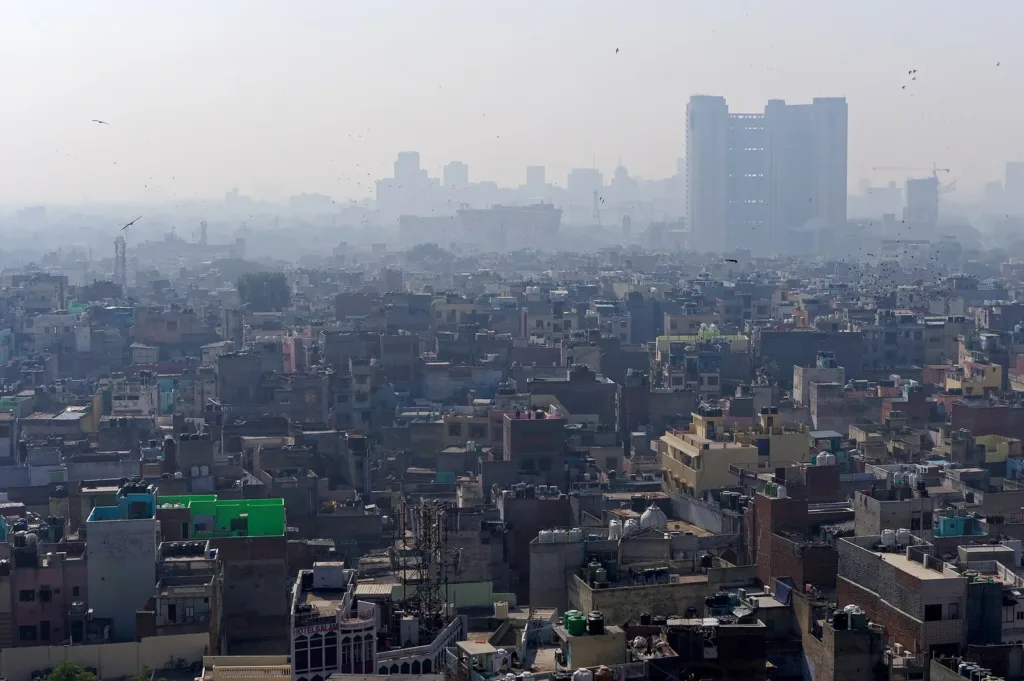
Representative image. Jakub Hałun, CC BY-SA 4.0, Wikimedia Commons

Why it matters
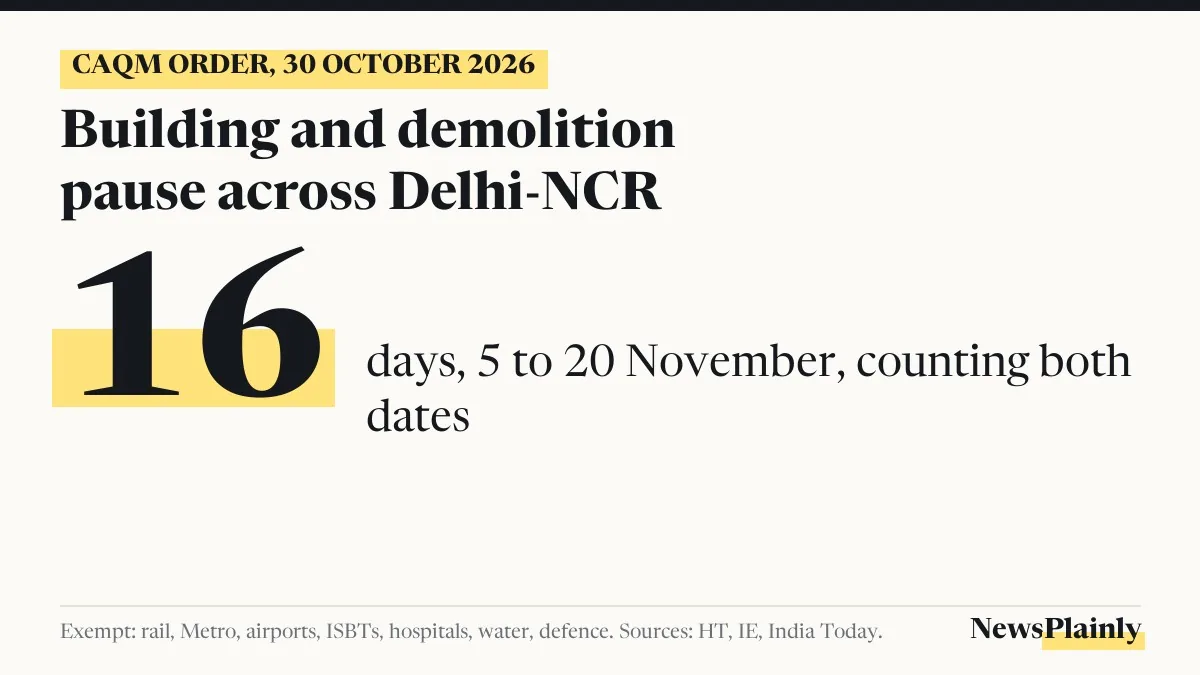
For 16 days, building and demolition sites across the NCR, and road and flyover projects, must stop dust-raising work. Office workers in Delhi and five nearby districts may have to work from home for part of the period. The curbs come on top of Delhi's own winter rules, so much of the change falls on the NCR districts outside Delhi.
An NCR construction ban will pause dust-raising building and demolition work across Delhi and the National Capital Region from 5 to 20 November 2026. The Commission for Air Quality Management (CAQM), the body that runs pollution control for the region, issued the order on 30 October, a few hours after Union Environment Minister Bhupender Yadav announced it. The same order asks government and private offices in Delhi and five nearby districts to keep up to half their staff working from home for those 16 days.
It is a precaution. Delhi’s air was in the “moderate” band on 30 October after heavy rain, but CAQM said its look at November air quality data from 2018 to 2025 showed a repeating pattern: pollution in Delhi-NCR tends to peak in early and mid-November, with some days reaching “Severe” and “Severe+”, the two worst grades on the Air Quality Index (AQI).
What the NCR construction ban stops, and what keeps going
According to the Indian Express and India Today, the order covers dust-generating demolition and outdoor civil construction across the region. Yadav described it more broadly when he announced it, calling it “a complete halt of construction and demolition activities across the NCR region”, India Today reported. In The Hindu’s account, he said it would apply to “dust generating demolition and outdoor civil construction activities”, with exemptions for projects of national importance.
Some projects are exempt, the reports say. Others that might look like public works are not:
- Allowed to continue: railways, Metro, airports, inter-state bus terminals, hospitals, water supply and sanitation, national security and defence work, and projects of national importance.
- Not exempt: “linear” public projects such as highways, roads, flyovers, overbridges, power transmission lines, pipelines and telecom lines. “This restriction shall also apply to linear public projects,” the order says, as quoted by the Hindustan Times.
The order runs from 5 November to 20 November. Counting both days, that is 16 days. The Indian Express described it as a 15-day ban; India Today’s report said 16.
Work from home: which offices are covered
The second part of the order is about traffic. Government and private offices in Delhi and in five districts with heavy vehicle traffic, Gurugram, Faridabad, Sonipat, Ghaziabad and Gautam Buddha Nagar (Noida), are to work with no more than 50% of staff attending in person. The rest work from home. Industrial units and essential services where this is not practical are left out, the order says, as quoted by the Hindustan Times.
India Today reported that CAQM has directed the Delhi government, the NCR state governments and the agencies that enforce its rules to make sure the order is followed.
How this fits with Delhi’s own winter curbs
For people in Delhi, several sets of rules now overlap. Delhi already has its own winter plan, and the reports describe it differently. The table puts the curbs side by side, with the source for each.
| Curb | Where | Dates | Reported by |
|---|---|---|---|
| Dust-raising construction and demolition paused | Delhi and NCR | 5 to 20 Nov 2026 | CAQM order (HT, IE, India Today) |
| Up to 50% staff in office, rest work from home | Delhi, Gurugram, Faridabad, Sonipat, Ghaziabad, Gautam Buddha Nagar | 5 to 20 Nov 2026 | CAQM order |
| Dust-raising demolition and outdoor construction banned | Delhi | From 1 Nov; to 31 Jan (The Hindu) or 28 Feb 2027 (IE) | Delhi government plan |
| Wider ban on all construction and demolition | Delhi | 10 Dec to 20 Jan | Delhi Winter Action Plan (IE, HT) |
| Older (non-BS-VI) vehicles from outside Delhi kept out | Delhi | 1 Nov 2026 to 31 Jan 2027 | Delhi government (NewsPlainly 756) |
What this means in practice: inside Delhi, the Indian Express and The Hindu report that dust-raising construction is already barred from 1 November under the city’s own plan, so the CAQM order adds the most in the NCR districts outside Delhi, where it now applies too. The 50% office rule is also new for the five districts; The Hindu reported that Delhi’s own notification already makes it mandatory in Delhi from 1 November.
Drivers have a separate change coming. From 1 November, petrol and diesel vehicles registered outside Delhi that do not meet BS-VI (Bharat Stage VI) emission standards will be kept out of the city, as NewsPlainly reported in its story on the non-BS-VI vehicle ban. Stage 1 of GRAP, the Graded Response Action Plan that adds curbs as the AQI worsens, is also in force, The Hindu reported.
Why mid-November, when the air is clean today
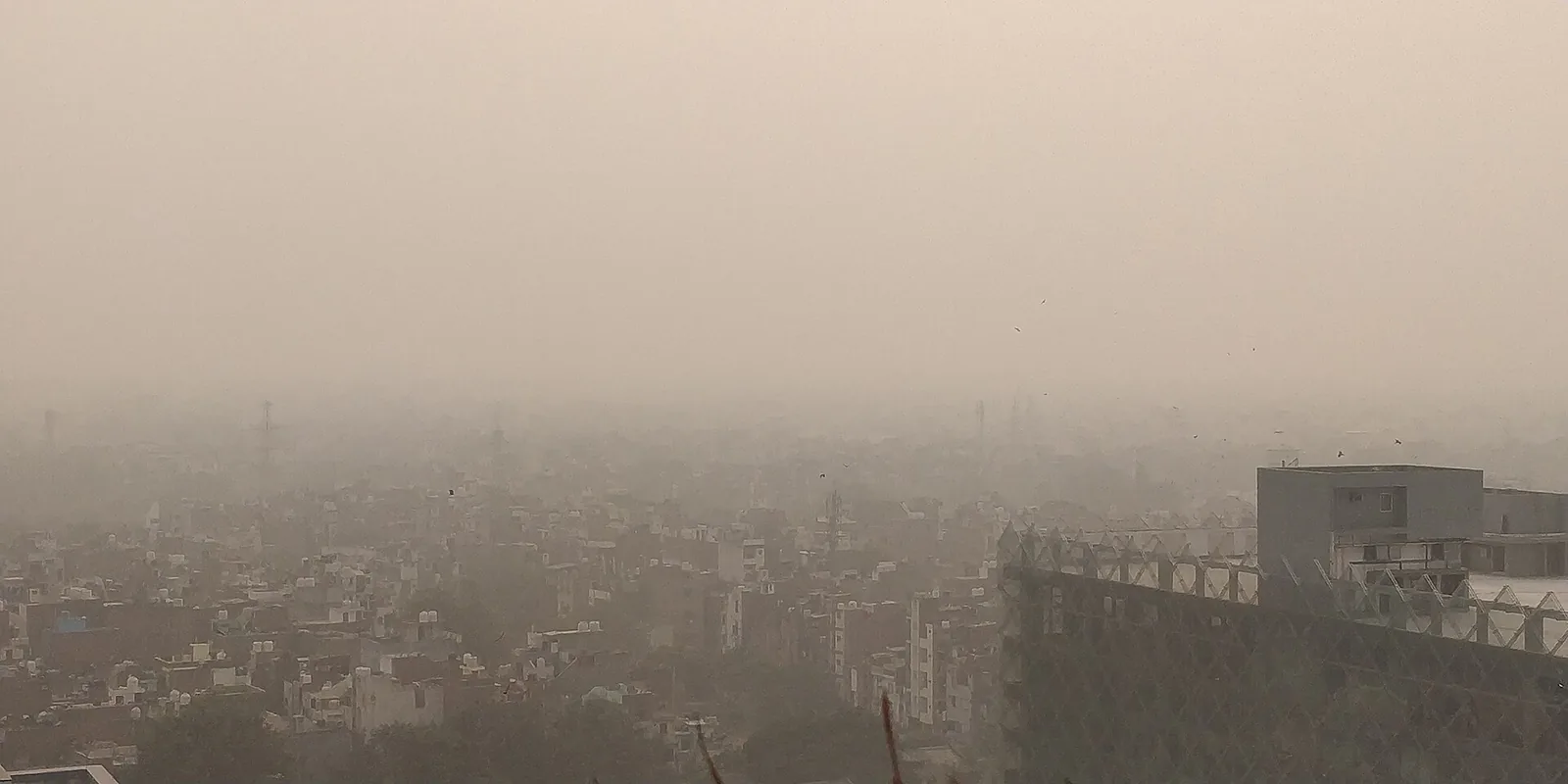
The order arrives during an unusually clean, cold spell. Rain from a western disturbance interacting with Cyclone Arnab pushed Delhi’s maximum temperature at Safdarjung down to 20.7 degrees Celsius on 30 October, the lowest for an October day since 1951, the Hindustan Times reported. Delhi’s average AQI for October was 167, the lowest for the month since 2015, according to an analysis by the Centre for Research on Energy and Clean Air (CREA) cited by the paper.
That is not expected to last. Delhi’s AQI was above 200, in the “poor” band, on 28 and 29 October, before the rain brought it down to 133 early on 30 October, according to Central Pollution Control Board figures cited by India Today and the Hindustan Times. The Air Quality Early Warning System for Delhi expects the air to stay moderate until 31 October and slip into “poor” from 1 November, then worsen over the following six days, HT reported.
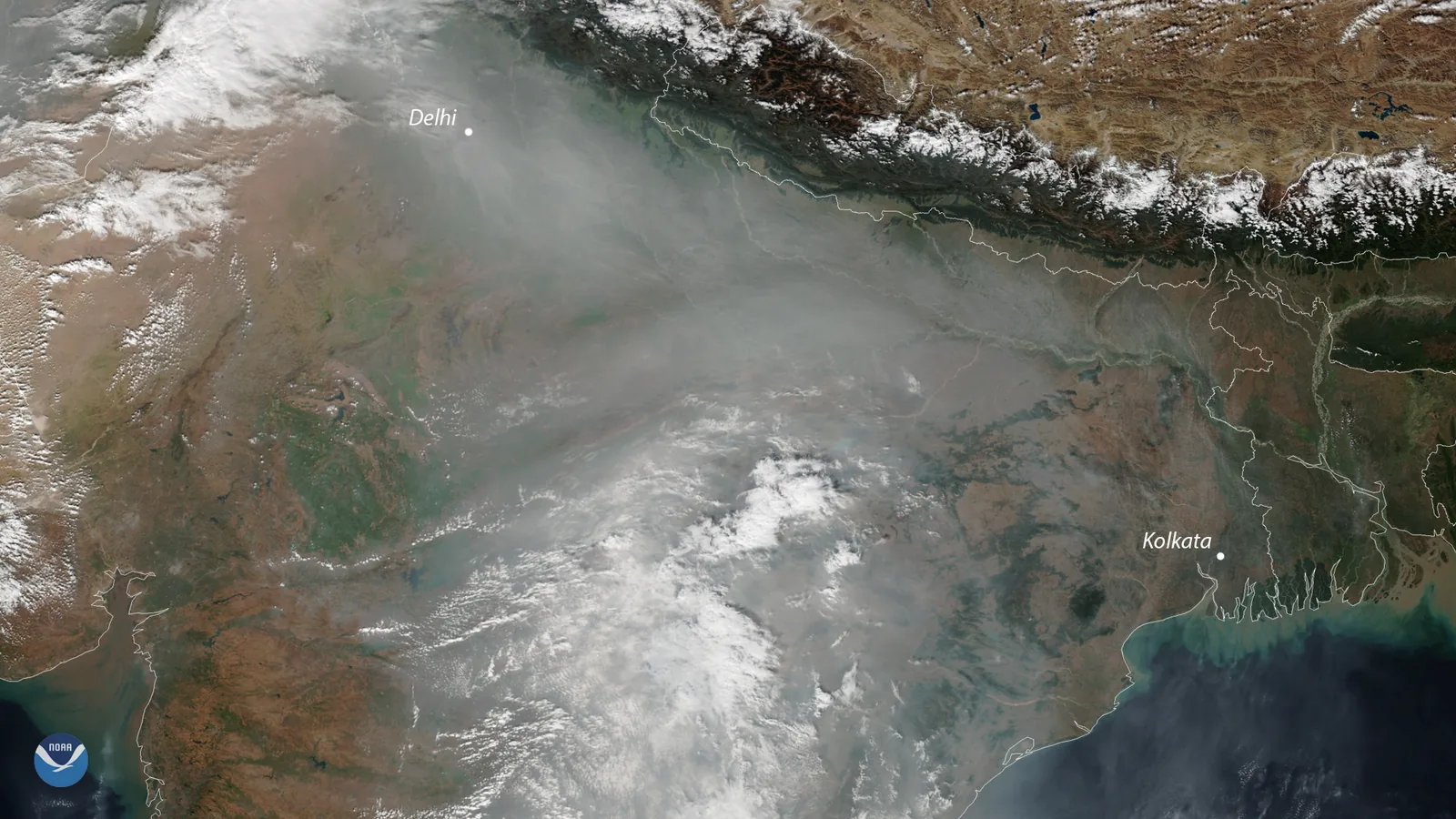
CAQM gave several reasons for acting early. Low winds and a shallow layer of mixing air trap pollution near the ground in November, it said, and this is also when paddy stubble burning in Punjab and Haryana usually rises. Dust is a major source of PM10 and PM2.5 (particulate matter, the fine particles that can reach deep into the lungs), the Indian Express noted. A senior official told The Hindu that Deepavali, on 8 November, and the expected firecracker smoke were part of the thinking; The Hindu also noted that a fixed-date construction ban is not a usual step for CAQM.
What happens on 5 November
The pause starts on Thursday, 5 November and runs to Friday, 20 November, and the office attendance cap covers the same days. After that, Delhi’s own calendar takes over: the city’s wider ban on all construction and demolition is set for 10 December to 20 January, according to the Indian Express and the Hindustan Times.
Yadav also told reporters that 98% of industries in Delhi-NCR have installed online continuous emission monitoring systems, which send real-time alerts to regulators, according to the Indian Express.
Frequently asked questions
When does the NCR construction ban start and end?
It runs from 5 November to 20 November 2026, 16 days counting both dates, under a CAQM order issued on 30 October.
Which projects are exempt from the construction ban?
Railways, Metro, airports, inter-state bus terminals, hospitals, water supply and sanitation, national security and defence, and projects of national importance. Highways, roads, flyovers, power lines, pipelines and telecom projects are not exempt.
Is work from home compulsory in Delhi-NCR?
The order asks government and private offices in Delhi, Gurugram, Faridabad, Sonipat, Ghaziabad and Gautam Buddha Nagar to have up to 50% of staff in person and the rest at home from 5 to 20 November. Industrial units and essential services where this is not feasible are exempt.
Why is construction stopped when Delhi's air is clean now?
CAQM said November data from 2018 to 2025 show pollution peaking in early and mid-November, so it is acting before that. Delhi's AQI is forecast to turn poor from 1 November.