Representative image. Root66, CC BY-SA 3.0, Wikimedia Commons

Why it matters
The MRP on the pack decides a large part of what families spend on these cancer medicines. From 9 November, a chemist or hospital pharmacy cannot charge more than the revised MRP for the listed brands. The cut varies widely by brand, and the cap does not touch tests, hospital charges or medicines outside the list.
Cancer drug prices for 137 medicines will be governed by a new ceiling from Monday, 9 November 2026, when revised maximum retail price (MRP) ceilings set under a cap on trade margins come into force. The National Pharmaceutical Pricing Authority (NPPA), the government body that regulates medicine prices, says the revised pricing will apply from that date “until further orders”, and its latest list shows some packs falling by more than 90%.
The Press Information Bureau (PIB) put out a release on 7 November headlined on the 9 November start date. The figures below come from NPPA’s own documents: a list of old and revised MRPs based on company data received up to 6 November, and a set of frequently asked questions (FAQ) for patients published the same day.
What the 30% trade margin cap on cancer drugs changes
A trade margin is the gap between the price a drug company charges a stockist or distributor and the MRP a patient pays, leaving out GST (goods and services tax). NPPA has capped that gap at 30% for 137 specified non-scheduled anti-cancer medicines, both branded and generic. Non-scheduled means they are not covered by the usual ceiling prices NPPA sets for essential medicines, as The Policy Edge, a policy research site, explained.
The cap was set on 17 October 2026, the Indo-Asian News Service (IANS) reported. Companies had to work out new MRPs using their average distributor prices for March 2026, leaving out medicines given free under patient assistance programmes and direct sales to the government, according to the same report.
NPPA’s FAQ makes a point that is easy to miss: a 30% cap on the margin does not mean every medicine becomes 30% cheaper. The cut depends on how wide the old margin was. Two brands of the same molecule can still carry different MRPs, because each is worked out from that company’s own selling price and pack size.
How far cancer drug prices fall for some brands
By 4 November, 70 companies had cut the MRPs of 120 of the 137 medicines, with average reductions of 20% to 70% and the steepest cut at 96.45%, according to the government factsheet as reported by IANS. The Policy Edge, which summarised the same factsheet, put the number of individual products at 1,136 by that date.
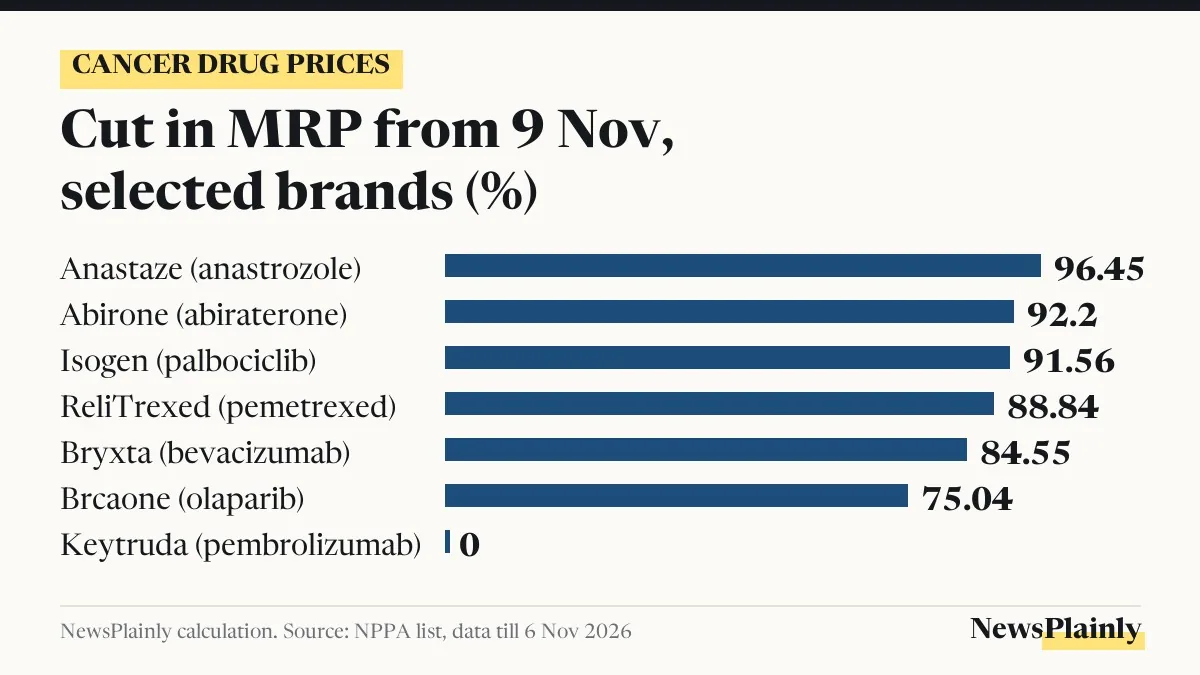
NPPA’s latest list, based on company data up to 6 November, runs to 1,225 entries. The table below picks seven brands from it to show the range, plus two brands from multinational makers whose MRPs did not change in the list. The percentage is NewsPlainly’s calculation: old MRP minus revised MRP, divided by old MRP.
| Medicine, strength and pack | Brand (company) | Old MRP (₹) | Revised MRP (₹) | Cut |
|---|---|---|---|---|
| Anastrozole 1 mg tablet, pack of 10 | Anastaze (MedPlus Health Services) | 713.30 | 25.35 | 96.45% |
| Abiraterone acetate 250 mg, 120 tablets | Abirone (Arvincare Pharma) | 41,250.00 | 3,218.23 | 92.20% |
| Palbociclib 100 mg, 21 capsules | Isogen (Samarth Life Sciences) | 24,505.00 | 2,068.92 | 91.56% |
| Dasatinib 70 mg, 30 tablets | Dasather 70 (TherDose Pharma) | 10,311.00 | 1,010.00 | 90.20% |
| Pemetrexed 500 mg vial | ReliTrexed (Reliance Life Sciences) | 9,977.00 | 1,113.00 | 88.84% |
| Bevacizumab 400 mg vial | Bryxta (Zydus Lifesciences) | 76,924.00 | 11,884.00 | 84.55% |
| Olaparib 150 mg, 60 tablets | Brcaone (Emcure Pharmaceuticals) | 46,364.05 | 11,573.68 | 75.04% |
| Pembrolizumab 100 mg | Keytruda (MSD) | 2,16,500.00 | 2,16,500.00 | No change |
| Bevacizumab 400 mg vial | Avastin (Roche) | 1,23,506.00 | 1,23,506.00 | No change |
The anastrozole pack in the first row matches the 96.45% figure the government gave as its steepest cut. The two unchanged rows show that the revised MRP list is not a flat discount: several brands, including several of the most expensive entries, carry the same old and revised MRP. The list itself does not give a reason for each unchanged entry. The Policy Edge noted that a medicine already priced below the new limit cannot be made more expensive.
The government estimates savings for patients at ₹3,357.49 crore, IANS reported. That number compares old and revised prices and applies the difference to sales volumes from April 2025 to March 2026, so it is a projection based on past sales, not money already saved.
Who the revised MRPs apply to from 9 November
The new prices cover the listed formulations wherever they are sold: retail chemists, hospital pharmacies and other dealers. According to NPPA’s FAQ, hospitals, medical institutions, retailers and dealers must follow the revised prices and display rules, and hospitals and medical institutions must put the revised prices prominently on their websites. Companies must report their new MRPs to NPPA, publish the cuts in newspapers and on their own websites, and send them to retailers and hospitals, IANS reported.
The revised MRP is a ceiling, not a fixed price. NPPA’s FAQ says the actual amount charged, or any discount, can still vary between shops and hospitals. It also says the cap applies only to the listed medicines, not to other parts of a cancer treatment bill such as tests or hospital charges, and that existing patient assistance programmes are not expected to be affected.
The Policy Edge reported that the order also bars companies from cutting production without permission and requires notice before a medicine is discontinued, provisions meant to protect supply as prices fall. NewsPlainly could not open the order itself, so this detail rests on that report.
How to check a price and complain about overcharging
NPPA lists five ways to check the price of a covered medicine: the MRP printed on the pack, the price list shown by the chemist or hospital, the manufacturer’s own revised price notice, NPPA’s website, and the Pharma Sahi Daam app or portal run by NPPA.
Anyone charged more than the applicable MRP can complain through Pharma Sahi Daam, by email to monitoring-nppa@gov.in, on the toll-free helpline 1800-11-1255, by post to the Deputy Director (Monitoring) at NPPA in New Delhi, or to their State Drug Controller, the FAQ says. NPPA asks complainants to keep the prescription, the purchase invoice and the medicine pack, and to give the brand, composition, pack size, MRP, maker and pharmacy details.
Why NPPA stepped in on cancer drug prices again
NPPA has used this tool on cancer medicines before. A 2019 trade margin intervention covered 42 non-scheduled anti-cancer drugs, according to both IANS and The Policy Edge. NewsPlainly reported in October on how mark-ups on cancer drugs rose after that 2019 cap, and on the Supreme Court case over high margins on medicine prices.
The new cap follows concerns from state authorities, patients and civil society groups about the gap between what hospitals and pharmacies pay for these drugs and the MRP printed on the pack, IANS reported. The Policy Edge said NPPA used its extraordinary powers in the public interest under the Drugs (Prices Control) Order, 2013 to act on these medicines directly.
For now, the new cancer drug prices are known only for the brands companies have reported. NPPA says it is still updating the list as companies send in revised prices. As of 4 November, revisions had been reported for 120 of the 137 medicines, which means the remaining 17 were not yet in that count.
Frequently asked questions
When do the new cancer drug prices start?
From 9 November 2026. NPPA's FAQ says the revised pricing stays in force until further orders.
Does the 30% cap mean every cancer medicine is 30% cheaper?
No. The 30% limit is on the trade margin, not the price. In NPPA's 6 November list some packs fall by over 90% and some brands do not change at all.
How can I check the revised MRP of my medicine?
Check the MRP on the pack, the price list at the chemist or hospital, the company's notice, NPPA's website or the Pharma Sahi Daam app.
Where do I complain if I am overcharged?
Through Pharma Sahi Daam, by email to monitoring-nppa@gov.in, on helpline 1800-11-1255, or to your State Drug Controller. Keep the bill and the pack.