Representative image. epSos.de, CC BY 2.0, Wikimedia Commons

Why it matters
For patients buying anti-cancer medicines, the MRP printed on the pack is the figure this revision changes. The 2019 record and ET's analysis suggest a lower MRP may not mean a lower price paid, because mark-ups can rise again. Patients buying the 159 packs with no cut see no change in the MRP.
The government is cutting the maximum retail price (MRP) of 137 anti-cancer medicines from 9 November. A similar cap in 2019 was followed by cancer drug mark-ups that climbed, according to an analysis of that earlier list reported by The Economic Times (ET). The analysis found mark-ups on many of the medicines had climbed to as much as 700% by 2026, so the new cut may face the same test.
What the new price list does
The National Pharmaceutical Pricing Authority (NPPA), the drug price regulator, is limiting the trade margin on 137 non-scheduled anti-cancer drugs to 30% of the MRP, excluding GST, ET reported. The government expects MRPs of the listed medicines to fall by up to 70%, depending on each product’s price structure. Companies must submit revised prices within seven days of the notification and keep production at existing levels, to avoid shortages.
The trade margin cap is the main tool in this round. A trade margin is the share that distributors and stockists keep from the final price, so a cap limits how much of the anti-cancer drug prices can be added on by the middle of the supply chain. The revised prices are scheduled to take effect from 9 November.
The cap has been through a few stages. The table below sets out the dates the reports read give, from the 2019 cap to the new prices, so readers can see where the current cut sits.
| Date | Step | Source |
|---|---|---|
| February 2019 | NPPA caps trade margin at 30% of MRP on 42 non-scheduled anti-cancer drugs | ET |
| 9 October 2026 | NPPA meeting minutes approve in principle a proposed 30% cap; the minutes give an estimate of ₹2,500 crore a year | South First |
| 14 October 2026 | Deadline for an expert committee to report, according to the minutes | South First |
| 30 October 2026 | ET finds 159 of 643 drug packs in the revised list had no MRP cut | ET |
| 9 November 2026 | Revised MRPs scheduled to take effect | ET |
How cancer drug mark-ups rose after the 2019 cap
In February 2019 the NPPA put a 30% trade margin cap on 42 non-scheduled anti-cancer drugs, and the MRPs of several medicines fell sharply. ET reports that 34 of the 137 medicines in the latest list also appeared on the 2019 list. A Times of India (TOI) analysis of those 34, cited by ET, found that most had mark-ups above the level a 30% trade margin allows. Only five brands from the earlier list had mark-ups of 43% before the latest revision, and four more had mark-ups between 43% and 100%. Most of the others were between 100% and over 700%.
The two terms are easy to mix up. A trade margin is measured as a share of the final MRP. A mark-up is measured on the price a stockist or distributor pays. ET gives a worked example: a 30% trade margin on the final price equals a mark-up of about 42.86% on the price to the stockist.
| Round | Brand MRP before | Brand MRP after | Cut |
|---|---|---|---|
| 2019 cap | ₹7,000 | ₹800 | 88.6% |
| 2026 revision | ₹1,095 | ₹297 | 72.9% |
The 2019 cap is the earlier attempt, and it was followed by cancer drug mark-ups that rose on many brands. The price cut in this example is deeper in 2019 than in 2026. ET also noted that several multinational companies that made large cuts in 2019 made smaller cuts, or none, this time.
Why a one-time cut may not hold
The All-India Drug Action Network (AIDAN), a group that works on access to affordable medicines, argues that the NPPA’s measure is a one-time reduction of MRPs rather than a cap. Without a continuing way to control trade margins, it says, cancer drug mark-ups can return. Malini Aisola of AIDAN told TOI the measure would not be enough to stop mark-ups rising again, as happened after 2019. AIDAN says calling the step a cap is misleading, because it is a one-time cut in MRPs.
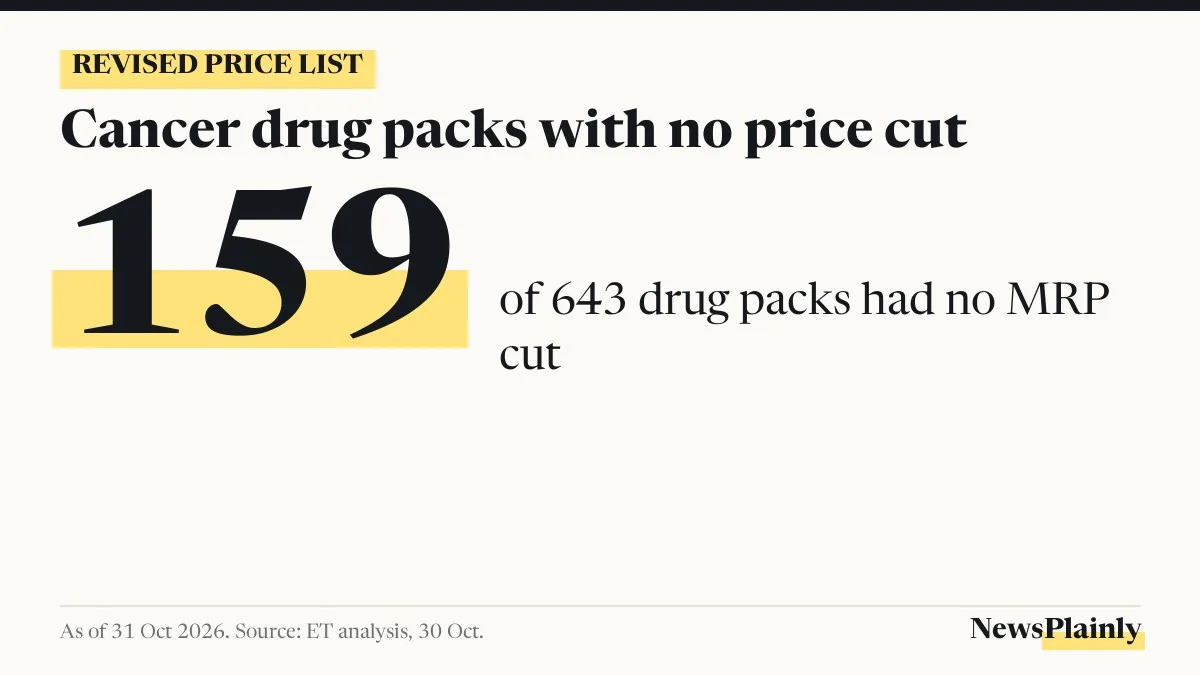
Not every medicine is affected by the cut. ET’s review of the revised list found that 159 of the 643 drug packs had no MRP cut, among them several expensive patented medicines. It named Keytruda (pembrolizumab), at ₹2.16 lakh for a 100 mg injection pack, Tagrisso (osimertinib), at ₹4.16 lakh for 30 tablets, and Koselugo (selumetinib), at over ₹10 lakh for 60 capsules, as unchanged. The average cut across the 643 packs was 38.22%, according to ET’s analysis of data supplied by advocate KC Jain, a petitioner in the Supreme Court case on medicine pricing.
South First, reporting on NPPA meeting minutes from early October, gave a different picture of scale. The minutes put the annual savings at about ₹2,500 crore and expected MRPs to fall by roughly 20% to 70%, depending on each medicine’s trade structure. They also cited an analysis of Pharmarack data showing an average trade mark-up of about 170% on non-scheduled anti-cancer medicines, reaching 700% in some cases. South First noted that this came from that analysis, not from a direct NPPA measurement.
What happens next for patients and the cap
Readers tracking anti-cancer drug prices have two dates to watch, and the trade margin cap will be the main test of whether the 2026 cut holds. Companies must submit revised prices within seven days of the notification, and the new MRPs are due to apply from 9 November. The reports read do not say how the NPPA will check that trade margins stay within 30% once the new prices start, or whether the cap will be reviewed. A separate Supreme Court case on medicine pricing is also running. Our earlier report on the court reserving its order on medicine mark-ups is at this link.
The open question for patients is which packs the cut reaches, and whether the cap holds beyond this revision, so that anti-cancer drug prices do not climb back. The reports read answer the first part only in part, and say nothing yet about the second.
Frequently asked questions
When do the new cancer drug prices take effect?
The revised prices are scheduled to take effect from 9 November 2026, ET reported.
Does the cut cover every cancer drug?
No. The revision covers 137 non-scheduled anti-cancer drugs. ET's analysis of the revised list found 159 of 643 drug packs had no MRP cut.
What is a trade margin?
It is the share distributors and stockists keep from the final MRP. A 30% trade margin on the MRP works out to a mark-up of about 42.86% on the price paid to the stockist.