Representative image. Pinakpani, CC BY-SA 4.0, Wikimedia Commons

Why it matters
Liposomal amphotericin B is a critical injectable antifungal, and the case asks whether permissions granted for a pandemic emergency can keep supporting regular sales after they lapse. The bench has said its order will apply to every company given emergency licences without proper trials during Covid, so the outcome could reach beyond the firms named. The reports read mention no order so far that stops sales of the drug.
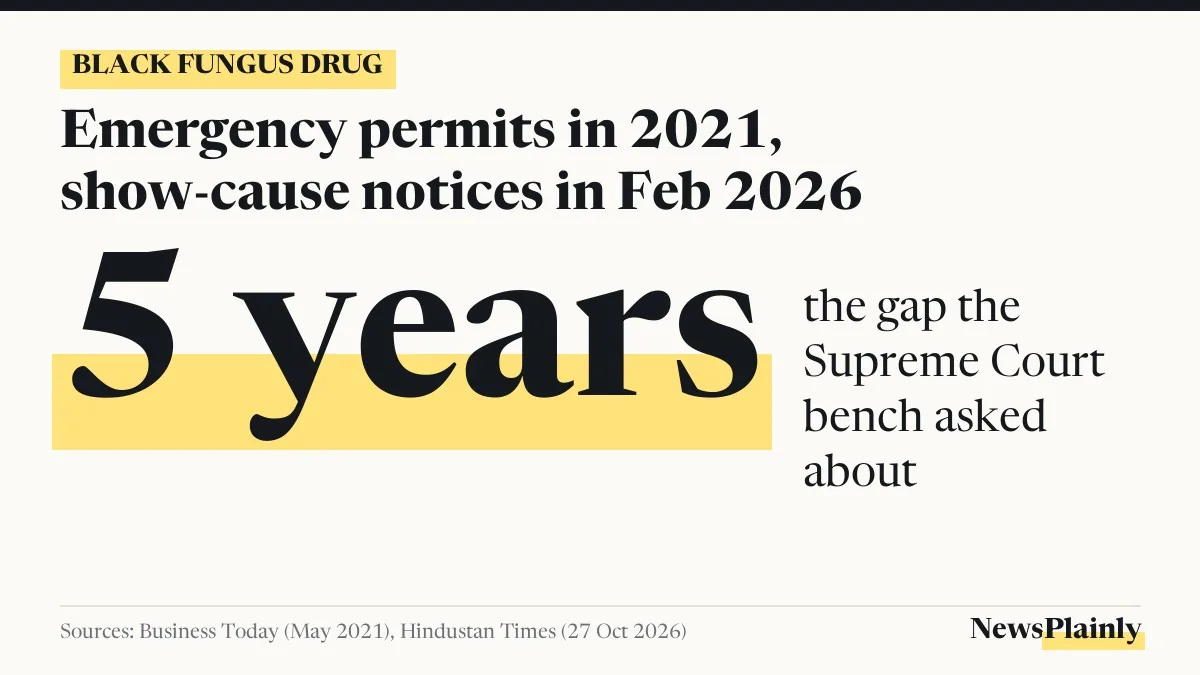
The Supreme Court on 27 October 2026 asked why the Centre and the Drugs Controller General of India (DCGI) took about five years to act against companies accused of making and selling amphotericin B, the black fungus drug, on emergency permissions granted during the 2021 Covid wave that have since run out. A bench of Justices Vikram Nath, Sandeep Mehta and Aparesh Kumar Singh heard the public interest litigation (PIL) and reserved its order, Hindustan Times reported.
The bench said its directions would not stop at the companies in front of it. According to HT, it said whatever it orders “will apply across the board” to every company that got emergency licences without proper trials during Covid. The news agency ANI’s report of the hearing, carried in Hindi by Prabhasakshi, gives the same account.
What the bench asked the drug regulator about amphotericin B
The drug at the centre of the case is liposomal amphotericin B, an injectable antifungal. In 2021 it was in short supply because doctors were using it to treat mucormycosis, the black fungus infection that hit many Covid patients during the second wave.
On Tuesday the bench’s questions were pointed. “What were your officers doing for five years when these drugs were being sold without clinical trials and other regulatory requirements? Were they sleeping or were their hands greased?” it asked the government, as quoted by HT. These were remarks to the drug regulator’s side during the hearing, not findings in an order.
The bench also said the government had moved only after the court stepped in. “You woke up only in February 2026 and started issuing notices after this court gave you a nudge,” it said, according to the same report.
Senior advocate S Muralidhar, for the petitioner Rajendra Prasad, pointed to the latest affidavit in the case to argue that several companies had received emergency approvals but the regulators had not followed up. Senior advocate Amit Anand Tiwari, appearing for Sun Pharmaceutical Industries, told the court that Sun Pharma had not been granted emergency approvals. HT’s report and the ANI account did not set out what the government’s lawyers said in reply on 27 October.
Why the black fungus drug got emergency approval in 2021
When black fungus cases rose in May 2021, five Indian companies made the liposomal drug and one more imported it, Business Today reported on 22 May 2021. It said amphotericin B output from those makers had been very limited in April, and that the government had licensed five more companies (Natco, Alembic, Gufic, Lyka and Emcure) to start making it, with about 1,11,000 vials a month expected from July 2021. Imports were planned to fill the gap.
The legal tool used, HT reported, was Section 26B of the Drugs and Cosmetics Act, 1940. In plain words, this section lets the Centre regulate or restrict how a drug is made, sold or distributed, by a notice in the official Gazette, when it is satisfied the drug is essential to meet an emergency caused by an epidemic or natural disaster. It was added to the Act in 2008 and took effect in August 2009.
The petition’s argument, as HT described it, is that these permissions were meant to be temporary. Once an emergency approval expired, it says, companies could not keep making and selling the black fungus drug on its strength without getting the regular approvals that apply in normal times.
How the black fungus drug case reached this point
The court first issued notice on the PIL in October 2025, when a bench of Justices Vikram Nath and Sandeep Mehta sought replies from the Union government, the DCGI and several drug makers, Medical Dialogues reported at the time.
In an order passed in April 2026, HT reported, the court recorded that show-cause notices had gone out in February 2026 to companies found not to have met the conditions of their licences. The companies had replied, and decisions were pending. The court asked the authorities to decide the notices within two months, and drew a line between firms that held regular manufacturing licences before the pandemic and those whose permissions came from the emergency arrangements.
| Date | What happened |
|---|---|
| 10 August 2009 | Section 26B of the Drugs and Cosmetics Act takes effect |
| April to May 2021 | Black fungus cases rise in the second Covid wave; supply of the liposomal drug is limited |
| May 2021 | Five more companies licensed to make it, Business Today reported |
| October 2025 | Supreme Court issues notice on Rajendra Prasad’s PIL |
| February 2026 | Show-cause notices issued to companies, as recorded in the April order (HT) |
| April 2026 | Court asks authorities to decide the notices within two months (HT) |
| 27 October 2026 | Bench questions the delay and reserves its order |
Which drug companies are in the emergency approval case
Not every company that makes amphotericin B is still a party. Some were removed once it was shown that their licences predated the pandemic, HT reported. Being named in the case does not mean a company has been found to have broken any rule; the court has not ruled.
| Company | Status in the case, as reported by HT |
|---|---|
| Cipla, Bharat Serums and Vaccines, BDR Pharmaceuticals International, Lifecare Innovations | Among those removed as parties: licences from before the pandemic, no show-cause notice |
| Sun Pharmaceutical Industries | Request to be removed turned down because it had received a show-cause notice; told the court on 27 October it had no emergency approvals |
| Emcure, Gufic Biosciences, Alembic, Lyka Labs, Natco Pharma, Intas | Named in the proceedings |
What the petition asks and what comes next
The PIL, filed through advocate-on-record Tushar Giri, asks the court to call for the records of the emergency manufacturing permissions given under Section 26B and to quash those licences or approvals, HT reported. It also asks for the companies concerned to stop making, distributing and selling the drug, and for stocks already in the market to be recalled, seized and destroyed under proper safety rules.
The court has not granted any of this yet. With the order reserved, the next step is a written order from the bench. The bench has said its directions will apply “across the board” to firms that relied on a Covid-era emergency approval, not only those named. The reports read do not say when the order will come.
The reports read mention no court order so far that stops sales of the black fungus drug. For a related look at how health authorities handle device and drug safety rules, see NewsPlainly’s report on the Directorate General of Health Services (DGHS) letter barring reuse of single-use devices.
Frequently asked questions
Why is the Supreme Court hearing a case on amphotericin B?
A PIL by Rajendra Prasad alleges that companies kept making and selling liposomal amphotericin B on emergency permissions granted under Section 26B in 2021, after those permissions expired, without regular approvals.
Has the court banned the black fungus drug?
No. On 27 October 2026 the court reserved its order, and the reports read mention no order so far that stops sales.
What is Section 26B of the Drugs and Cosmetics Act?
It lets the Centre, by Gazette notification, regulate or restrict the making, sale or distribution of a drug that it considers essential to meet an emergency caused by an epidemic or natural disaster.
Which companies are named in the amphotericin B case?
HT reported that Sun Pharma, Emcure, Gufic Biosciences, Alembic, Lyka Labs, Natco Pharma and Intas are in the proceedings, while Cipla, Bharat Serums and Vaccines, BDR and Lifecare were removed because their licences predate the pandemic.