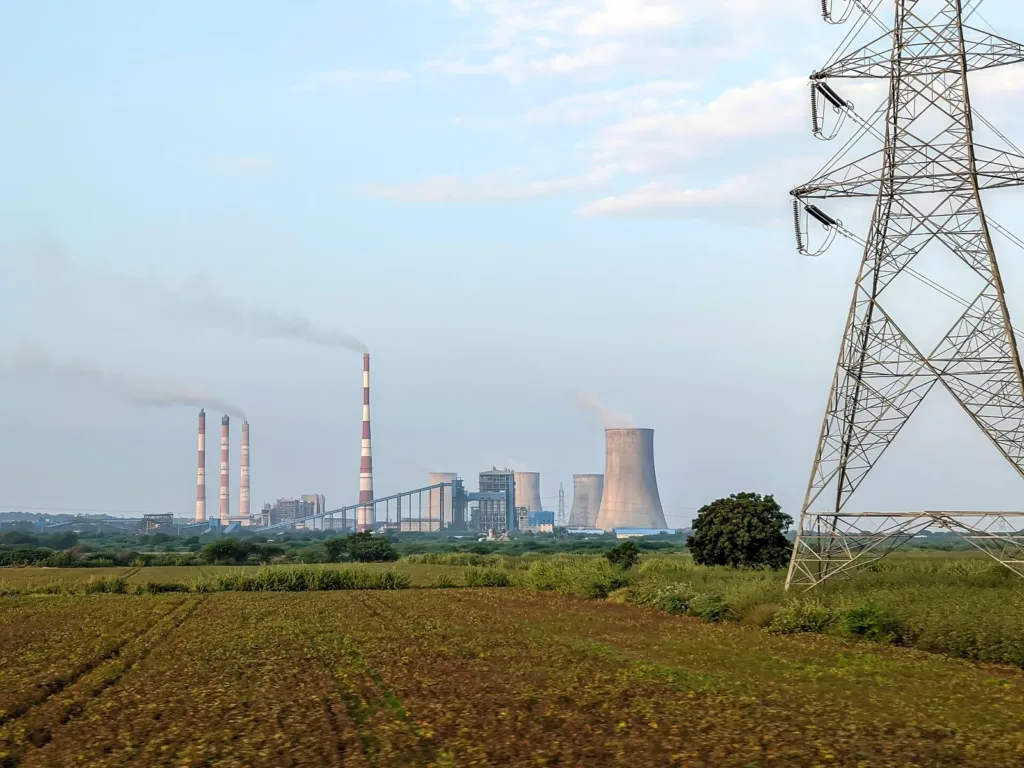
Representative image. Jay.Jarosz, CC BY-SA 4.0, Wikimedia Commons

Why it matters
The pledges shape how far the planet warms, and UNEP's chief linked every extra fraction of a degree to more floods, heatwaves and wildfires. The UN's tally shows promised cuts are still far short of what science requires, two weeks before COP31. India's own 2035 targets are tied to climate finance, one of the issues Simon Stiell listed for the talks.
Climate pledges made by governments so far would bring global greenhouse gas emissions down only about 6% below 2019 levels by 2035, the UN climate body said on 27 October 2026. Even if all climate pledges were carried out in full, including conditional elements (the parts a country says it will deliver only with outside help), the cut would reach about 9%, according to the 2026 Nationally Determined Contributions (NDC) Synthesis Report. NDCs are the national climate plans each country files under the 2015 Paris Agreement. PTI (Press Trust of India) reported on the findings.
The report was one of three that UN Climate Change, the secretariat of the UN Framework Convention on Climate Change (UNFCCC), released together about two weeks before the COP31 (31st UN Conference of the Parties) climate summit, which will be held in Antalya, Türkiye, from 9 to 20 November.
What the NDC synthesis report found
The NDC synthesis report covers 127 new climate plans, filed on behalf of 154 Parties to the Paris Agreement between 1 January 2024 and 31 August 2026. Together, those Parties account for around 70% of the world’s greenhouse gas emissions, UN Climate Change said in its release.
The secretariat described the cuts these climate pledges would bring as substantially off track compared with what science says is needed. Most of the new plans are tied to long-term net zero goals, with target years running from 2040 to 2070 and 2050 the most common, PTI reported from the report. Net zero means balancing the greenhouse gas a country emits with the amount it removes.
If the plans and those long-term goals are all met, the report puts the best estimate of warming by 2100 at 1.7°C to 2.3°C above pre-industrial levels, according to PTI. The report added that bringing warming back to 1.5°C would need substantial further cuts in the next few years, PTI quoted it as saying.
The release also listed what has improved. Some 98% of Parties say they involve local governments, civil society or business in carrying out their plans, up from 70% in their earlier plans. Ninety per cent say their plans drew on the first global stocktake, the Paris Agreement’s first review of collective progress, and 65% linked clean energy to energy security.
UN Climate Change Executive Secretary Simon Stiell said the reports showed governments “standing firm and pushing ahead” but that collective progress “remains clearly insufficient”.
Climate pledges in two UN reports: why the numbers differ
The NDC synthesis report arrived six days after the UN Environment Programme (UNEP) published its Emissions Gap Report 2026, titled “The Point of Return”, on 21 October. Both look at the same climate pledges, but they do not measure them the same way, so their percentages cannot simply be compared or subtracted.
| Question | UNFCCC NDC synthesis (27 Oct) | UNEP Emissions Gap Report (21 Oct) |
|---|---|---|
| Starting year for the cut | 2019 | 2025 |
| Cut by 2035 if pledges are met | About 6%; about 9% with every pledge in full | 11% to 15% with pledges fully carried out |
| Cut needed by 2035 | Not given in the release | 45%, for a peak of about 1.7°C to 1.8°C |
| Warming by 2100 | 1.7°C to 2.3°C with plans plus net zero goals | 2.6°C with pledges; 2.1°C with net zero goals; 2.8°C on current policies |
The emissions gap report’s figures, as reported by Anadolu Agency, are that emissions must fall 18% by 2030, 45% by 2035 and 69% by 2040 from 2025 levels to keep peak warming near 1.7°C to 1.8°C, with a chance of getting back to 1.5°C or below by 2100. That route would also need roughly 320 billion tonnes of carbon dioxide to be removed from the air and stored this century, Anadolu reported.
UNEP Executive Director Inger Andersen said every extra fraction of a degree raises the risk of the floods, heatwaves and wildfires seen this year, according to Anadolu. The New Indian Express reported that UNEP’s projections were worse than last year’s, partly because the United States has left the Paris Agreement.
NewsPlainly has written about the warming outlook before, including the World Meteorological Organization (WMO) El Nino warning and what it means for India’s rain.
Where India’s NDC stands
India’s NDC for 2031 to 2035 was approved by the Union Cabinet on 25 March 2026 and submitted to the UNFCCC in April, according to Hindustan Times and Down To Earth. That puts it inside the January 2024 to August 2026 window the NDC synthesis report covers. The UN release does not give country-by-country figures.
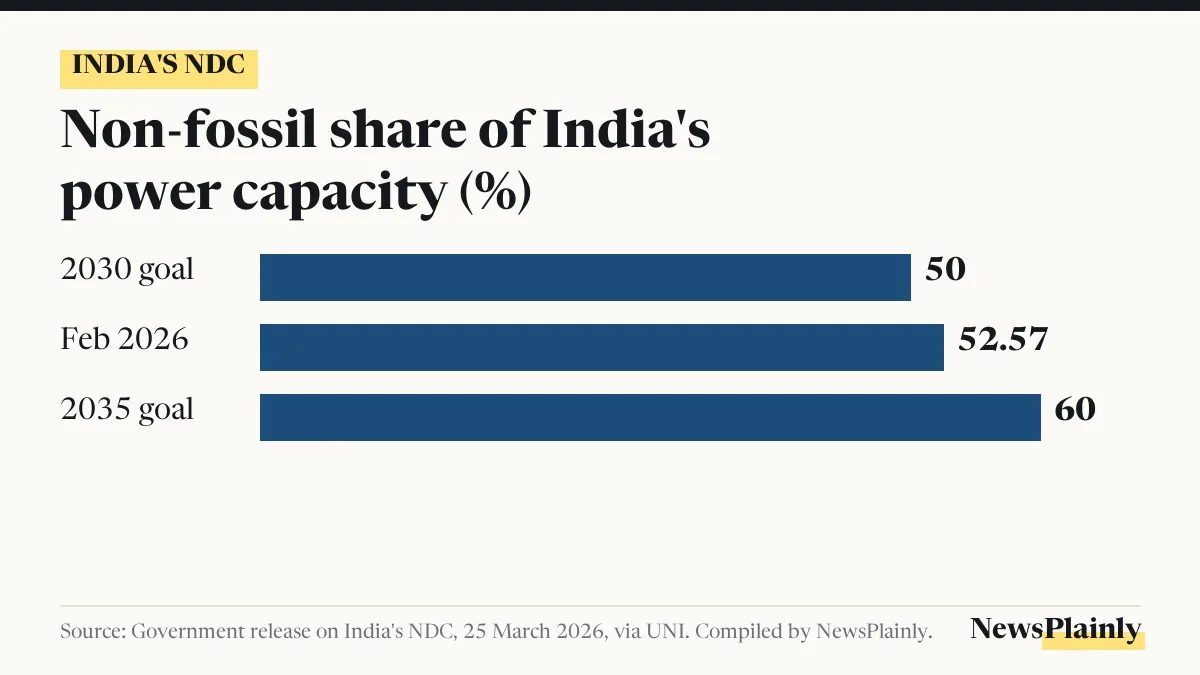
The plan raises all three of India’s number targets from the 2030 round. The government’s release on the Cabinet decision, carried by the news agency UNI (United News of India), also gave its own figures for progress so far.
| India’s target | By 2030 | By 2035 | Progress, per the government |
|---|---|---|---|
| Cut in emissions intensity of GDP, from 2005 | 45% | 47% | 36% by 2020 |
| Non-fossil share of power capacity | 50% | 60% | 52.57% in February 2026 |
| Extra carbon sink from forest and tree cover | 2.5 to 3 billion tonnes CO2e | 3.5 to 4 billion tonnes CO2e | 2.29 billion tonnes by 2021 |
Emissions intensity is the amount of greenhouse gas released for each rupee of GDP, so it can fall even while total emissions rise. On the government’s own numbers, NewsPlainly’s calculation of the distance left is 11 percentage points on intensity (47 minus 36, measured to 2020), 7.43 points on clean power capacity (60 minus 52.57) and 1.21 to 1.71 billion tonnes on the carbon sink (3.5 to 4 minus 2.29, measured to 2021). The progress figures are from different years, so they show distance, not pace.
The emissions gap report noted that India’s 2035 target is the only one among G20 members with such targets that is not expected to bring emissions below the 2030 target level, and that India could meet it without cutting total emissions, The New Indian Express reported. The same report stressed that emissions per person in India remain far lower than in most other big emitters, the paper said. India is also one of six G20 members UNEP assessed as likely to meet their unconditional 2030 targets on current policies.
India’s conditions on climate finance before COP31
India’s NDC says its targets depend on developing countries getting enough money and technology, and that they may be changed to match the support that arrives, Hindustan Times reported in April. The document blames a “mitigation ambition gap” on developed countries that have not met their obligations, and cites estimates that developing countries need $5.012 trillion to $6.852 trillion by 2030 to carry out their plans, the paper said.
Money is also in the UN’s own package. One of the finance reports released alongside the climate pledges tally found that global climate finance rose 32% to an average of $1.9 trillion a year in 2023 and 2024, while gaps remained in reaching developing countries and in funding adaptation, the UN said.
India has set a net zero target of 2070. Stiell said COP31 could help close some of the gaps in this year’s reports, through negotiated outcomes on emission cuts, adaptation, climate finance and a just transition. UN Climate Change also plans to publish its Yearbook of Global Climate Action 2026 at the start of COP31.
Frequently asked questions
How much will climate pledges cut emissions by 2035?
About 6% below 2019 levels if current pledges are met, and about 9% if every pledge is carried out in full, including conditional parts, according to the UNFCCC's 2026 NDC Synthesis Report.
What is an NDC?
A Nationally Determined Contribution is the climate plan each country files under the 2015 Paris Agreement, setting its own targets. Each new round is meant to go further than the last.
What is India's climate target for 2035?
A 47% cut in emissions intensity of GDP from 2005 levels, 60% of power capacity from non-fossil sources, and an extra carbon sink of 3.5 to 4 billion tonnes CO2e through forest and tree cover.
Why do the UNEP and UNFCCC figures differ?
They use different starting years (2025 for UNEP, 2019 for the UNFCCC synthesis) and different methods, so their percentages cannot be compared directly.