Representative image. Chanduclicks, CC BY-SA 4.0, Wikimedia Commons

Why it matters
E20 is what most petrol pumps now sell, so the row touches every petrol car and two-wheeler owner. Puri's remarks mean the 20% level is not set to rise for now, and the new E100 rules apply only to flex-fuel vehicles. Owners of older vehicles still face the trade-off the government itself describes: a mileage loss of about 3 to 5% for some older models.
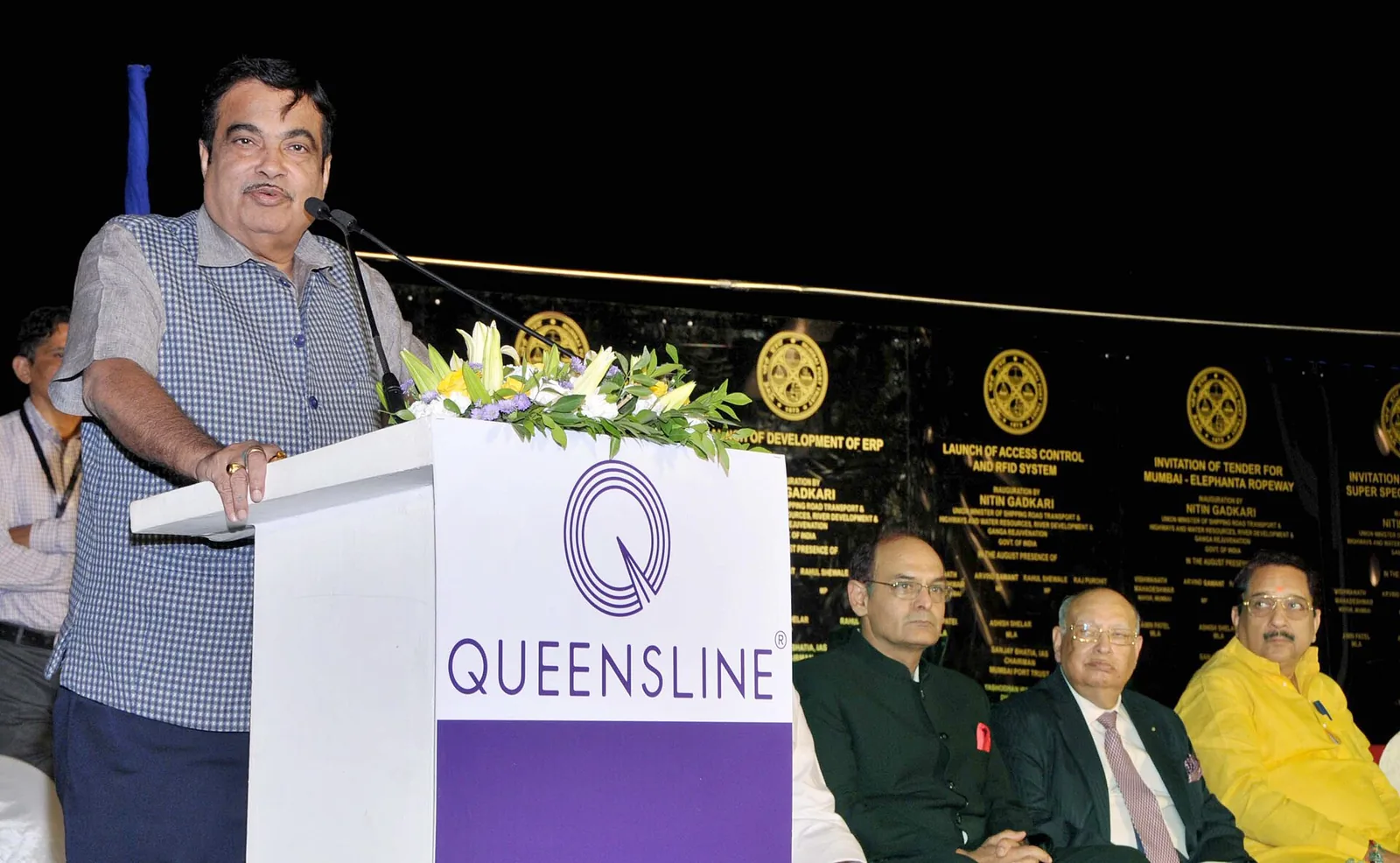
Union Road Transport Minister Nitin Gadkari said on 27 October 2026 that the public anger over E20 petrol, the fuel sold with 20% ethanol mixed into it, had been “a paid campaign”. He made the remark at an event of the Confederation of Indian Industry (CII), an industry body, the news agency Press Trust of India (PTI) reported, one day after his ministry notified rules that let flex-fuel vehicles run on blends of up to E100, which is nearly pure ethanol.
On the same day in South Goa, Petroleum Minister Hardeep Singh Puri said the government had no wish “just now” to raise the ethanol blending level above 20%, Fortune India reported. The two remarks together set out where the Centre stands after a summer of protests, petitions and online campaigns over the fuel.
What Gadkari said about the E20 petrol backlash
PTI quoted Gadkari as saying that “huge noise” was made against E20 fuel three months ago, that the rage was now over, and that “It was a paid campaign.” According to PTI, he said more than 20 crore two-wheelers and over 3 crore petrol cars had been running on these blends for three years without verified evidence of widespread engine failure caused by ethanol.
The Indian Express, which reported the speech separately, gave his words in a slightly different form. In its version he put the figure at 4 crore cars and 20 crore two-wheelers since 2022, asked whether anyone’s vehicle had broken down yet, and called the protest “entirely paid propaganda”. The 3 crore car figure in PTI’s report matches the one the petroleum ministry used in its 30 July fact sheet. Neither report says who, in Gadkari’s view, paid for the campaign, and neither quotes him offering evidence for it.
He has argued this before. In a July interview with the Indian Express, quoted by Mint, he accepted that ethanol’s lower energy content can reduce mileage, but called claims of damaged parts part of a “concerted false narrative”. In late July the Bombay High Court allowed him to file a civil suit against Meta, X, Google and other platforms over posts and alleged deepfake videos that linked him and his family to profits from the E20 policy, Hindustan Times reported. That was permission to sue, not a finding on the posts.
What critics of E20 petrol have said
Opposition parties and some consumer groups objected to the E20 petrol rollout mainly because of older vehicles that were not designed for a 20% blend, PTI noted. Hindustan Times, reporting on the row in July, listed the critics’ main points as the risk of damage in older models, lower fuel efficiency and the large amount of water needed to grow crops for ethanol.
Congress spokesperson Kuldeep Singh Rathore said in July that the policy was being implemented “without adequate scientific validation and at the expense of millions of vehicle owners across the country”, Hindustan Times reported. Aam Aadmi Party (AAP) chief Arvind Kejriwal ran an online petition that he said had more than 2 lakh signatures, planned a “National Town Hall Against E20” in Delhi for 1 August, and said unblended petrol should cost ₹82 a litre and E20 ₹70, according to Hindustan Times and Mint. Delhi taxi and tourist transport groups announced a march to Parliament for 4 August, Hindustan Times reported, quoting PTI.
The Supreme Court has twice turned down petitions on the fuel. It dismissed a public interest petition against compulsory blending in September 2025, and on 31 August 2026 it dismissed a plea asking for every petrol pump nozzle to show the exact ethanol content, leaving the petitioner free to approach the authorities, Hindustan Times reported. The reports of Gadkari’s 27 October speech read for this article, by PTI and the Indian Express, did not include a response from AAP, the Congress or the transport groups.
How ethanol blending in petrol reached 20%
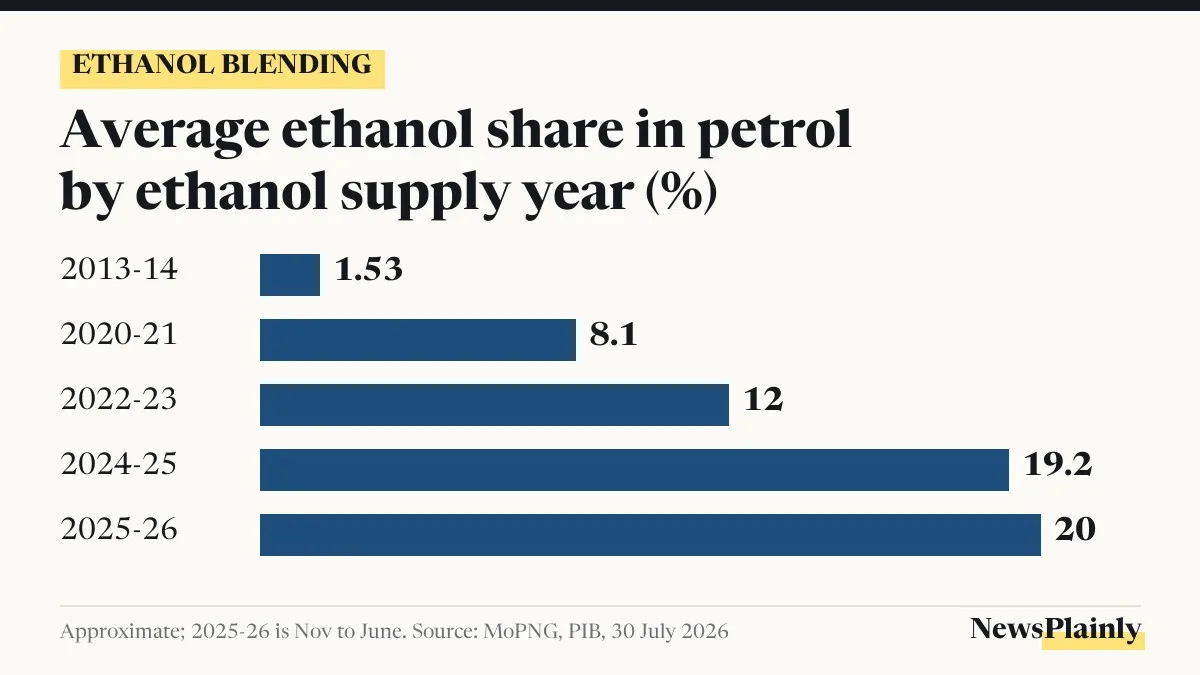
India’s Ethanol Blended Petrol (EBP) Programme started as a pilot in 2001, and E5, petrol with 5% ethanol, came in 2006. For years the level barely moved. The petroleum ministry’s fact sheet of 30 July 2026 gives the average blend for each ethanol supply year, the period used to plan ethanol purchases.
| Ethanol supply year | Average blend in petrol |
|---|---|
| 2013-14 | about 1.53% |
| 2020-21 | about 8.1% |
| 2021-22 | about 10% |
| 2022-23 | about 12% |
| 2023-24 | about 14.6% |
| 2024-25 | about 19.2% |
| 2025-26 (November to June) | 20% |
By NewsPlainly’s calculation from those figures, the blend in 2025-26 is about 13 times the 2013-14 level (20 divided by 1.53). Most of the rise came in the last five years: the blend more than doubled between 2020-21 and 2024-25. Since 2023, every new petrol vehicle sold has had to be E20-compatible, the Indian Express reported.
What the government says on mileage and older vehicles
Much of the argument over E20 fuel is about two questions: how much mileage drivers lose, and whether older engines suffer. Here is what each side has said on record.
| Issue | What critics say | Government position |
|---|---|---|
| Mileage | Lower fuel efficiency (HT’s summary of critics) | Loss for some older E10-designed vehicles generally about 3 to 5%; Maruti Suzuki put it at 3 to 3.5% (PIB fact sheet) |
| Older vehicles | Risk of damage in models not built for E20 (PTI, HT) | Maruti serviced 2.84 crore vehicles in 2025-26, about 1.5 crore not E20-certified, and found no E20-linked corrosion (PIB, citing the company) |
| Testing | Rolled out “without adequate scientific validation” (Congress) | Tested with carmakers, ARAI and oil companies before rollout (PIB) |
| Choice at the pump | Cheaper petrol and continued E10 sales demanded (AAP, protest groups) | Unblended petrol is available at about 50% higher price, Gadkari said in July (HT) |
On 27 October Puri added one qualification of his own. Vehicles made before 2003 could face compatibility problems, he said, according to Fortune India’s report, while vehicles designed and certified for E20 are meant to use it.
Will ethanol blending go beyond 20%?
Not for now, on Puri’s account. “The 20 per cent (of ethanol blending) was the target, and there is no desire, just now, to increase by more than 20 per cent,” he said at the 29th Energy Technology and Innovation Meet, Fortune India reported. BusinessLine’s report, as carried by ChiniMandi, gave the same message. He said the programme had saved ₹1.6 lakh crore, of which ₹1.4 lakh crore went to farmers, and described the criticism as a “contrived narrative”.
The E100 rules notified on 26 October do not change this for ordinary drivers. As NewsPlainly explained in its report on the E100 flex fuel rules, E85 and E100 are meant only for vehicles built as flex-fuel models, and petrol or E20 cars cannot use them. Pumps keep selling E20 petrol, and Puri said ethanol blending is not set to go higher for now.
Frequently asked questions
What did Nitin Gadkari say about E20 petrol?
At a CII event on 27 October 2026 he called the anger over E20 fuel "a paid campaign" and said crores of vehicles have used the blend without verified widespread engine failure, PTI reported.
Will ethanol blending go above 20%?
Not for now. Petroleum Minister Hardeep Singh Puri said on 27 October there is "no desire, just now" to raise it above 20%, Fortune India reported.
Does E20 petrol reduce mileage?
The petroleum ministry's 30 July 2026 fact sheet says the loss for some older E10-designed vehicles is generally about 3 to 5%; Maruti Suzuki put it at 3 to 3.5%.
Can I use E100 in my petrol car?
No. Under the rules notified on 26 October, E85 and E100 are only for vehicles built as flex-fuel models; ordinary petrol and E20 cars cannot use them.