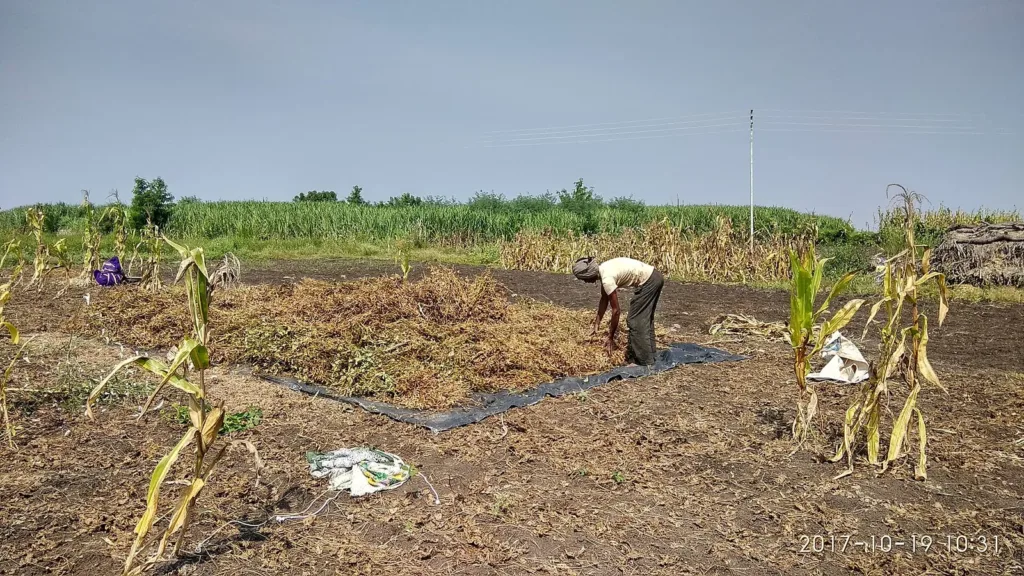
Representative image. Valisport24, CC BY-SA 4.0, Wikimedia Commons

Why it matters
Drought has been declared in 304 of Maharashtra's 358 talukas, and this advance is the cash the state is sending ahead of the final damage assessment. The advance is flat, so it covers far less per hectare for larger farms, and the bigger compensation still depends on the state's survey and help from the Centre.
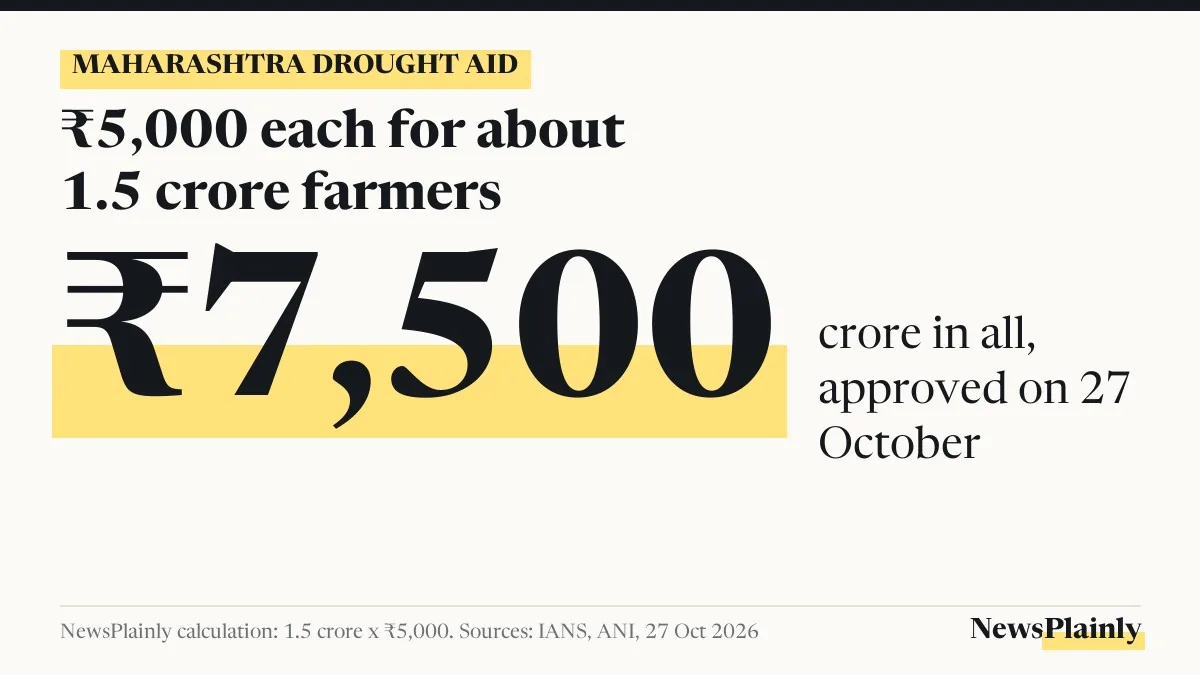
The Maharashtra Cabinet on 27 October 2026 formally approved a ₹5,000 advance for each farmer hit by the drought, a Maharashtra drought aid payout expected to cost the state about ₹7,500 crore and reach nearly 1.5 crore farmers. The money goes straight into bank accounts, and the government wants it there before Diwali, according to reports by the news agencies IANS (Indo-Asian News Service) and ANI (Asian News International).
The advance is meant for farmers whose crops suffered more than 33% damage in the 304 talukas under drought, National Herald reported, citing a statement from the Chief Minister’s Secretariat. Chief Minister Devendra Fadnavis also told officials to make sure banks do not deduct anything from the payment, ANI reported.
Who gets the Maharashtra drought aid
The Maharashtra Cabinet decision, as reported, sets two conditions for the drought advance. The farmer’s land must be in one of the drought-declared talukas, and the crop loss there must be above 33%. IANS reported that the advance will go to all such farmers across the board.
Payment is by direct benefit transfer (DBT), the system that sends government money straight to a beneficiary’s bank account. National Herald reported, citing unnamed sources, that Fadnavis wanted the transfers finished within the week.
What is still missing is the fine print. The Free Press Journal reported that a detailed eligibility list for this advance had not been announced separately and that no dedicated application portal had been confirmed. The state’s Directorate General of Information and Public Relations (DGIPR) had not posted the 27 October Cabinet decisions on its Mahasamvad website when NewsPlainly checked at 6.12 pm IST, so this article relies on the agency reports and the statement quoted by National Herald.
Deputy Chief Minister Eknath Shinde said the drought advance comes on top of the regular drought relief concessions. “After a drought was declared, 12 kinds of benefits provided to them will certainly be provided to farmers,” he said, according to ANI, listing fee waivers, water supply, loan restructuring and easier loan recovery. He said a provision of ₹7,500 crore had been made.
How far a ₹5,000 drought advance goes
The ₹5,000 is an advance, not the final compensation. IANS reported that it is part of a proposed relief package that will be announced once the damage in the 304 talukas has been assessed. Fadnavis has said as much himself. “I understand farmers’ hardships, and Rs 5,000 cannot compensate for their losses, but it will offer some relief,” he told reporters in Wardha, ANI reported.
Critics have pointed to the same gap. When the drought advance was first announced in mid-October, Ajit Navale of the All India Kisan Sabha said it only added to the farmers’ pain, and NCP (SP) leader Anil Deshmukh asked for ₹1 lakh a hectare for up to three hectares, The New Indian Express reported on 14 October.
The table puts the flat advance next to that demand for three farm sizes. It is NewsPlainly’s calculation and a hypothetical illustration, not an estimate of what any farmer will finally receive.
| Crop land | Advance approved | Advance per hectare | Deshmukh’s demand |
|---|---|---|---|
| 1 hectare | ₹5,000 | ₹5,000 | ₹1,00,000 |
| 2 hectares | ₹5,000 | ₹2,500 | ₹2,00,000 |
| 3 hectares | ₹5,000 | ₹1,667 | ₹3,00,000 |
Because the drought advance is flat, it is worth more per hectare to a small farmer than to a larger one. That is the point Fadnavis made in Wardha: he said farmers with small plots used to get barely ₹1,000 earlier and will now get at least ₹5,000, with the rest paid later, according to ANI. He also said neighbouring Karnataka had paid ₹2,500 in its drought. Both are his comparisons; the reports did not give figures to check them against.
The total adds up. At ₹5,000 for each of 1.5 crore farmers, the bill comes to ₹7,500 crore, the figure in the official statement.
How the Maharashtra drought list grew to 304 talukas
The government first declared drought in 265 talukas in late September. In mid-October it added 40 more, and Fadnavis told reporters the total was 305 of the state’s 358 talukas, according to a Press Trust of India report carried by BusinessLine. The 27 October statement and a DGIPR release of 26 October from Soil and Water Conservation Minister Sanjay Rathod both use 304. The sources read do not explain the difference of one taluka.
- 22 September: the Cabinet set up a sub-committee on the drought under Revenue Minister Chandrashekhar Bawankule, and crop-loss surveys were ordered to start the next day, a DGIPR release said. Soybean, maize and cotton were the worst hit.
- Late September: drought declared in 265 talukas.
- Mid-October: after a Cabinet meeting, Fadnavis announced the ₹5,000 advance before Diwali (IANS dates the meeting to 13 October), and 40 talukas were added to the list.
- 26 October: the All India Kisan Sabha’s march to Mumbai set off from Akole, demanding more relief.
- 27 October: the Cabinet gave formal approval to the advance.
The dry spell is uneven. The state-wide monsoon shortfall is about 18%, but Solapur’s deficit is 57%, Beed’s 49%, Hingoli’s 48%, Jalna’s 46% and Dharashiv’s 45%, according to state figures cited by ANI.
The drought advance is one part of a wider response. Fadnavis said in October that water tables in Marathwada had dropped by three metres, that water tankers would be tracked by satellite location (GPS) and that nearly 16,000 illegal water connections had been cut, according to PTI and The New Indian Express. The government has told banks and microfinance lenders not to force recovery of loans or electricity bills, and it plans to buy fodder directly, IANS reported. A list of 3.5 lakh more farmers has been finalised for the loan waiver scheme, the agency said.
What farmers still wait for after the Maharashtra Cabinet decision
The bigger drought relief payment depends on two things. One is the state’s own damage assessment, which will decide the final relief package. The other is help from the Centre. Fadnavis said in October that central relief procedures could not be completed before Diwali, which is why the state stepped in with its own money, PTI reported. He said help from the Centre would be passed on when it arrives.
The farmers on the road to Mumbai want more than the advance. Their demands, from a wider loan waiver to quicker crop insurance payments, are set out in NewsPlainly’s report on the Kisan Sabha’s long march. The reports read for this article did not say whether the 27 October Cabinet decision changed anything for the marchers.
Until a beneficiary list is published, a farmer who expects the money but does not get it has no named channel in the reports read other than the local revenue office. FPJ advised farmers to check with their talathi (village revenue officer) or tehsil office and to avoid unofficial links or agents. The National Herald report carries the Chief Minister’s Secretariat’s account of the decision.
Frequently asked questions
Who will get the ₹5,000 drought advance in Maharashtra?
Farmers whose crops suffered more than 33% damage in the 304 drought-declared talukas, about 1.5 crore people, according to the Chief Minister's Secretariat statement reported by National Herald.
When will the ₹5,000 reach farmers' bank accounts?
The government says before Diwali. National Herald reported, citing sources, that the Chief Minister wanted the transfers completed within the week of 27 October.
Is ₹5,000 the full drought compensation?
No. It is an advance. IANS reported it is part of a relief package to be announced after the crop damage is assessed.
Do farmers need to apply for the drought advance?
The reports read did not mention an application. FPJ reported that no dedicated portal had been confirmed and advised farmers to check with the talathi or tehsil office.