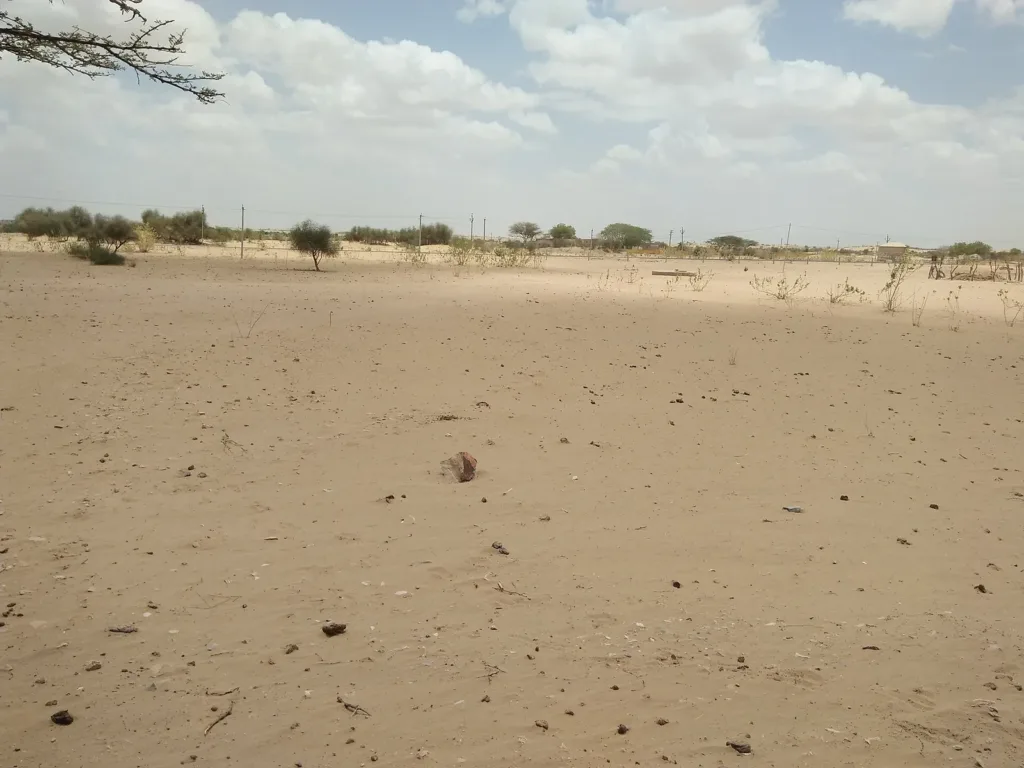
Representative image. Vishnaram, CC BY-SA 4.0, Wikimedia Commons

Why it matters
A drought notification is what lets district officials start relief work, open fodder depots and arrange water in the notified tehsils. It covers large parts of western Rajasthan, where farmers and herders depend on rain-fed crops and livestock. With dam storage far below last year, water for drinking and for the rabi crop could also be tight in the coming months.
The Rajasthan drought has now been formally recognised in 80 tehsils across 14 districts, most of them in the dry west of the state. Two notifications from the state’s Disaster Management, Relief and Civil Defence Department, dated 24 and 25 October 2026, put 69 of these tehsils in the “severe” category and 11 in the “moderate” one, Hindustan Times reported on 26 October.
The declarations stay in force for six months from the date they were published. Jodhpur has the most drought-affected tehsils, 12, followed by Barmer and Jalore with 10 each.
How the 80 tehsils were added in two rounds
The first notification listed 53 drought-affected tehsils in 13 districts. Dainik Bhaskar’s English site, reporting from Jalore, said the state issued it on Sunday, 25 October, and listed districts from Jodhpur and Barmer in the west to Banswara and Dungarpur in the south. A second notification then added 27 more tehsils across 10 districts, Hindustan Times said. Bikaner entered the list only in this second round, which took the total to 14 districts. Of the 27 new tehsils, 25 were rated severe and two moderate.
The 14 districts are Banswara, Barmer, Balotra, Beawar, Bikaner, Churu, Dungarpur, Jaisalmer, Jalore, Jodhpur, Nagaur, Pali, Phalodi and Sirohi. Balotra, Beawar and Phalodi are among the newer districts Rajasthan created in 2023, carved out of older ones such as Barmer and Jodhpur.
According to the notifications, as reported, officials looked at four things before deciding: the rainfall deficit, how much surface water and groundwater was left, the state of standing crops, and readings from the Centre’s Drought Monitoring Portal. The process followed the Centre’s Drought Management Manual of 2016, which sets out how states assess and declare drought.
Which districts the Rajasthan drought hits hardest
Almost nine in every ten drought-affected tehsils sit in the severe band (69 of 80). Every listed tehsil in Barmer, Jalore, Balotra and Pali is rated severe. Jodhpur has 11 severe tehsils, including Osian, Shergarh, Balesar and Luni, with Pipar Shahar the only moderate one. In Jaisalmer, Pokaran, Ramgarh and Mohangarh are among six severe tehsils, while Jaisalmer tehsil itself is moderate.
The southern tribal belt is split. Dungarpur has four severe tehsils (Aspur, Galiyakot, Jhauthri and Sabla) and three moderate ones. Banswara has two severe and one moderate. At the other end of the list, Bikaner, Nagaur and the two Beawar tehsils, Raipur and Jaitaran, are rated moderate only.
| District | Severe | Moderate | Total tehsils |
|---|---|---|---|
| Jodhpur | 11 | 1 | 12 |
| Barmer | 10 | 0 | 10 |
| Jalore | 10 | 0 | 10 |
| Balotra | 9 | 0 | 9 |
| Pali | 8 | 0 | 8 |
| Jaisalmer | 6 | 1 | 7 |
| Phalodi | 6 | 1 | 7 |
| Dungarpur | 4 | 3 | 7 |
| Banswara | 2 | 1 | 3 |
| Churu | 2 | 0 | 2 |
| Beawar | 0 | 2 | 2 |
| Sirohi | 1 | 0 | 1 |
| Nagaur | 0 | 1 | 1 |
| Bikaner | 0 | 1 | 1 |
| Total | 69 | 11 | 80 |
Rainfall deficit and low dams behind the Rajasthan drought
The Water Resources Department’s report dated 30 September put Rajasthan’s monsoon rainfall from 1 June to 30 September at 350.83 mm, against a normal of 424.71 mm, Hindustan Times reported. That is a gap of 73.88 mm. By NewsPlainly’s calculation, that rainfall deficit works out to about 17.4% below normal over the four months.
The same report rated 14 of the state’s 41 districts rainfall-deficient, 24 normal and three excess. Balotra, Banswara, Dungarpur, Jaisalmer, Jalore, Jodhpur, Pali and Sirohi were among the deficient ones, and all eight have drought-affected tehsils on the new list.
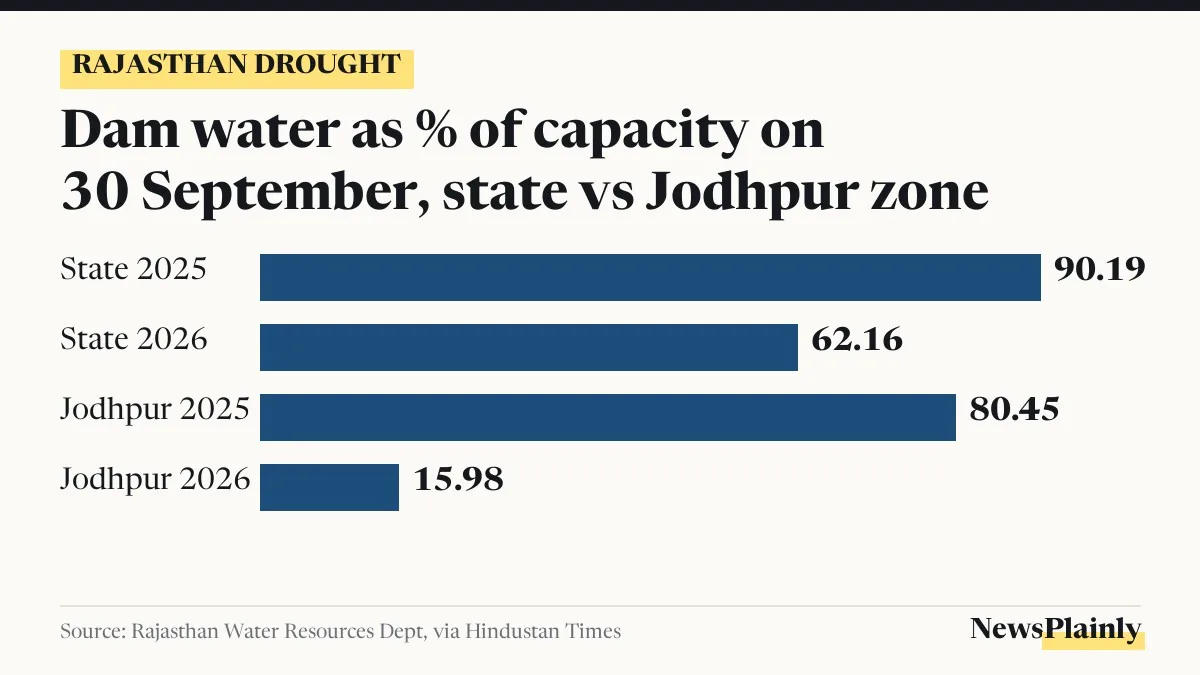
Reservoirs tell a sharper story. On 30 September the 693 dams the department monitors held 62.16% of their combined capacity, against 90.19% on the same date a year earlier. In the department’s Jodhpur zone, storage was 15.98%, down from 80.45%. That is a fall of about 28 percentage points for the state and about 64 points for the Jodhpur zone, NewsPlainly’s calculation from the reported figures shows.
The Rajasthan drought did not arrive without warning. On 2 October, the Free Press Journal reported that Chief Minister Bhajan Lal Sharma had extended tanker drinking water supply in Barmer and Jaisalmer until 31 December 2026, let district collectors approve contingency relief works of up to ₹1 crore, and announced fodder depots in areas such as Barmer, Balotra and Jaisalmer. The same report said the Revenue Department would assess 117 tehsils through girdawari, the field survey of crops. Former chief minister Ashok Gehlot of the Congress urged the government to begin relief measures at once, the same report said. Rajasthan is not alone: Telangana has listed 358 mandals as drought-hit this season.
What a drought notification means for farmers and livestock
A formal declaration lets the district administration start relief work in the notified areas, arrange fodder and water for animals and take other administrative steps, Dainik Bhaskar reported. Jogeshwar Garg, chief whip in the Legislative Assembly, said the state would open fodder depots for livestock in the affected tehsils and provide all possible help, according to the same report.
The kharif crop, sown with the monsoon in June and July, is the one the notifications say was damaged.
What farmers will actually receive is not settled yet. Bhaskar’s report said detailed guidelines on the affected villages in each tehsil and on the relief to be given would be issued later. Neither report gave a relief amount per hectare or a date for payments.
What happens next in the drought-affected tehsils
The notifications remain valid for six months from publication, which by NewsPlainly’s count runs to late April 2027. The list of affected villages in each tehsil and the relief rules are to follow in separate guidelines, Dainik Bhaskar reported. Tanker water supply in Barmer and Jaisalmer was already extended to 31 December under the chief minister’s October order.
The rainfall deficit and low dam levels also matter for the coming rabi season, sown from late October and grown on stored water and soil moisture. The Free Press Journal report warned that lower soil moisture and reservoir storage could affect irrigation for the early rabi crop.
Frequently asked questions
Which districts in Rajasthan are drought-affected?
Banswara, Barmer, Balotra, Beawar, Bikaner, Churu, Dungarpur, Jaisalmer, Jalore, Jodhpur, Nagaur, Pali, Phalodi and Sirohi, covering 80 tehsils.
How long will the drought declaration last?
Six months from the date each notification was published, according to the notifications as reported.
How much less rain did Rajasthan get this monsoon?
350.83 mm against a normal of 424.71 mm from 1 June to 30 September, per the Water Resources Department. That is about 17.4% short by NewsPlainly's calculation.
What relief will farmers get?
Fodder depots and relief work are planned in the affected tehsils. Detailed guidelines on villages and relief had not been issued when Dainik Bhaskar reported the decision.