Representative image. Prime Minister's Office, GODL-India, Wikimedia Commons

Why it matters
A conviction for criminal defamation can carry up to two years in prison, and a two-year sentence in a separate 2023 case cost Gandhi his Lok Sabha seat until the Supreme Court stayed that conviction. This acquittal ends the risk in the Sultanpur case unless the complainant gets the High Court's leave to appeal and wins.
A special court in Sultanpur, Uttar Pradesh, acquitted Leader of the Opposition Rahul Gandhi on Monday, 26 October 2026, in a 2018 Rahul Gandhi defamation case over his remarks about Amit Shah, who was BJP president at the time and is now Union Home Minister. Judge Shubham Verma of the special MP-MLA court, which hears cases against sitting and former lawmakers, pronounced the verdict with Gandhi present in the courtroom, LiveLaw reported.
BJP leader Vijay Mishra filed the complaint on 4 August 2018. The verdict came a little over eight years later.
What the Sultanpur court decided
The Sultanpur court found that Gandhi’s remarks were not defamatory, according to Bar and Bench, a legal news site. The written judgment was not available in the material NewsPlainly checked, so the court’s full reasoning is not yet known.
The case was a criminal defamation complaint under Sections 499 and 500 of the Indian Penal Code (IPC). Section 499 defines defamation, and Section 500 sets the punishment: simple imprisonment of up to two years, a fine, or both. A conviction would have carried that risk. The acquittal removes it in this case.
The Uttar Pradesh Congress’s media department chairman, Kunwar Singh Nishad, told the Press Trust of India (PTI) news agency that the judge had dismissed the case and given Gandhi relief. The Congress party posted “Truth alone triumphs” on X after the verdict, India Today reported. The reports read for this article did not carry a response from the complainant or his lawyer after the verdict.
The 2018 Amit Shah remark at the centre of the case
The complainant, Vijay Mishra, is a local BJP leader from Sultanpur and a former chairman of the Sultanpur District Cooperative Bank. He objected to what Gandhi said in Bengaluru during the 2018 Karnataka Assembly election campaign.
According to the complaint, as quoted by LiveLaw and Bar and Bench, Gandhi said people in India forget that “the president of BJP is a murder accused” and that a party talking about honesty had such a person as its president.
The reference was to the Sohrabuddin Sheikh case, an alleged fake encounter in Gujarat in 2005. A special CBI court had discharged Amit Shah in that case in 2014, about four years before Gandhi’s remark, Bar and Bench reported. Vijay Mishra argued that calling Shah a “murder accused” after the discharge harmed his reputation.
How both sides argued the Rahul Gandhi defamation case
During the final hearings, Gandhi’s lawyers accepted that he made the remarks, India Today reported. They argued that he spoke in good faith, without any intention to insult anyone, and that his words had been taken out of context. His counsel Kashi Prasad Shukla had called the complaint baseless and asked for it to be dismissed, the Indian Express reported. Senior Advocate R.S. Cheema also appeared for him, according to Bar and Bench.
The complainant’s lawyer asked the court to convict Gandhi. He argued that the admission that the words were spoken was enough to hold him guilty, India Today reported.
That gap between the two sides is the heart of most defamation trials. Saying something about a person is not, by itself, defamation under Section 499. The law lists exceptions, including statements of truth made for the public good and opinions expressed in good faith on public conduct. Which exception, if any, the court relied on will only be clear from the judgment.
Eight years at the Sultanpur court: a timeline
The case moved slowly, with long gaps and several side disputes. Vijay Mishra also tried to have Gandhi’s voice compared with a recording of the Bengaluru remarks. The trial court rejected that request, the sessions court dismissed his revision petition, and the Allahabad High Court later turned down his challenge to both orders, PTI reported.
| Date | What happened |
|---|---|
| May 2018 | Gandhi’s remarks about Amit Shah in Bengaluru during the Karnataka campaign |
| 4 August 2018 | Vijay Mishra files the defamation complaint in Sultanpur |
| 20 February 2024 | Gandhi surrenders before the court and gets bail on two bonds of ₹25,000 each |
| 26 July 2024 | Gandhi’s statement is recorded |
| Undated in reports | Voice-sample plea rejected by trial court, sessions court and Allahabad High Court |
| 6 to 12 October 2026 | Final arguments |
| 13 October 2026 | First date fixed for the verdict; moved to 26 October |
| 26 October 2026 | Gandhi acquitted |
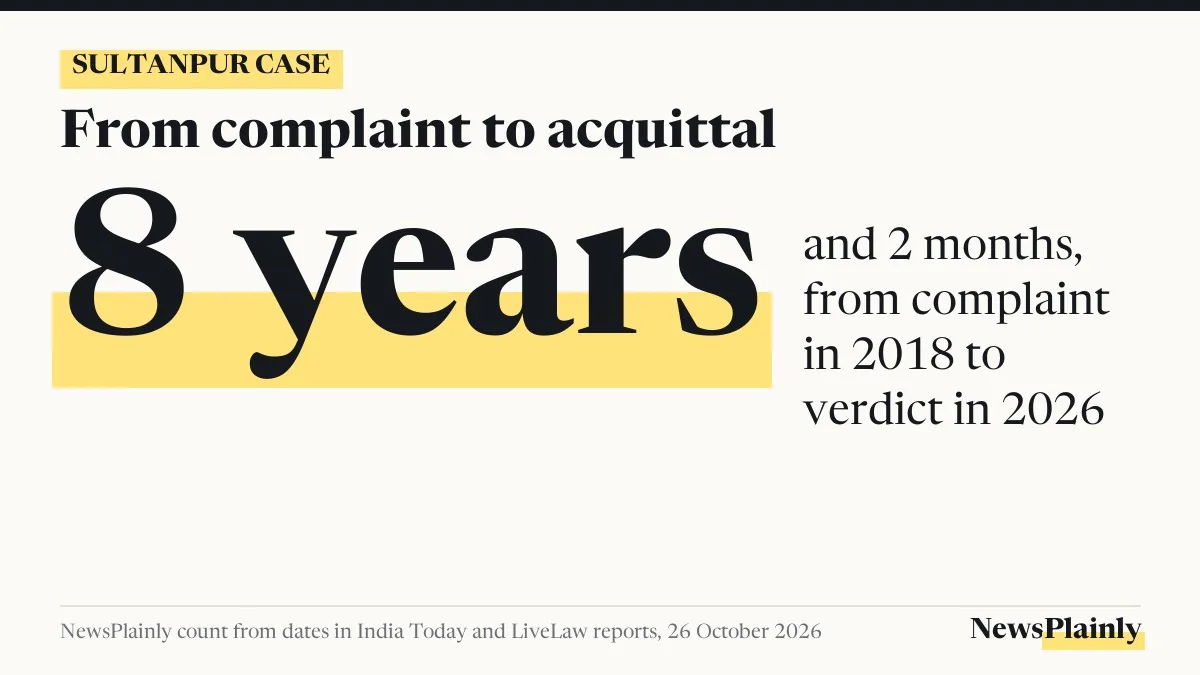
By NewsPlainly’s count, the case ran for 8 years, 2 months and 22 days from the complaint to the verdict. Of that, more than five and a half years passed before Gandhi surrendered before the court and took bail. Some PTI copies on Monday dated his bail to 2023; India Today and a Madhyamam report published on the day put it at 20 February 2024, and this article uses that date.
On his way to court on Monday, vehicles in Gandhi’s convoy collided on the Purvanchal Expressway at about 10.15 am. A police officer told PTI that Gandhi was safe and that no major injuries were reported.
How this compares with the Surat case
This is not the first defamation case against Gandhi to reach a verdict. In 2023, a court in Surat, Gujarat, convicted him over his 2019 remark linking the Modi surname to fugitives such as Nirav Modi and Lalit Modi, and sentenced him to two years in prison. He was disqualified from the Lok Sabha as MP for Wayanad. The Supreme Court later stayed the conviction, which let him continue as a lawmaker, Bar and Bench noted.
The two cases ended differently in the trial courts. In Surat, the court gave the full two-year term that Section 500 allows. In Sultanpur, the trial court found that the Amit Shah remark was not defamation at all.
The verdict came on the same day the BJP had called nationwide protests over Congress president Mallikarjun Kharge’s remark about Prime Minister Narendra Modi, a row NewsPlainly covered here.
Can the acquittal be challenged?
India’s criminal procedure law lets a complainant in a private complaint case ask the High Court for special leave to appeal against an acquittal. Whether Vijay Mishra will do so was not stated in the reports read. If he does, the Allahabad High Court would first decide whether to hear the appeal at all.
The full judgment, once available, should show why the court found the words not defamatory, and whether it relied on Shah’s 2014 discharge, on good faith, or on another ground.
Frequently asked questions
Why was Rahul Gandhi acquitted in the Sultanpur defamation case?
The court found his 2018 remarks about Amit Shah were not defamatory, Bar and Bench reported. The full judgment with the court's reasons was not available on 26 October 2026.
What did Rahul Gandhi say about Amit Shah in 2018?
In Bengaluru during the Karnataka campaign, he called Shah, then BJP president, a murder accused, referring to the Sohrabuddin Sheikh case in which a special CBI court had discharged Shah in 2014.
Who filed the defamation case against Rahul Gandhi in Sultanpur?
Local BJP leader Vijay Mishra, a former chairman of the Sultanpur District Cooperative Bank, filed it on 4 August 2018.
Is this the same as the Modi surname case?
No. That case was heard in Surat, Gujarat, where Gandhi was convicted in 2023; the Supreme Court later stayed the conviction.