Representative image. Election Commission of India, GODL-India, Wikimedia Commons

Why it matters
SIR decides whose names stay on the electoral rolls, so the way errors are flagged matters to voters in the states under revision. The reply leaves the tool's name and any automated flagging undisclosed for now. The RTI Act's appeal route, with its 30 and 90 day limits, is how that decision could be tested.
The Election Commission of India (EC) has refused to name the SIR software it used to spot errors in voter rolls, telling a Right to Information (RTI) applicant that the details are covered by an exemption for trade secrets and commercial confidence. SIR is the Special Intensive Revision, the commission’s intensive recheck of electoral rolls. The reply is dated 16 October 2026 and was first reported by Hindustan Times on 25 October; The Times of India carried its own account on 26 October.
The answer has drawn sharp criticism from opposition leaders, while the commission’s position, as quoted in the reports, is that no new software was built or bought for the exercise and that officials, not a program, decide who stays on the voter rolls.
What the RTI application asked about the SIR software
The application was filed by M.A. Mujeeb Ayyub, a social activist from Telangana, and is dated 27 July 2026, according to The Times of India. Hindustan Times, which saw the reply, listed five things he wanted to know:
- the name and version of any software, app or artificial intelligence (AI) platform used to detect errors in voter rolls;
- whether that system flags records automatically for checking, correction or deletion, and what happens next;
- whether AI, machine learning or other automated decision tools were used at any stage;
- what safeguards exist against genuine voters being wrongly flagged;
- which authority reviews flagged entries before a voter’s record is changed.
On the first question, both newspapers reported, the commission cited Section 8(1)(d) of the RTI Act, the clause on commercial confidence, trade secrets and intellectual property. It also said no new software had been developed or procured for SIR, and that electoral registration officers (ERO), the officials in charge of each constituency’s roll, decide on adding or removing an elector based on facts and records.
The questions on automatic flagging, AI use and safeguards were treated as requests for “clarification” rather than information under Section 2(f) of the Act, the reports said. On who reviews flagged entries, Hindustan Times reported that the commission cited Section 8(1)(g) and pointed to Section 13B of the Representation of the People Act, 1950, which makes the ERO the statutory authority for preparing and revising a constituency’s roll.
What the RTI Act sections cited by the Election Commission say
Coverage has summed up the reply as a trade secrets refusal, but the exemptions the commission used are narrower and carry conditions. NewsPlainly read the text of the Right to Information Act, 2005, published by the Central Information Commission, against each answer as reported.
| Question (as listed by HT) | EC’s answer (as reported) | What the provision says |
|---|---|---|
| Name and version of the software | Withheld under Section 8(1)(d) | Exempts commercial confidence, trade secrets or intellectual property whose disclosure would harm a third party’s competitive position, unless the competent authority finds a larger public interest in disclosure |
| Automatic flagging and workflow | Called a “clarification”, not information under Section 2(f) | Section 2(f) defines information as material held in any form, including records, emails, reports and electronic data |
| Use of AI or machine learning | Same as above | Same definition |
| Safeguards against wrong flagging | Same as above | Same definition |
| Who reviews flagged entries | Section 8(1)(g) cited; ERO named as statutory authority | Exempts information that would endanger a person’s life or safety or reveal a confidential source used for law enforcement or security |
Two points in the law did not feature in most reports. Section 8(1)(d) protects information only where disclosure would hurt the competitive position of a third party; the reports did not say which third party the commission had in mind. And Section 8(2) lets any public authority release exempt information when the public interest in disclosure outweighs the harm to the protected interest.
Election Commission’s view and the opposition’s charge
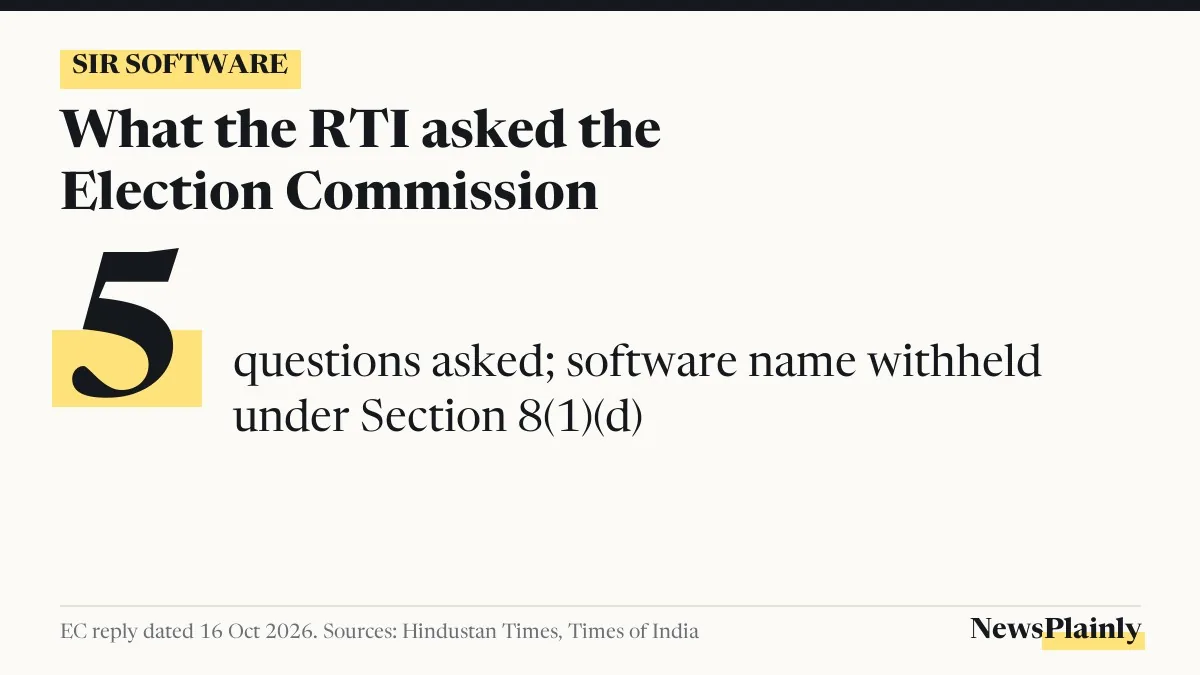
An EC official told The Times of India that software and algorithm details are conventionally not shared in reply to RTI requests. The paper noted that the makers of electronic voting machines (EVM), Bharat Electronics Ltd and Electronics Corporation of India Ltd, have in the past also declined RTI requests for EVM source code.
Congress general secretary Jairam Ramesh said on X that the refusal “reveals the reality of the massive, centralised manipulation that has taken place”, Hindustan Times reported on 26 October, and said Chief Election Commissioner (CEC) Gyanesh Kumar must go and SIR must be suspended. Congress leader Pawan Khera accused the CEC of “blocking transparency”, while Trinamool Congress Rajya Sabha MP Menaka Guruswamy asked what the poll body was hiding.
Hindustan Times said there was no immediate reaction from the commission or the BJP when it filed that report, and added that both have earlier denied any wrongdoing in the roll revision. The allegations of manipulation remain claims; neither report cited evidence of altered entries linked to the software.
Former Chief Election Commissioner O.P. Rawat told Hindustan Times that the right course for the applicant was to file an appeal with the competent authorities. Earlier NewsPlainly coverage of the revision includes how many names were cut from Delhi’s rolls and how few claims followed.
How an appeal against the SIR software reply would work
The Act sets out a two-step route for anyone unhappy with a reply, and the timelines below come from its text.
- First appeal: within 30 days of receiving the decision, to an officer senior to the public information officer in the same authority (Section 19(1)). Late appeals can be admitted for sufficient cause.
- Second appeal: within 90 days of the date the first appeal decision was due or received, to the Central Information Commission, which can also admit a late appeal (Section 19(3)).
The Act also gives a public information officer 30 days from receiving a request to answer it (Section 7(1)). By the dates in the reports, 81 days passed between the application (27 July) and the reply (16 October), a NewsPlainly count. The reports did not say when the commission received the request or whether it was transferred between offices, both of which affect how that deadline is counted.
Neither newspaper reported whether Ayyub has filed or plans to file an appeal.
Frequently asked questions
Why did the Election Commission refuse to name the SIR software?
According to Hindustan Times and The Times of India, it cited Section 8(1)(d) of the RTI Act, which exempts commercial confidence, trade secrets and intellectual property when disclosure would harm a third party's competitive position.
Did the EC say it built new software for SIR?
No. The reply, as reported, said no new software was developed or procured for the exercise and that electoral registration officers decide on including or excluding electors.
Can the RTI reply be appealed?
Yes. Section 19(1) of the RTI Act allows a first appeal within 30 days of receiving a decision, and Section 19(3) a second appeal to the Central Information Commission within 90 days.