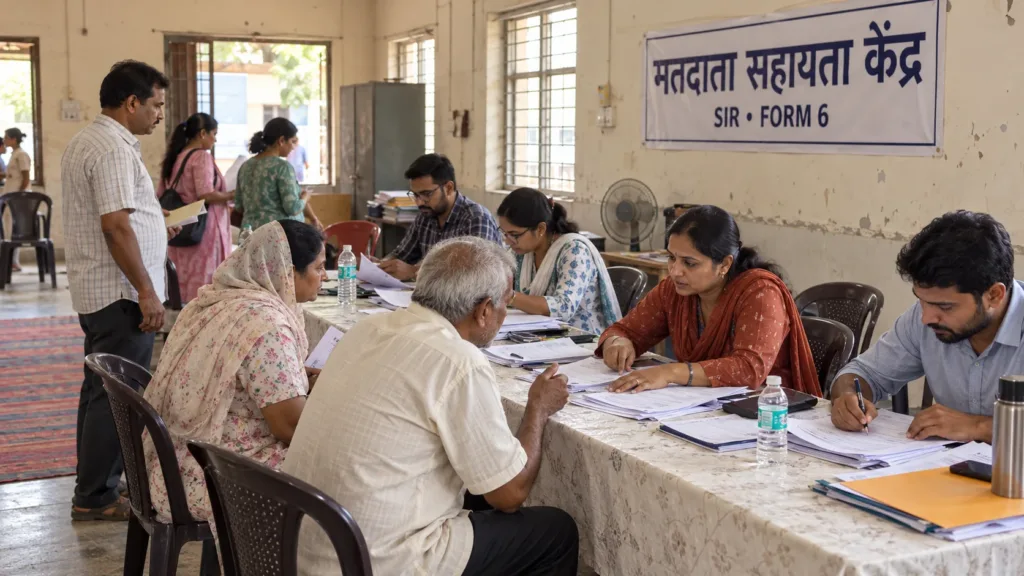
AI-generated illustration, not a photo of a real event.
Why it matters
A name missing from the final roll means that person cannot vote in Delhi until it is restored. With about a week left to file claims, the gap between names removed and applications received shows how many Delhi residents may not yet have checked. The Supreme Court hearing on 28 October could change what the form asks of people who apply.
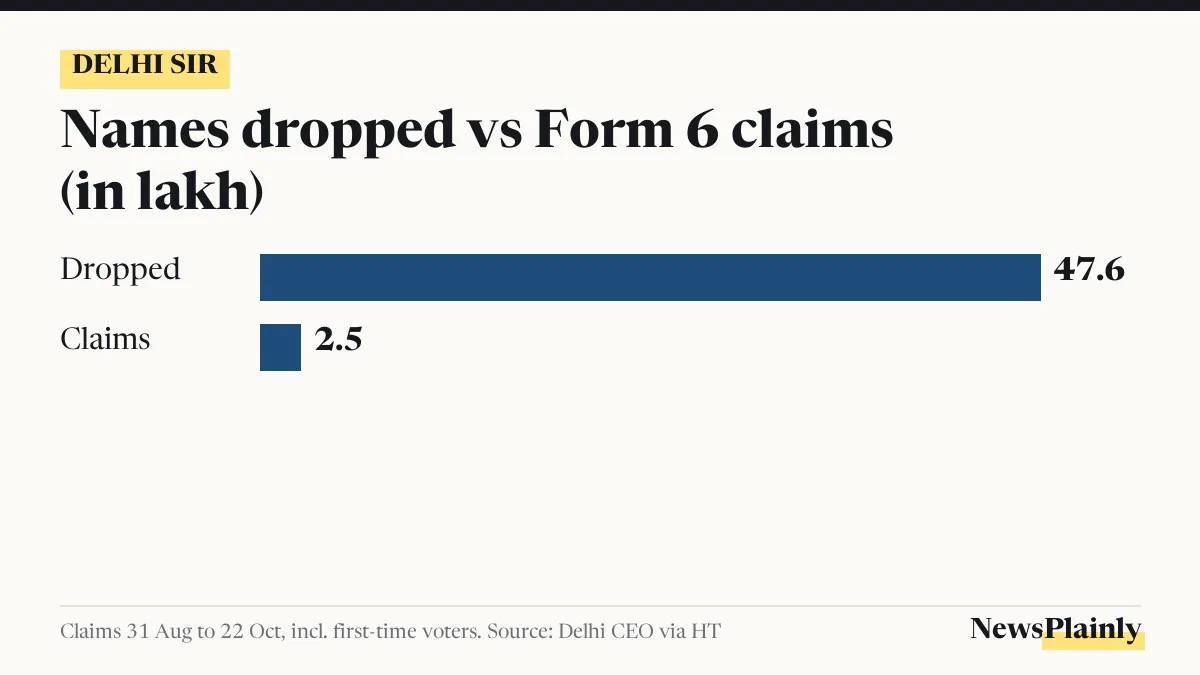
Delhi SIR figures released on Friday, 23 October 2026, show how few of the people dropped from the city’s voter list have asked to be put back. Delhi’s chief electoral officer (CEO) said in data released by the office that 2,50,754 Form 6 applications reached the office between 31 August and 22 October, against about 47.6 lakh names left out of the draft roll. The window for claims closes on 30 October, two days after the Supreme Court takes up petitions against the process.
SIR stands for Special Intensive Revision, the Election Commission’s house-to-house recheck of who is on the electoral roll. In Delhi it began on 30 June, when the roll held about 1.45 crore voters.
How many Delhi voters were dropped and how many applied
The draft roll published on 31 August left out 47,56,722 electors, or 32.78% of the earlier electorate, according to figures cited in the Supreme Court and reported by Outlook. All of them were placed in the ASDD (absent, shifted, dead or duplicate) lists drawn up during the door-to-door count.
Form 6 is the standard application to get a name onto an electoral roll. The Election Commission has asked people removed in the SIR to use the same form to return. The CEO’s office told Hindustan Times that its 2,50,754 count includes first-time voters as well as people seeking reinstatement, so the number of dropped voters who have applied is lower than that figure. Even if every application came from a dropped voter, it would cover only about 1 in 19 of the names removed.
Another 2,12,400 Form 6 applications had arrived before the draft roll came out, the office said.
Where in Delhi the Form 6 claims came from
The west district, which takes in Tilak Nagar, Janakpuri, Rajouri Garden and Vikaspuri, sent the most applications at 30,361. North West Delhi (Kirari, Rohini, Mangolpuri) followed with 25,925, and East Delhi with 24,200. South East, North East, South West and South districts each recorded between 21,000 and 24,200.
New Delhi district, covering the New Delhi and Delhi Cantonment seats, had the fewest at 4,341. The Old Delhi district, which includes Chandni Chowk, Ballimaran, Matia Mahal and Sadar Bazar, had 10,668, and the Central district 10,796. A poll official in New Delhi district told the paper that about a fifth of names there were removed because people living in government quarters, including retired officials, had moved away.
What election officials have done to reach dropped voters
The Election Commission announced special camps across the country to help people get back on the rolls. Delhi held its first on 20 September, and about 89,000 camps have been held since then, according to the CEO’s office. Form 6 applications received from 20 September to 22 October numbered 1,58,470, which means most of the inflow came after the camps began.
Booth-level officers (BLOs), the local staff who keep the roll for each polling booth, are also visiting neighbourhoods to trace people who were on the old list but are missing from the draft, and help eligible residents file Form 6, the office said.
A second group of voters was also under review. About 33 lakh people on the draft roll were flagged, either because they could not be linked to the 2002 roll used as the base for the revision or because of “logical discrepancies” in their forms. The CEO’s office said about 29.5 lakh of those cases have been resolved, and those people will stay on the final roll unless someone files a Form 7, the form used to object to a name or seek its removal.
Why the Delhi voter list case is in the Supreme Court
Right to information (RTI) activist Anjali Bharadwaj and social activist Amrita Johri went to the Supreme Court on 16 September over the exclusion of more than 47 lakh voters, Outlook reported. Advocate Prashant Bhushan later sought an early hearing on a fresh application.
The petitioners object to two parts of the modified Form 6. One asks for “legacy” details linking the applicant to the 2002 electoral roll, which they say was added by executive order without backing in law. The other is a declaration that the applicant is seeking inclusion for the first time. The plea argues that people who were already voters cannot truthfully sign that, and could face penalties under Section 31 of the Representation of the People Act, 1950, which deals with false declarations. It also points to media reports that over 3,200 Form 7 deletion requests were disposed of between 31 August and 4 October, against 569 Form 6 applications.
Chief Justice Surya Kant directed that all petitions on the Delhi SIR be listed together on 28 October, and said the court was thinking of passing an order that would “take care of the situation”, according to Outlook. The court has also said it has not ruled on whether the modified form is valid.
Election officials see the numbers differently. An official who did not want to be named told Hindustan Times that the low count, despite thousands of camps, suggests the ASDD list was drawn up with due process. The Election Commission has not changed its position that Form 6 is the route back to the rolls. On 23 October the dispute also reached the streets, when police stopped a march against the SIR heading to the Election Commission.
Delhi SIR dates: what happens after 30 October
The claims and objections window, during which people can file Form 6 to be added, Form 7 to object and Form 8 to correct details, closes on 30 October. All claims will be decided by 30 November, and the final roll will be published on 4 December, the CEO’s office said.
Anyone unsure whether their name survived the draft can search the roll on the Election Commission’s voter services portal or ask their booth-level officer. A person who finds their name missing and is still eligible can file Form 6 before 30 October, either online or at a camp, with the documents the form asks for. Whether the 2002 link and the declaration remain part of that form could depend on what the Supreme Court decides on 28 October.
Frequently asked questions
What is the last date to file Form 6 in the Delhi SIR?
The claims and objections window closes on 30 October 2026. Form 6 can be filed online or at a special camp.
When will Delhi's final voter list come out?
The CEO's office said all claims will be decided by 30 November and the final roll will be published on 4 December 2026.
Why is Form 6 being challenged in the Supreme Court?
Petitioners object to its demand for links to the 2002 roll and to a declaration that the applicant is applying for the first time. The court hears the case on 28 October.