Representative image. Jim Carter, CC BY-SA 3.0, Wikimedia Commons

Why it matters
Lakhs of small investors applied, but with the retail portion 2.72 times covered, many will get one lot or nothing, decided by a draw. Money blocked in bank accounts is released for those who miss out. The listing will also add one of India's most valuable companies to the market, which can affect index funds and the wider market.
The Jio IPO subscription closed on Friday, 23 October 2026, with bids for 22.19 times the shares on offer, according to stock exchange data reported by Business Standard. Jio Platforms, the telecom and digital arm of Reliance Industries, was selling shares worth ₹30,213 crore, the largest initial public offering (IPO, a company’s first sale of shares to the public) India has seen. Big institutions drove most of the demand, while small investors bid far more cautiously.
For the lakhs of people who applied, the next three working days matter most. The Jio IPO allotment is due on Monday, 26 October, and the Jio Platforms listing is scheduled for 28 October.
How the Jio IPO subscription built up over three days
The issue opened on 21 October and was fully covered in less than two hours, YourStory reported that day. NewsPlainly explained the price band and lot size before bidding began. The Jio IPO subscription then kept climbing until the last minute on Friday.
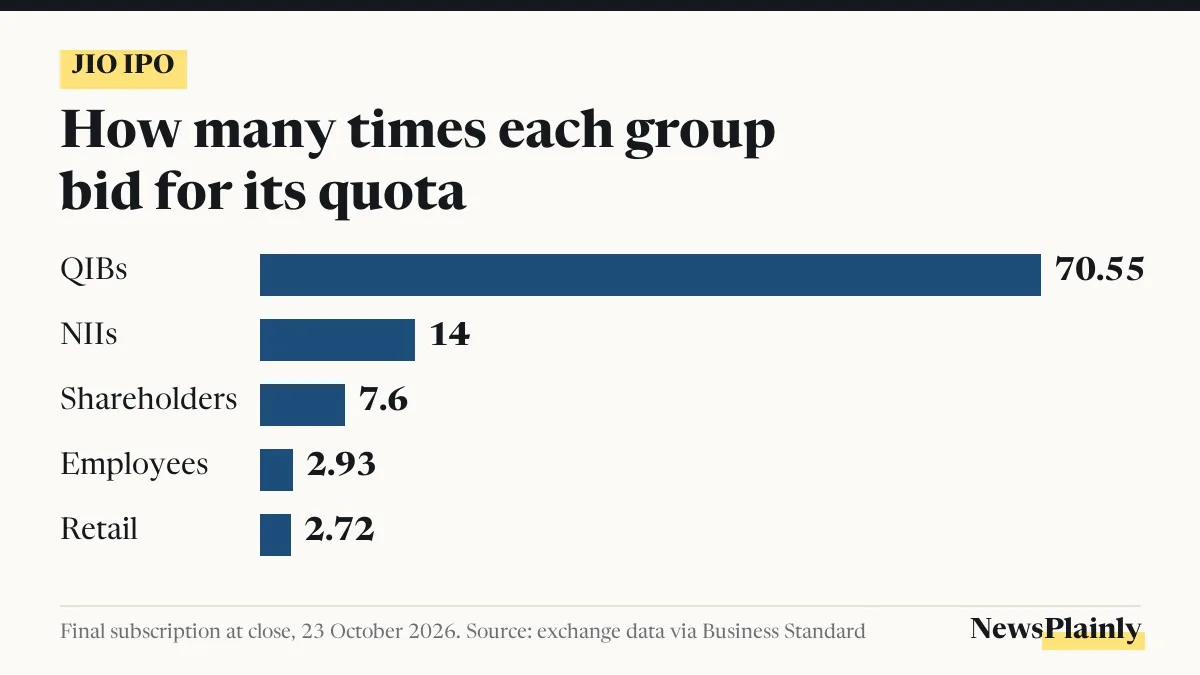
Qualified institutional buyers (QIBs), which means mutual funds, banks, insurers and foreign funds, bid for their quota 70.55 times over. That was almost double the 36.5 times they had reached by Thursday evening. Together they asked for about 345.8 crore shares, while only 4.9 crore were set aside for them. Domestic banks and insurers wanted about 152.5 crore shares, foreign portfolio investors about 123.9 crore and mutual funds about 35.7 crore, Business Standard reported.
Non-institutional investors (NIIs, wealthy individuals and firms bidding more than ₹2 lakh) covered their part 14 times, up from 5.28 times a day earlier. Within that group, bids above ₹10 lakh were 15.89 times subscribed, against 10.22 times for bids between ₹2 lakh and ₹10 lakh.
Retail investors, people bidding up to ₹2 lakh, ended at 2.72 times, compared with 2.23 times on Thursday. They asked for about 23.1 crore shares against 8.5 crore reserved. Existing Reliance Industries shareholders, who had a separate ₹2,500 crore quota, bid 7.60 times, and employees, who get a 5% discount on a ₹500 crore quota, bid 2.93 times.
Counting the anchor investors who came in before the public sale, total demand crossed ₹7.4 lakh crore and applications neared 1.39 crore. The public offer alone drew bids worth more than ₹4.9 lakh crore, and retail bids topped ₹25,867 crore. The anchor book had already raised ₹8,109.85 crore on 19 October, according to the issue details listed by IPO tracker Chittorgarh.
What 22 times demand means for your Jio IPO allotment chance
A heavy oversubscription does not mean every applicant gets shares; in fact it makes the Jio IPO allotment harder for small investors. Under the rules of the Securities and Exchange Board of India (SEBI, the market regulator), when the retail portion is oversubscribed, shares are given out in minimum lots and the lots are decided by a computerised draw.
The minimum lot here is 12 shares, which cost ₹13,428 at the top price of ₹1,119. The retail quota of about 8.5 crore shares works out to roughly 70.8 lakh lots of 12. So at most about 70.8 lakh retail applicants can receive a lot, and anyone who applied for more than one lot will in most cases get only one. The exact odds depend on how many separate retail applications were made, a number the registrar will publish in the basis of allotment.
Money blocked through UPI or ASBA (a bank facility that holds the application money in your account) is released for applicants who receive nothing. Refunds and the credit of shares to demat accounts are both scheduled for 27 October.
Jio Platforms listing date and how to check allotment status
The timetable published for the issue, which may still change, is:
- Basis of allotment: Monday, 26 October 2026
- Refunds and share credit to demat accounts: Tuesday, 27 October
- Jio Platforms listing on BSE and NSE: Wednesday, 28 October
Applicants can check their Jio IPO allotment status on the website of the registrar, KFin Technologies, using their PAN (permanent account number) or application number, or on the BSE and NSE allotment pages once the basis of allotment is final. Nineteen banks managed the sale, with Kotak Mahindra Capital as a lead manager.
How big the Jio Platforms listing will be
At the top of the ₹1,065 to ₹1,119 price band, Jio Platforms would be valued at about ₹10.3 lakh crore, or roughly $109 billion, Business Standard calculated. That is more than Facebook’s $104 billion valuation at its 2012 listing. Among telecom companies listed anywhere, it would rank seventh by market value, behind China Mobile, Verizon, T-Mobile US, AT&T (the American telecom group), Deutsche Telekom and Bharti Airtel.
The sale was a fresh issue of 27 crore new shares, so the money goes to the company rather than to existing owners. It is the Reliance group’s first IPO since Reliance Petroleum in April 2006. The comparison with the group’s very first public offer is striking: in 1977 Reliance Textile Industries sold 28 lakh shares at ₹10 each and raised ₹2.8 crore. The Jio issue is more than 10,000 times that size.
The bidding came during a bad week for Indian shares. Midcap and smallcap stocks had their worst week in 20 months, and Reliance Industries shares fell 1.75% over the week before closing at ₹1,190 on Friday, up 0.46% on the day.
What analysts said about demand and listing day
Independent market analyst Ambareesh Baliga told Business Standard that demand was “much better than anticipated”, especially from institutions, and said he expected the shares to open about 10% above the issue price. He added that the real test would be whether institutional interest carried over into trading.
Geetanjali Kedia of S P Tulsian Investment Advisory Services said retail bids were held back by the falling secondary market and the sheer size of the offer. Kranthi Bathini of WealthMills Securities pointed to the possible entry of Jio Platforms into the Nifty 50 and Sensex indices as one reason for institutional interest, and said the large IPO may be one of several reasons for the market’s recent fall, along with oil prices and global tensions.
These are views, not guarantees. A heavily oversubscribed issue can still see a flat or weak Jio Platforms listing, and NewsPlainly does not give investment advice.
Frequently asked questions
When is the Jio IPO allotment date?
The basis of allotment is scheduled for Monday, 26 October 2026, with refunds and demat credit on 27 October.
How can I check Jio IPO allotment status?
On the registrar KFin Technologies' website using your PAN or application number, or on the BSE and NSE IPO allotment pages after the basis of allotment is final.
When will Jio Platforms shares list?
Listing on BSE and NSE is scheduled for Wednesday, 28 October 2026. The date can still change.
How many times was the Jio IPO subscribed?
22.19 times overall, according to exchange data: 70.55 times for institutions, 14 times for non-institutional investors and 2.72 times for retail investors.