Representative image. Biswarup Ganguly, CC BY 3.0, Wikimedia Commons

Why it matters
For people in these 48 villages, the rules on land, building and possibly property tax are changing. Urban status makes planned projects such as land pooling possible, but new roads and sewers will still need separate approval and money.
Delhi villages are losing their last rural tag: the Delhi government has decided to declare its remaining 48 rural villages urban, which means the national capital will soon have no village officially classed as rural. Chief Minister Rekha Gupta announced the decision on Friday, 23 October 2026, saying it would let roads, sewers and other services in these areas be planned properly.
The change does not bring new roads or drains by itself. It changes which rules apply to the land, and that will affect residents’ building plans, property taxes and future development.
What the order on the last 48 Delhi villages says
The Urban Development Department issued the notification on 23 October under Section 507(a) of the Delhi Municipal Corporation Act, 1957, the provision that lets the government declare a rural area urban, The Tribune reported. It has been sent to the General Administration Department for publication in the Delhi Gazette, and the change takes effect once it is published.
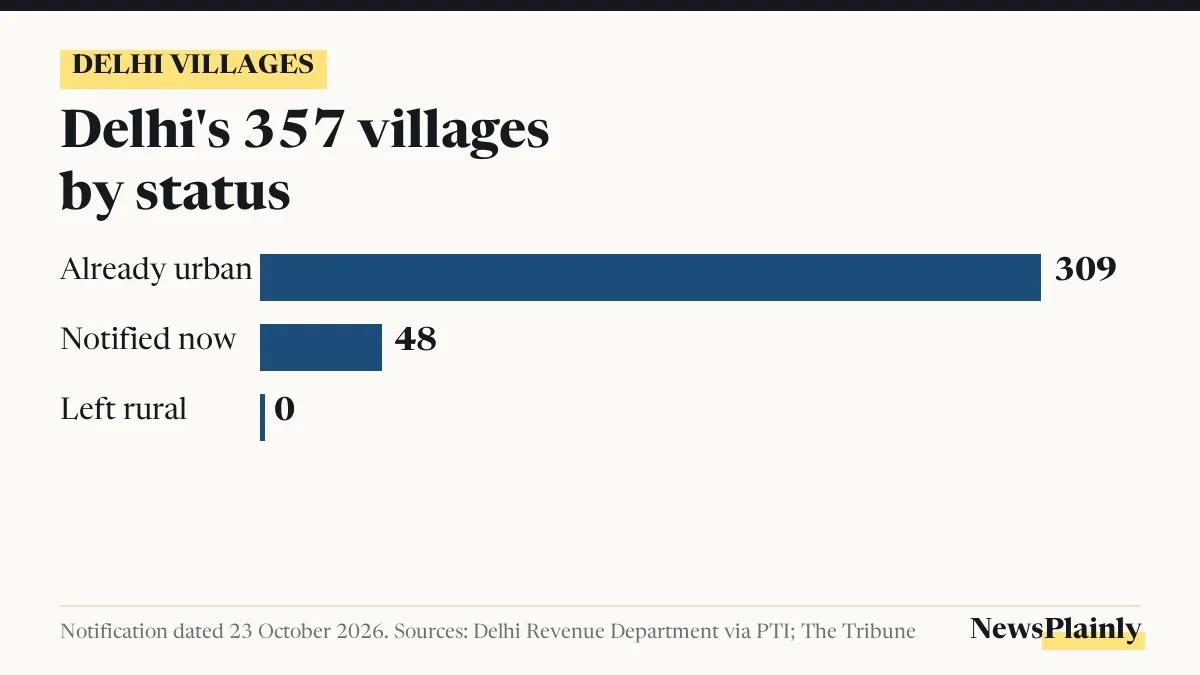
Delhi has 357 villages, and 309 of them had already been given urban status over the years, Revenue Department officials said, according to a PTI report. That means 48 villages, about 13% of the total, were still rural on paper. The Delhi Development Authority (DDA), the city’s planning body, approved the proposal earlier this year.
The 48 Delhi villages include Bakoli, Palla, Hamidpur, Kulakpur, Singhola, Sultanpur Majra, Mungeshpur, Auchandi, Jafrabad, Tajpur Kalan, Fatehpur Beri, Chandan Hola, Jhatikara, Kanganheri, Raghopur, Bijwasan, Bakargarh, Dhansa, Issapur, Kair, Mundela Kalan, Mundela Khurd, Surakhpur and Chak Chilla.
Why the Delhi government wants urban status for the villages
Gupta said in a statement from the Chief Minister’s Office that the move would lay the base for planned growth and help the government work out what each village needs in land use, road links, sewerage, water supply and sanitation. It would also bring the villages into Delhi’s urban planning under the Draft Master Plan 2041, the long-term plan for how the city’s land is used.
Until now these villages followed rules meant for farmland, The Tribune noted. According to the DDA, urban status makes them eligible for land pooling, a scheme in which owners hand over plots for planned development and get back a developed share, as well as green-area projects, regeneration of older settlements and transit-oriented development, which means denser building near metro and rail stations.
The Chief Minister’s Office also set a limit: development work will only happen under the relevant plans, with the required approvals and within existing rules. In other words, the order makes these projects possible but does not start any of them.
What urban status means for people in Delhi villages
Residents of the newly urban Delhi villages will notice the change mostly in paperwork at first. Than Singh Yadav, president of the Delhi Panchayat Sangh, a body representing village councils, told PTI, the Press Trust of India news agency, that people will need approval from the Municipal Corporation of Delhi (MCD) for building plans once the villages are urban. He said small shops and properties that were outside the MCD’s tax net could also come under it.
Yadav said declaring the villages urban was not enough on its own. He asked the government to keep land aside for traditional needs, including about two acres per village for grazing, since many families still keep cows and buffaloes, and space for playgrounds, primary schools and parking. He also asked for the phirni roads, the ring roads that run around old village settlements, to be widened to 100 feet from the present 20 to 25 feet in some places, and for village ponds to be restored with walking paths.
The government has not said how much money it will spend on these villages or in what order work will be taken up. The Tribune pointed out that roads, sewers and drains still need separate planning, funding and approval by the agencies concerned.
Does the urban status change Delhi’s census count?
No. The Section 507 order is a Delhi municipal decision and does not change how the national census defines an urban area, The Tribune reported. Under the census framework, a place counts as urban if it is a statutory town, or a census town with at least 5,000 people, a density of at least 400 people per square kilometre and at least 75% of male main workers in non-farm jobs.
The difference matters because a village can be urban for Delhi’s planning purposes while census figures are counted under separate rules. For now, the immediate next step is publication in the Gazette, after which the 48 villages formally leave the rural category. Readers can see the details in the Chief Minister’s statement as reported by PTI.
Frequently asked questions
Which Delhi villages are getting urban status?
The last 48 rural villages, including Bakoli, Palla, Hamidpur, Bijwasan, Fatehpur Beri, Dhansa, Issapur, Kair and Chak Chilla.
When does the change take effect?
Once the notification, dated 23 October 2026, is published in the Delhi Gazette.
Will residents need MCD approval to build?
Delhi Panchayat Sangh president Than Singh Yadav told PTI that building plans will need MCD approval once the villages are urban.