Representative image. arunpnair_787, CC BY-SA 4.0, Wikimedia Commons

Why it matters
Almost every adult who drives in India deals with a licence at some point. If adopted, the rules make the learner's test harder for new drivers but remove fees and waiting for people who only need to update a name, address or phone number.
New driving licence rules proposed by the Centre would make it harder to pass the road-safety test for a learner’s licence and easier, and free, to fix details on an existing licence. The Ministry of Road Transport and Highways (MoRTH) has published draft changes to the Central Motor Vehicles Rules, 1989, which also bring colour-coded licence cards for Indian and foreign nationals and a QR (quick response) code, the square barcode a phone can scan, in place of the old machine-readable strip. The public has 30 days to send objections and suggestions.
What changes for learner’s licence applicants
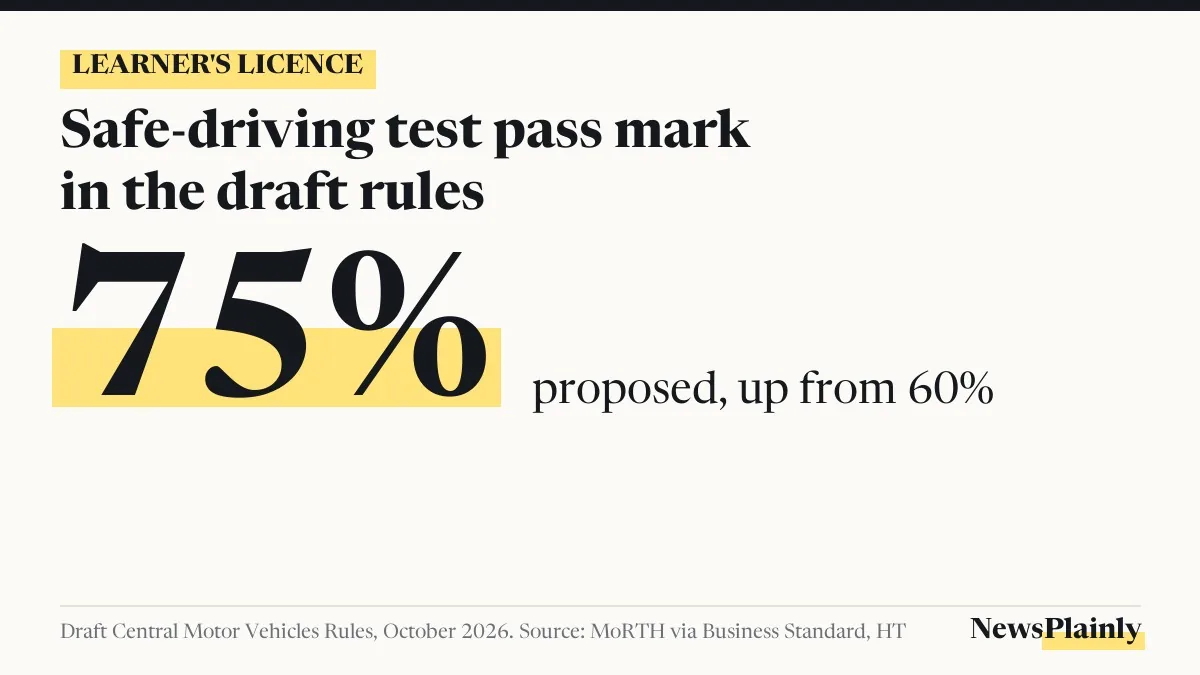
The biggest change for new drivers is the safe-driving tutorial, the short road-safety lesson and assessment that people take before getting a learner’s licence. Under the draft, the pass mark for the assessment would rise from 60% to 75%, the tutorial would have to last at least 30 minutes, and applicants would get 15 days to finish it instead of the current seven, Business Standard and Hindustan Times reported.
In plain numbers, someone answering 20 questions would need 15 right instead of 12.
The draft also ends two shortcuts. People holding older learner’s licences, and those with a certificate from a driving school, would no longer be exempt and would have to take the tutorial and the test like everyone else, according to Hindustan Times.
A learner’s licence would carry a printed validity of six months from the date of issue. Mistakes on it, including a wrong date of birth, could be corrected through a written request with the original documents before the holder applies for a full licence.
Free online changes under the new driving licence rules
For the many people who already hold a licence, the draft is mostly about cost and paperwork. It proposes:
- No fee for changing the name, address or other personal details on a licence. Hindustan Times reported that updating a mobile number or email ID would also be free.
- No charge for specified services used online through Aadhaar authentication, the check that confirms identity using the 12-digit Aadhaar number.
- No late fee for delays in submitting a no-objection certificate (NOC), the clearance needed in some cases when a licence holder changes residence.
- A new online form, Form 2A, filed on the transport portal with supporting documents, to update details.
Licensing authorities, usually the local Regional Transport Office (RTO), would have to approve or reject such requests within 15 days and record their reasons if they say no, telling the applicant electronically as well. An address change that is neither approved nor rejected within 30 days would count as approved.
Colour-coded driving licence cards and a QR code
Every driving licence issued or renewed would come as a laminated or polyvinyl chloride (PVC) plastic card in a format called Form 7. Indian and foreign nationals would get separate designs with different background colours, and nationality would be printed among the details, Business Standard reported. Foreign applicants would also have to prove they are legally present in India.
The card itself would change. The existing machine-readable zone would give way to a QR code zone, and the information recorded could include nationality, medical conditions, allergies, medicines or prescriptions, organ-donor status and an emergency contact. Application forms would make blood group compulsory and collect mobile and emergency contact numbers.
Photos for online applications would have fixed rules: a file no bigger than 1 MB, a plain white background, and the face filling 70% of the frame.
Which documents would count as proof
The draft rewrites the lists of documents accepted for identity, age and address, as reported by Hindustan Times:
- Identity: Aadhaar, a valid Indian passport, an e-ration card, specified government service or pension documents, or a PAN (permanent account number) card.
- Age or date of birth: a passport, a marksheet or certificate from a recognised school or college showing the date of birth, a birth certificate, or specified service or pension documents.
- Address: Aadhaar, voter ID card, passport, e-ration card, a government service photo ID, a pensioner’s or freedom fighter’s ID, or a pension payment order. Electricity and household gas bills would count if they are no more than three months old.
One more rule covers people who give up a vehicle class. If a holder permanently surrenders a category, say heavy vehicles, it would be deleted from the licence within seven days of the application, and the person could not apply for a learner’s or driving licence in that category for one year.
When the driving licence rules could take effect
Nothing changes yet. The ministry notified the draft on 16 October and it appeared in the Gazette of India on 21 October, Business Standard reported; the 30-day window runs from the date copies are made available to the public. The ministry will consider the comments after that, and the rules take effect only when the final version is published in the Gazette, unless it says otherwise. Earlier changes to these rules are listed on the ministry’s motor vehicle legislation page.
Road-safety groups have welcomed the tougher test with a caution. Piyush Tewari, founder and chief executive of the SaveLIFE Foundation, told Hindustan Times that raising the pass mark is a positive move, but that “a higher pass mark alone is insufficient” unless the test checks real understanding of traffic rules and hazards and practical driving tests are strict and free of manipulation.
This is the second set of rules from the Centre that NewsPlainly has explained this week, after the telecom sandbox rules for testing new technology.
Frequently asked questions
What is the new pass mark for the learner's licence test?
The draft raises the pass mark for the safe-driving tutorial assessment from 60% to 75%. The tutorial would last at least 30 minutes and must be finished within 15 days.
Will changing the address on a driving licence be free?
Yes, under the draft. Changes to name, address and other personal details would carry no fee, and an address change not decided in 30 days would count as approved.
Are the new driving licence rules in force?
No. They are a draft open for comments for 30 days and apply only after the final rules are published in the Gazette of India.
Why are there different colour licences?
The draft proposes separate card formats, with different background colours, for Indian and foreign nationals, with nationality printed on the card.