
Representative image. Adityamadhav83, CC BY-SA 4.0, Wikimedia Commons

Why it matters
The rules give Indian startups and labs a legal way to try new telecom services on real networks without first clearing every licensing step. For ordinary users, any such trial must be free, explained in advance and based on consent, and the product cannot be sold until the trial ends.
New telecom sandbox rules now let startups, companies, researchers and even individual citizens test new telecom technologies in a controlled setting, with some licensing rules relaxed for the trial. The Centre notified the Telecommunications (Regulatory Sandbox) Rules, 2026 in the Official Gazette, and they took effect on 21 October 2026, Business Standard and the news agency ANI (Asian News International) reported.
A regulatory sandbox is a fenced-off testing space. A firm gets permission to try a new service, product or business model on real networks or real users for a fixed time, under the regulator’s watch, without first meeting every rule that would apply to a full commercial launch.
What the telecom sandbox rules allow
Under the rules, the Centre can grant exemptions from some provisions of the Telecommunications Act, 2023, India’s main telecom law, and of the Telecom Regulatory Authority of India (TRAI) Act, 1997. Any exemption from the TRAI Act needs prior consultation with TRAI, the telecom regulator, according to the notification as reported by Business Standard.
The government can set up a sandbox in two ways. It can create one on its own after deciding there is a need, or it can approve a proposal from an applicant, either sent on the applicant’s own initiative or in reply to a government call for proposals, ANI reported, quoting the notification. Each sandbox order will spell out its scope, aims, who can take part, testing conditions, risk controls and reporting duties.
Who can apply for a regulatory sandbox, and at what cost
The list of eligible applicants is wide. It covers authorised telecom entities, companies, societies, partnership firms, statutory bodies, Indian citizens and research and development institutions recognised by the Department of Science and Technology, Business Standard reported.
Applications go through a government portal. They must include reports of limited tests already done in a laboratory or offline setting, including on isolated experimental networks, and must list the exemptions the applicant wants. There is a non-refundable processing fee of ₹10,000, and the government can accept or reject any proposal.
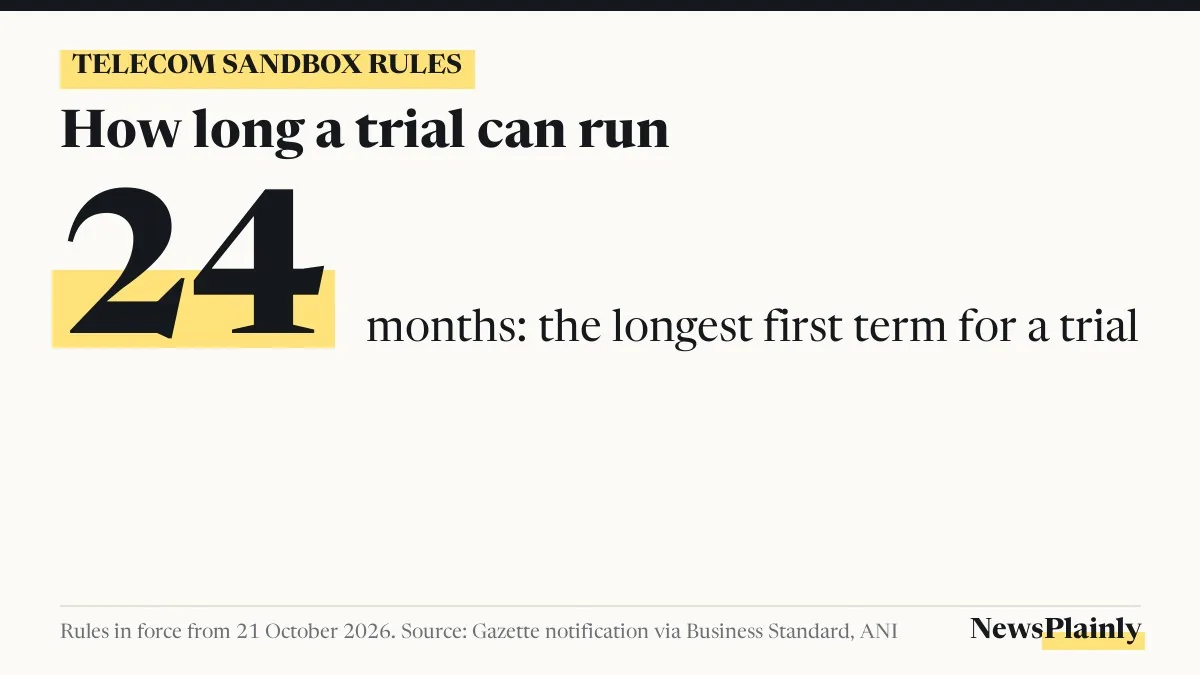
A sandbox can run for up to 24 months at first. The government can extend it by up to 12 months at a time, if the applicant asks at least 30 days before the current term ends. So a trial that needs three years in total would need one extension on top of the first term.
How the rules protect people in telecom trials
Several of the rules deal with ordinary users who take part in a test. Approved applicants must tell users the purpose and scope of the trial, take their consent in advance and must not charge them anything for taking part, according to both reports. Applicants must also follow data protection and security laws.
Anything under test cannot be sold or offered commercially while the sandbox runs. Applicants have to keep records of work plans, methods, test locations, results and user consent for at least one year after the sandbox ends, or longer if the government asks.
Within 15 days of finishing a test, an applicant must file a full report on results, user feedback, complaints, security problems and how the trial was wound up. The government can suspend or cancel an approval for false information, for breaking the conditions, for interfering with a licensed operator’s network, or in the interest of national security or the public, Business Standard reported.
What comes after a sandbox trial
Once a test is over, the government has three choices. It can let the sandbox continue under changed conditions, order it to close, or allow steps towards a commercial launch of the product or service under the normal law.
The final rules have been a long time coming. A draft version was published on 27 November 2024, and the government said it considered the objections and suggestions it received before notifying the final text. That is a gap of almost 23 months between draft and final rules.
The rules arrive in a busy week for the telecom sector, with the share sale of Jio Platforms open for bids. NewsPlainly explained what the Jio IPO offers investors when it opened.
For readers, the change will mostly be felt indirectly. New kinds of telecom services may now reach small groups of users as free trials, with consent and reporting rules attached, before they are launched to the public. Readers can follow the Department of Telecommunications’ notices on its official website for the portal and the first sandbox orders.
Frequently asked questions
What is a telecom regulatory sandbox?
A limited, supervised trial in which a new telecom service or product is tested for a fixed time with some regulatory rules relaxed.
Who can apply?
Authorised telecom entities, companies, societies, partnership firms, statutory bodies, Indian citizens and recognised research institutions.
How long can a sandbox run?
Up to 24 months at first, extendable by up to 12 months at a time.