Representative image. BSEINDIA, CC BY-SA 3.0, Wikimedia Commons

Why it matters
A Tata Sons listing would let ordinary investors buy into the holding company of one of India's largest business groups for the first time. It would also let the Shapoorji Pallonji Group sell its stake more easily. The Governor's words make clear the RBI is applying its listing rule to Tata Sons as it stands.
Reserve Bank of India (RBI) Governor Sanjay Malhotra said on Friday, 23 October 2026, that a finance company placed in the central bank’s upper layer is required to list its shares, a remark widely read as a signal on the Tata Sons listing. Speaking at the NDTV World Summit, a conference held by the news channel in New Delhi, he did not announce any new decision, but he set out the rule that the RBI has applied to the Tata group’s holding company since 2022.
What RBI Governor Sanjay Malhotra said
Malhotra was asked whether a company could restructure or reorganise itself to avoid having to list. His answer used two RBI terms. An NBFC is a non-banking financial company, a lender or investor that is not a bank. A core investment company (CIC) is a type of NBFC that mainly holds shares in its own group companies.
“As long as it’s an NBFC within our definition, it’s a CIC, it has access to funds, direct or indirect, it’s required to be registered,” he said, according to The Indian Express. “And if it is in the upper layer, then it is required to list.”
Tata Sons, which owns large stakes in firms such as Tata Consultancy Services, Tata Steel and Tata Motors, is classified as one.
The Governor named Tata Sons directly when explaining why such firms are regulated. NBFCs and CICs “like for example, Tata Sons and others” must register with the RBI because of systemic risks, he said, since they sit on top of group companies. He added that public money, whether held by banks or raised through corporate bonds, is at risk when these holding companies borrow, and that they can use the balance sheets of group firms to repay those funds, the news agency Press Trust of India (PTI) reported.
Why the upper layer NBFC rule matters for Tata Sons
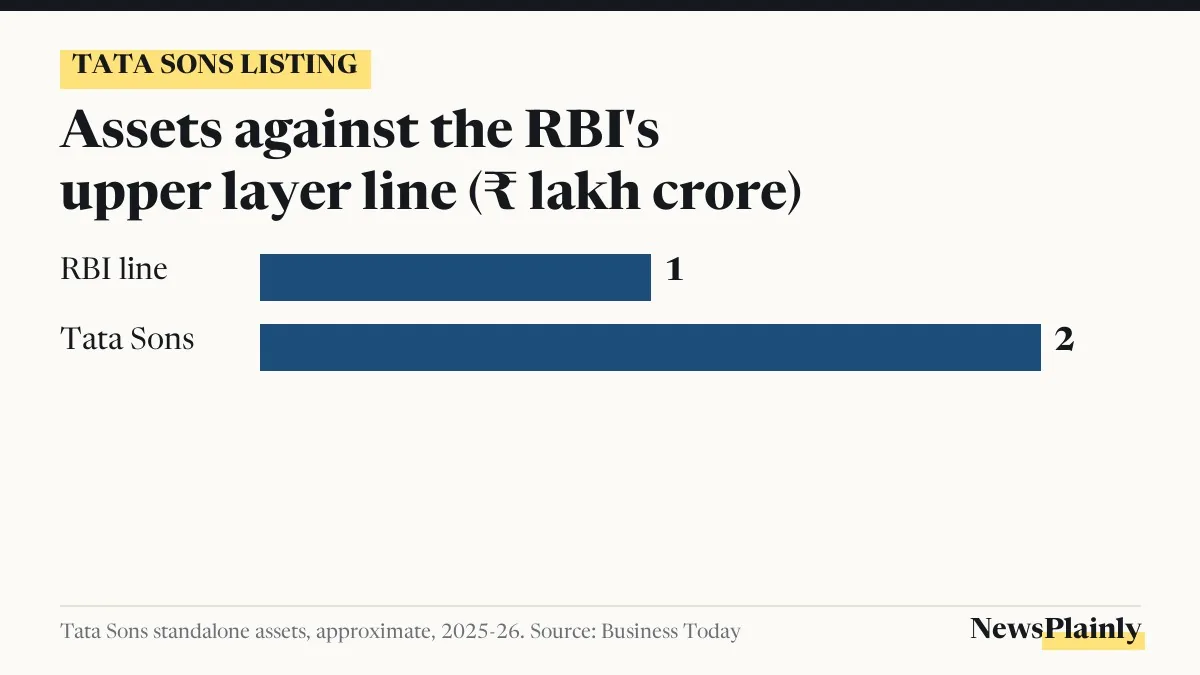
The RBI sorts NBFCs into layers by size and risk under what it calls scale-based regulation. Under the norms in force since June 2026, the upper layer covers NBFCs with assets of ₹1 lakh crore or more, and every company in it must list on the stock exchanges. Tata Sons had standalone assets of about ₹2 lakh crore in 2025-26, twice the threshold, Business Today reported.
Tata Sons was first named in the upper layer in September 2022. The RBI kept it there in a revised list on 6 August 2026, saying the inclusion was without prejudice to its pending application to deregister as a core investment company. In September, the RBI rejected that application, according to Business Today and PTI. Tata Sons was the only unlisted company left on the list, Business Today reported.
The Governor had hinted at this line before. After a monetary policy meeting in May, he told reporters that all companies meeting the criteria would continue in their layer, Business Today reported.
Tata Trusts and the board: where the Tata Sons listing dispute stands
The listing question has split the group’s leadership. At a board meeting on 17 September, Tata Sons directors decided to go ahead with listing, as the RBI had directed, despite opposition from Tata Trusts chairman Noel Tata, The Indian Express reported. Tata Trusts, a group of charitable trusts, is the largest shareholder in Tata Sons.
On 28 September, Tata Trusts sent the Tata Sons board a proposal to merge two group firms, Tata Electronics Systems Solutions and Tata Consulting Engineers, into Tata Sons. The Indian Express reported that the move, if approved, would change the nature of Tata Sons and could take it outside the rules that triggered the listing order. Malhotra’s remark on restructuring was made in answer to a question on such moves.
The dispute has also reached the Charity Commissioner, the official who oversees public trusts in Maharashtra. Tata Sons could not hold its annual general meeting for lack of quorum after the Commissioner issued a restraining order on the Sir Ratan Tata Trust, and trustees Venu Srinivasan and Vijay Singh have filed complaints with the Commissioner, The Indian Express reported.
On the other side, the Shapoorji Pallonji (SP) Group, which holds a little over 18% of Tata Sons, has argued for listing for some time. Shapoorji Pallonji Mistry said earlier this year that a listed holding company strengthens board accountability and broadens the investor base, Business Today reported. A listing would let the SP Group sell shares more easily.
Neither Tata Sons nor Tata Trusts had responded publicly to the Governor’s remarks in reports available by Friday evening.

What else the Governor said on inflation and the rupee
On the economy, Malhotra said price stability remains the RBI’s primary goal alongside support for growth. Inflation is within the RBI’s tolerance band, he said, though food and fuel prices create supply-side pressure; he cited an average inflation projection of 5.1% for the year, PTI reported. He described growth as broad-based, pointing to cement and steel sales, bank credit, tax collections and car sales. Readers can see how the RBI’s rate-setters viewed these risks in the minutes of the October policy meeting.
On the currency, he said the RBI does not target any price for the rupee and steps in only to keep the foreign exchange market orderly.
For investors, the practical question is timing. Tata Sons shares are not traded today, so a listing would open one of India’s most valuable private holding companies to public shareholders for the first time. No date, size or structure for any share sale has been announced.
Frequently asked questions
Does Tata Sons have to list on the stock market?
Under RBI rules, every NBFC in the upper layer must list. Tata Sons is in that layer and the RBI rejected its request to deregister in September 2026. RBI Governor Sanjay Malhotra said on 23 October that a company in the upper layer is required to list.
What is an upper layer NBFC?
It is the RBI's top tier of non-bank finance companies, for firms with assets of ₹1 lakh crore or more under the norms in force since June 2026. These firms face tighter rules, including mandatory listing.
What is a core investment company?
A non-bank finance company that mainly holds shares in its own group companies. Tata Sons is classified as one.
Who owns Tata Sons?
Tata Trusts is the largest shareholder. The Shapoorji Pallonji Group holds a little over 18%.