Representative image. Sailko, CC BY 3.0, Wikimedia Commons

Why it matters
A higher repo rate and a tightening stance mean loans linked to the repo rate, including many home loans, can get costlier, and no cut is expected soon. The minutes show the RBI is more worried about prices rising across the board than about growth, which affects what people pay for food, fuel and EMIs.
The RBI MPC minutes released on 21 October 2026 show that all six members of the Reserve Bank of India’s Monetary Policy Committee (MPC) voted to raise the repo rate, but two of them did not want to signal more hikes. The repo rate is the rate at which the RBI lends money to banks, and it sets the direction for loan and deposit rates across the country.
The committee met from 5 to 7 October and lifted the repo rate by 25 basis points (0.25 percentage point) to 5.50%. It also changed its policy stance from “neutral” to “calibrated tightening”. The minutes, which the RBI must publish 14 days after each meeting under the RBI Act, explain why each member voted the way they did.
What the RBI MPC minutes say about the 6-0 vote
Every member backed the 25 basis point increase. Governor Sanjay Malhotra, Deputy Governor Poonam Gupta, RBI Executive Director Indranil Bhattacharyya and the economist Saugata Bhattacharya also voted for the change in stance.
The two other external members, Nagesh Kumar of the Institute for Studies in Industrial Development and Prof. Ram Singh, Director of the Delhi School of Economics, wanted the stance kept at neutral. So the rate decision was unanimous, while the stance passed by four votes to two.
Malhotra wrote that the new stance means rate cuts are off the table in the near term, and that the next move can only be a hike or a pause. Bhattacharyya said the same thing more bluntly in his statement: given conditions at home and abroad, cuts are “not an option in the near term”, according to the minutes published by the RBI.

Why the MPC chose a repo rate hike
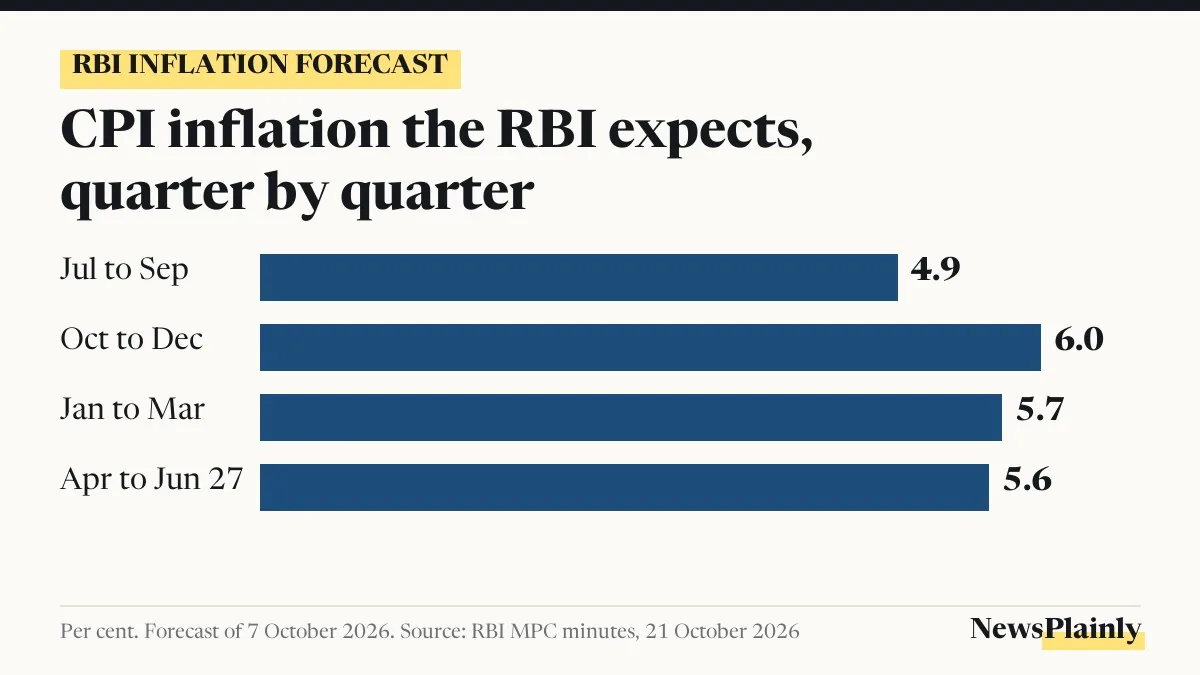
The reason is inflation. Retail inflation, measured by the Consumer Price Index (CPI), rose to 4.8% in August from 4.5% in July. In its new inflation forecast, the RBI expects prices to rise 5.2% on average in 2026-27, up from 5.0% earlier, and to reach 6.0% in the October to December quarter. That is the top of the band the RBI is required to keep inflation within, which runs from 2% to 6% around a 4% target.
The members gave several causes: a weak south-west monsoon, a strong El Niño (the Pacific Ocean warming that disrupts rainfall in Asia), crude oil prices driven up by the conflict in West Asia (NewsPlainly explained what Brent crude at $110 means for India), high gold prices and a weaker rupee. Sugar and onion prices were singled out in the resolution.
Malhotra pointed to how widely prices are now rising. In August, 37% of the items in the CPI basket had inflation above 4%, against just 20% in March, he wrote. Ram Singh noted that in the RBI’s September survey, households’ median expectation of inflation over the next three months jumped to 9.9%. Bhattacharya said wholesale input prices were rising close to 9% a year and were being passed on to shoppers.
Growth, by contrast, is holding up. The economy grew 7.8% in the April to June quarter, and the RBI raised its forecast for 2026-27 to 7.1% from 6.7%. That strength is what gave most members room to tighten. The RBI sees growth of 7.2% in July to September, 6.9% in October to December and 6.8% in January to March.
Under calibrated tightening, the committee keeps the option of further hikes open without committing to a fixed path. Under the neutral stance it had before, a cut, a hike or a pause were all possible, Bhattacharyya explained in his statement.
Why two members wanted to keep the neutral stance
Both dissenters agreed with the repo rate hike itself. Their worry was the message. Ram Singh wrote that a tightening stance may signal a long cycle of rate increases, which could hurt borrowing for homes and cars and slow private investment. He argued that inflation today comes mainly from supply shocks such as fuel and food, not from an overheated economy, and favoured “incremental, mild” hikes rather than rates kept high for long.
Nagesh Kumar said growth was strong but uncertainty over the West Asia conflict and trade policy remained high, so a neutral stance was more suitable. He also expected the India and European Union free trade agreement to lift exports from early 2027.
Poonam Gupta took the other side of that argument. She wrote that in the period since the pandemic, the RBI has acted whenever inflation reached the edge of its band, and that this record keeps people’s inflation expectations steady. Since monetary policy works with a delay, she said, waiting for clearer proof could be costly.
What the repo rate hike means for your home loan
Many home loans in India are linked to an external benchmark such as the repo rate, so banks can pass a hike on to borrowers. The size of the change depends on each bank and each loan.
As a rough guide, if a bank passes on the full 0.25 percentage point, the home loan EMI (equated monthly instalment) on a ₹30 lakh loan over 20 years rises by about ₹460 to ₹480 a month for loans starting between 7.5% and 8.5%. That is a NewsPlainly calculation, not a bank figure. Some lenders extend the loan term instead of raising the EMI.
The RBI MPC minutes do not say how many more hikes may follow. Malhotra wrote that the length and size of the hiking cycle will depend on underlying inflation and how far price rises spread. The next MPC meeting is scheduled for 2 to 4 December 2026.
Frequently asked questions
What is the repo rate now?
5.50%, after the MPC raised it by 25 basis points on 7 October 2026.
What does calibrated tightening mean?
It means the RBI's next move can only be a rate hike or a pause, not a cut, in the near term, Governor Sanjay Malhotra wrote.
When is the next RBI policy meeting?
The MPC meets next from 2 to 4 December 2026.
Will my home loan EMI go up?
It can, if your loan is linked to the repo rate and your bank passes on the hike. Each bank decides; some extend the loan term instead.