Representative image. Photo: Rangan Datta Wiki, CC BY-SA 4.0, via Wikimedia Commons

Updated
Why it matters
India imports about 90% of its crude oil, so a sustained rise above $110 raises the chance of higher petrol and diesel prices. State-run oil companies are already selling fuel at a loss, and diesel costs feed into transport and food prices for every household.
Filling up could soon cost more. Brent crude, the oil benchmark that decides what India pays for most of its imports, crossed $110 a barrel on 19 October 2026 for the first time in five months. The trigger was a fresh run of attacks on tankers in the Persian Gulf, and the rise lands hard on a country that buys about 90% of its crude from abroad.
For now, the price at most Indian pumps has not moved. That could change if Brent crude stays this high.
How high Brent crude has gone
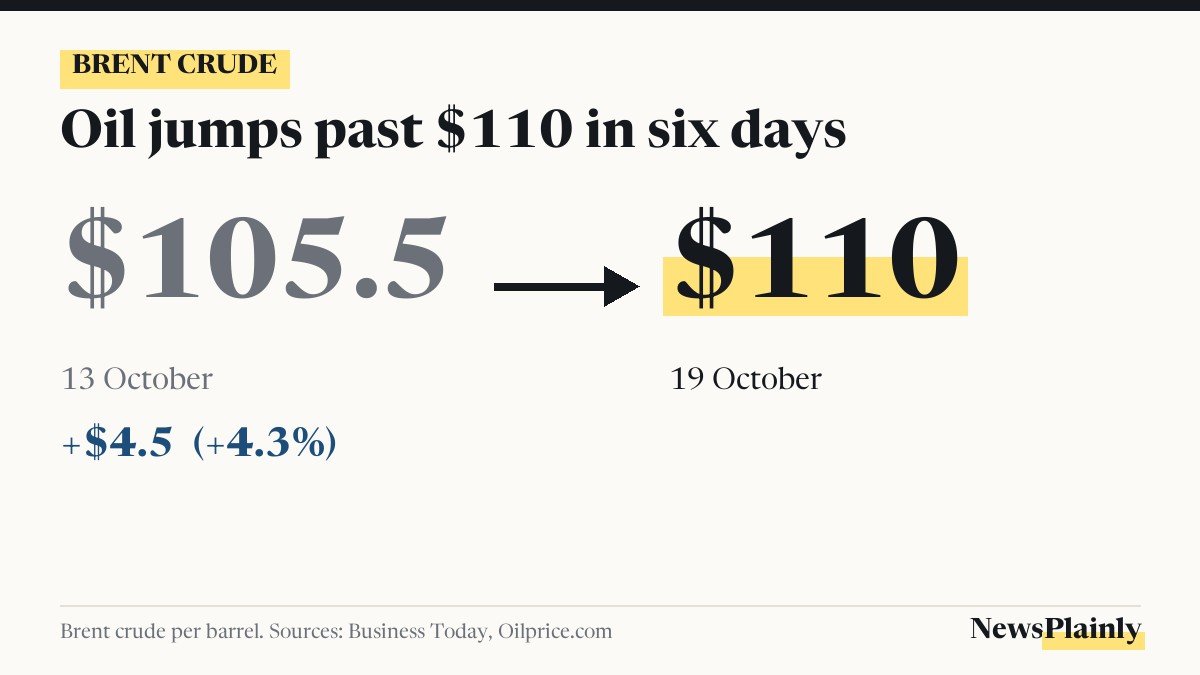
Brent crude climbed past $110 during trading and was at $109.68 a barrel later in the day, Oilprice.com reported. WTI, the main US benchmark, also went back above $100 and stood at $98.55.
Six days earlier, on 13 October, Brent crude was close to $105.5 and WTI was at $92.66, according to Business Today. In less than a week, Brent crude has risen by a little more than 4%.
Tanker attacks behind the oil price jump
Shipping is the problem. Reuters, citing ship-tracking data from Kpler, counted at least 18 attacks on oil tankers in the last two weeks. The amount of oil leaving the Persian Gulf fell to about 8.5 million barrels a day, Kpler said, against more than 20 million barrels a day two weeks before.
Earlier in October, Kpler had reported that exports from the region were back at pre-war levels. Iranian strikes on tankers in the Strait of Hormuz, the narrow sea lane between Iran and Oman, wiped out that recovery. Yemen’s Houthis have also hit Saudi Arabia again, striking energy sites, airports and military targets.
Analysts say the market is now paying for fear as much as for oil. ING’s commodity team wrote that prices held up even when Gulf shipments looked healthy, a sign of a large risk premium, the extra amount traders pay when they expect supply to get worse. Warren Patterson and Ewa Manthey of ING said that premium would only shrink if shipments stayed steady, and that there were no signs of that yet.
Petrol and diesel prices in India today
Indian Oil, BPCL and HPCL, the state-run companies behind most fuel stations, have kept petrol and diesel prices unchanged. On 13 October, Business Today listed these rates:
- Delhi: petrol ₹102.12, diesel ₹95.20 a litre
- Mumbai: petrol ₹111.21, diesel ₹97.83
- Kolkata: petrol ₹113.51, diesel ₹99.82
- Chennai: petrol ₹107.76, diesel ₹99.55
- Hyderabad: petrol ₹116.15, diesel ₹104.23
The gap between cities comes mostly from state taxes, which differ from one state to the next.
Private retailers have already passed on some of the cost. Jio-bp put up petrol by ₹5 a litre and diesel by ₹3 a litre from 11 October, following an earlier increase by Nayara Energy. At a Jio-bp pump, a driver filling a 40-litre tank now pays about ₹200 more for petrol than before.
The ₹530 crore a day cost of steady fuel prices
Holding the petrol price steady is not free. Rating agency ICRA estimated that in September the state-run companies lost about ₹8 on each litre of petrol and ₹9 on each litre of diesel. Across the three companies, that came to roughly ₹530 crore a day. Brent crude was cheaper in September than it is now, so the daily gap is probably wider today.
A weak rupee adds to the bill. India pays for its oil in dollars, so whenever the rupee slips against the dollar, each barrel costs more in rupees even if the global crude oil price stays flat.
The rise was not a complete surprise. SBI Research, in a report cited by Business Today, had said Brent crude could reach $110 and that India’s crude basket, the average price of the grades the country actually buys, could touch $130 within days. The first part has happened.
Will petrol and diesel prices go up?
No decision has been announced. Neither the government nor the state-run retailers have said they will change the diesel price or the petrol price. What happens next depends on three things:
- whether the tanker attacks in and around the Strait of Hormuz continue;
- how long Indian Oil, BPCL and HPCL can keep selling fuel at a loss;
- where the rupee goes against the dollar.
Households should watch diesel most closely. Trucks, buses and tractors run on it, so a diesel price rise usually shows up later in the cost of transport, vegetables and other goods. You can follow every move in fuel and markets in our business section.
Frequently asked questions
Will petrol and diesel prices go up in India?
Indian Oil, BPCL and HPCL have not changed prices so far, and no official decision has been announced. Private retailers Jio-bp and Nayara Energy have already raised theirs.
Why is Brent crude rising?
Attacks on oil tankers in and around the Strait of Hormuz have sharply cut the oil leaving the Persian Gulf, from more than 20 million barrels a day to about 8.5 million, according to Kpler data reported by Reuters.
What is the petrol price in Delhi now?
As of 13 October 2026, petrol cost ₹102.12 a litre and diesel ₹95.20 a litre in Delhi, according to Business Today.