Representative image. Pulakit Singh, CC BY-SA 4.0, Wikimedia Commons

Why it matters
Peace bonds let the authorities restrain a person without charging them with any crime, so how courts check this power affects anyone who joins a protest. The order that Bora must be shown the police material is a safeguard other protesters facing similar notices can also ask for. The case is part of the wider row over the voter list revision and the Chief Election Commissioner.
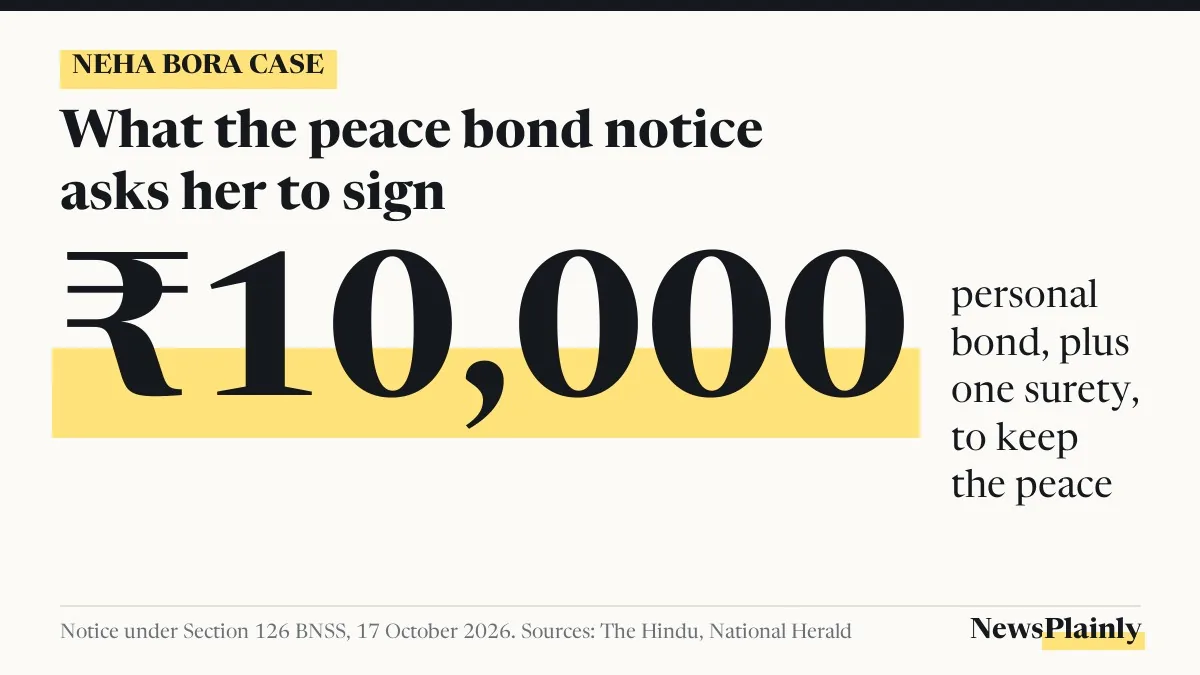
The Delhi High Court on Friday, 23 October 2026, rejected a petition by student leader Neha Bora against a police notice asking her to sign a ₹10,000 peace bond, a written promise to keep the peace, backed by one guarantor. Bora, president of the All India Students’ Association (AISA), the student wing linked to the CPI(ML) Liberation, had called the notice an attempt to silence peaceful protest. The court turned down her challenge for now but ordered that she be given all the material the police relied on.
What the Delhi High Court decided on Neha Bora’s plea
Justice Subramonium Prasad announced the decision on the Neha Bora petition in open court. “I am rejecting the writ petition at this juncture,” he said, according to The Hindu. The Indian Express reported that the judge found there were “sufficient safeguards” in the process before the magistrate.
The order also carries directions. The Special Executive Magistrate (SEM), an executive officer of the Delhi government who hears such preventive cases, must supply Bora with all the material used against her. Her lawyers had told the court a day earlier that they had not been given the police report, called a kalandra, on which the case rests. The detailed written judgment had not been released by Friday evening, National Herald reported.
In plain terms, the peace bond case against her stays alive. Neha Bora still has to explain before the magistrate why she should not be bound over, but she will now see the police’s grounds before she does.
How the peace bond notice came about
The dispute began on 16 October. Delhi Police detained Neha Bora at the Mandi House roundabout while she was on her way to the “Lehra Do Tiranga” march at Central Park, Connaught Place, called by the Cockroach Janta Party (CJP). The Cockroach Janta Party is a new protest group that has led marches against Chief Election Commissioner (CEC) Gyanesh Kumar over the Special Intensive Revision (SIR) of voter lists. Police also took CJP founder Abhijeet Dipke into preventive custody that day, The Indian Express reported.
Bora was released in the early hours of 17 October after formalities under Section 65 of the Delhi Police Act, 1978, which lets police remove a person who does not follow their reasonable directions. The same day, SEM Mahesh Kumar Meena issued the notice under Section 126 of the Bharatiya Nagarik Suraksha Sanhita (BNSS), the criminal procedure law that replaced the old CrPC in 2024. It asked her to appear on 19 October and show cause why she should not sign a personal bond of ₹10,000 with one surety for keeping the peace while the inquiry runs.
The notice listed three grounds, according to the reports:
- shouting slogans and creating a nuisance at the Mandi House roundabout on 16 October;
- taking part in repeated protests around Jantar Mantar despite prohibitory orders under Section 163 of the BNSS, which bans gatherings in an area;
- urging people to join the demonstration at Central Park, which police said had no permission.
What Section 126 allows, and the case each side made
Section 126 lets an executive magistrate ask a person to sign a bond if there is credible information that they are likely to breach the peace or disturb public calm. A peace bond is a preventive tool: nobody is charged with a crime, and no offence has to be proved. Sections 130 and 135 set out how the notice must be issued and how the inquiry must be held. A person who signs and then breaks the peace can lose the bond amount; a person who refuses can, in some cases, be held in custody.
Bora’s side. The petition by Neha Bora, drafted by lawyer Abhik Chimni, said the notice was vague, factually wrong and gave no material showing she was likely to break the peace. It called the notice a “colourable exercise of preventive powers to suppress peaceful dissent”, The Indian Express reported, and said it violated her rights to free speech and to gather peacefully.
In the Delhi High Court on Thursday, senior advocate Gopal Sankaranarayanan argued that the notice was issued mechanically, without the magistrate applying his mind. He said Bora had called for a peaceful gathering at Mandi House, was detained soon after she arrived, and was not behind the separate CJP call to hoist the flag at Central Park. Citizens need no permission to hoist the national flag, he argued, adding, “There is nothing wrong in (demanding a) regime change in a democracy,” according to National Herald.
The government’s side. Additional Solicitor General Chetan Sharma, appearing for the Centre, said the preventive proceedings were legally sound. He pointed to what he called repeated violations by Bora and cited police records, general diary entries and earlier cases as the basis for fearing a breach of the peace, National Herald reported. The government also argued that Section 126 and Section 130 can be used together in such proceedings.
The judge, for his part, had asked during the hearing whether the authorities had already decided a bond was needed before finishing the inquiry, and whether the magistrate had weighed the police information on his own.
Where the wider anti-SIR protest stands
The Delhi High Court ruling came on the same day as a separate march towards the Election Commission headquarters, which Delhi Police stopped on Ashoka Road. The protests demand that the SIR be rolled back and that the CEC resign. The Election Commission has defended the revision, and no court has ruled the exercise unlawful.
Bora is not the only protester facing preventive proceedings. Hindustan Times reported that CJP members Saurav Das and Ashutosh Ranka appeared at the SEM court on 23 October, days after their own release.
Neha Bora is expected to argue against the peace bond before the magistrate on Saturday, 24 October, The Indian Express reported. She can still challenge any final bond order later in a higher court. Neither Delhi Police nor the Election Commission had commented publicly on Friday’s ruling by Friday evening.
Frequently asked questions
Why did Neha Bora get a peace bond notice?
Police cited sloganeering at Mandi House on 16 October, repeated protests near Jantar Mantar despite prohibitory orders, and urging people to join an unpermitted march at Central Park. Bora disputes these grounds.
What is a peace bond under Section 126 BNSS?
It is a written promise to keep the peace for a set period, backed by money and a guarantor. A magistrate can ask for one if there is credible information that a person may disturb public order. It is not a criminal charge.
Did the Delhi High Court say Neha Bora broke the law?
No. It only declined to quash the notice at this stage and said the process has enough safeguards. The magistrate's inquiry will decide whether a bond is needed.
Who is Neha Bora?
She is the president of the All India Students' Association (AISA) and has taken part in the protests against the voter list revision and the Chief Election Commissioner.