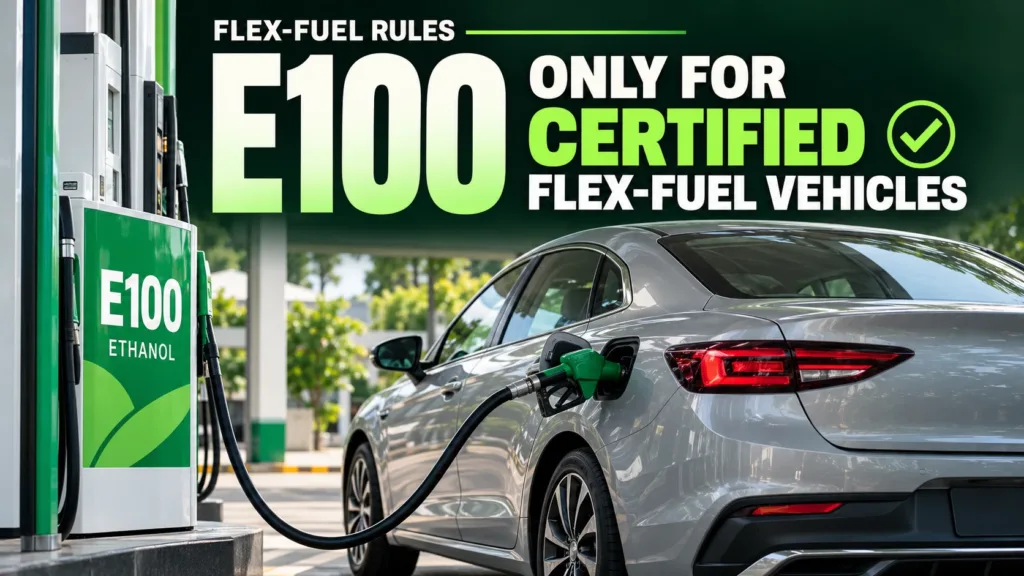
Representative image.
Why it matters
For owners of ordinary petrol and E20 vehicles, officials said nothing changes: these vehicles cannot use E85 or E100 and owners need not modify anything. The rule matters for buyers of factory-built flex-fuel models such as Maruti's Wagon R Flex Fuel, and for carmakers planning E100 launches. Whether the fuel itself reaches pumps, and at what price, was not set out in the reports read.
Vehicles built to run on almost pure ethanol now have a clear place in India’s vehicle law. The Ministry of Road Transport and Highways (MoRTH) has amended the Central Motor Vehicles Rules, 1989 to add E100 flex fuel next to E85 in the emission rules, the news agencies Press Trust of India (PTI), Asian News International (ANI) and Indo-Asian News Service (IANS) reported on Monday, 26 October 2026. The change is narrow: officials told reporters that E85 and E100 are meant only for vehicles designed and certified for them, and that ordinary petrol and E20 cars cannot use them.
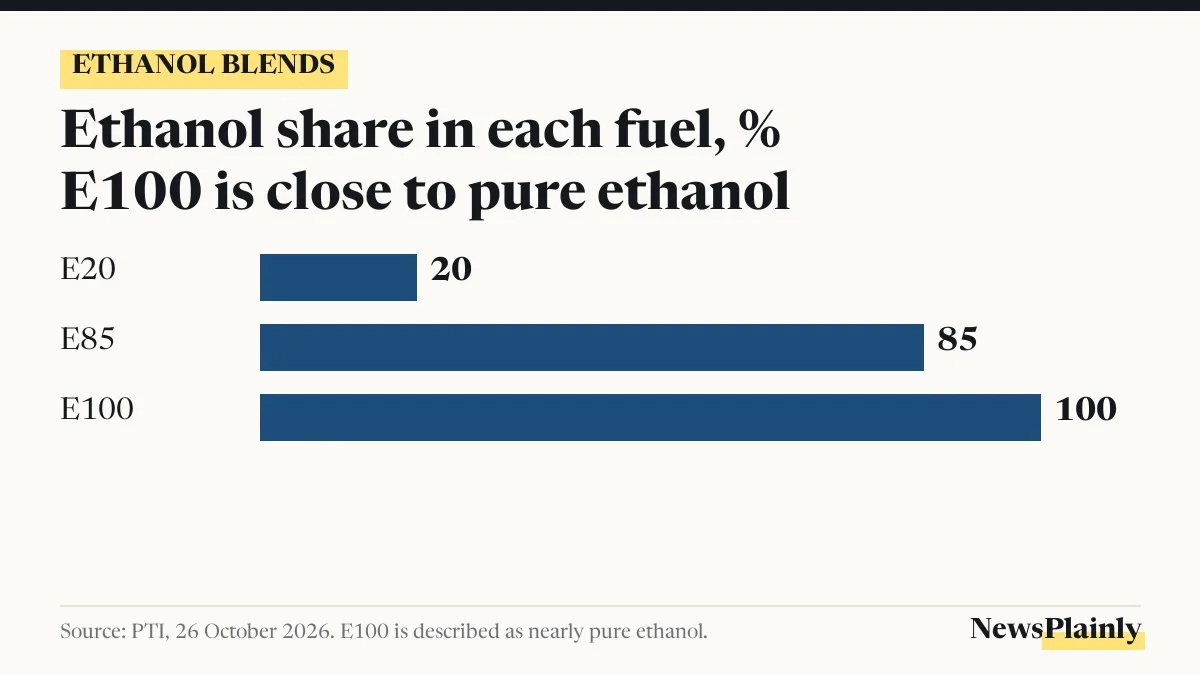
The letters and numbers are simple once decoded. The “E” stands for ethanol, a fuel alcohol, and the number is its share in the mix. E20, which India has already rolled out, is 20% ethanol and 80% petrol. E85 is 85% ethanol. E100 is close to pure ethanol.
What the E100 flex fuel notification changes
The amendment was issued as G.S.R. 911(E), ANI reported after reading the Gazette notification. Wherever Rule 115, the rule that sets vehicle emission standards, used to mention only E85, it now says “E85 or E100”. ANI quoted one line from the notification that sets the limit: “E85 or E100 shall be used in the vehicles designed by the original equipment manufacturers as Flex-fuel vehicles.” An original equipment manufacturer is the company that builds the vehicle in the first place.
A flex-fuel vehicle is one built to run on a range of petrol and ethanol blends from a single tank.
The notification also makes smaller technical changes. A gross vehicle weight limit in one emission table goes up from 3,000 kg to 3,500 kg; PTI said this concerns light petrol and diesel vehicles. IANS reported updates to the references for E20, for hydrogen mixed with compressed natural gas (HCNG) and for biodiesel standards, along with corrections in the emission testing tables and notes.
These rules started as a draft on 27 April 2026. The ministry said in the notification that it had considered the public’s objections and suggestions on that draft, ANI reported, and the amended rules take effect from the date they are published in the Official Gazette. The April draft also dealt with B100, which is pure biodiesel, PTI reported.
Can your E20 petrol car use E100? No
This is the question most car and bike owners will have about E100 flex fuel, and the officials’ answer was direct. Fuel beyond E20 and up to E100 is intended only for vehicles designed and certified to use it, a senior ministry official told PTI. Vehicles that run on E20 or normal petrol cannot use E85 or E100.
Officials quoted by The Times of India went a step further. They said the notification does not require owners of existing vehicles to switch to E85 or to modify their vehicles, now or in future.
| Who | What the amended rules mean for them |
|---|---|
| Owners of ordinary petrol or E20 cars and two-wheelers | Nothing changes. Officials said these vehicles cannot use E85 or E100 and owners need not switch or modify. |
| Owners of a factory-built flex-fuel vehicle | The emission rules now name E100 as well as E85 as fuels for vehicles built for them. |
| Carmakers and two-wheeler makers | Vehicles designed by them as flex-fuel models can be covered for E100 under Rule 115. |
| Fuel buyers looking for E100 at a pump | The notification did not give a timeline for E100 sales across the country, ANI reported. |
Which E100 flex fuel vehicles are on sale or coming
At least one is already on the road. In June 2026 Maruti Suzuki India launched the Wagon R Flex Fuel, which PTI described as India’s first flex-fuel passenger vehicle, able to run on blends from E20 to E100. Toyota, Tata Motors and Hyundai are also developing flex-fuel vehicles for India, according to PTI. The Times of India reported that the notification comes a few months before some carmakers plan to launch E100 models; it did not name them.
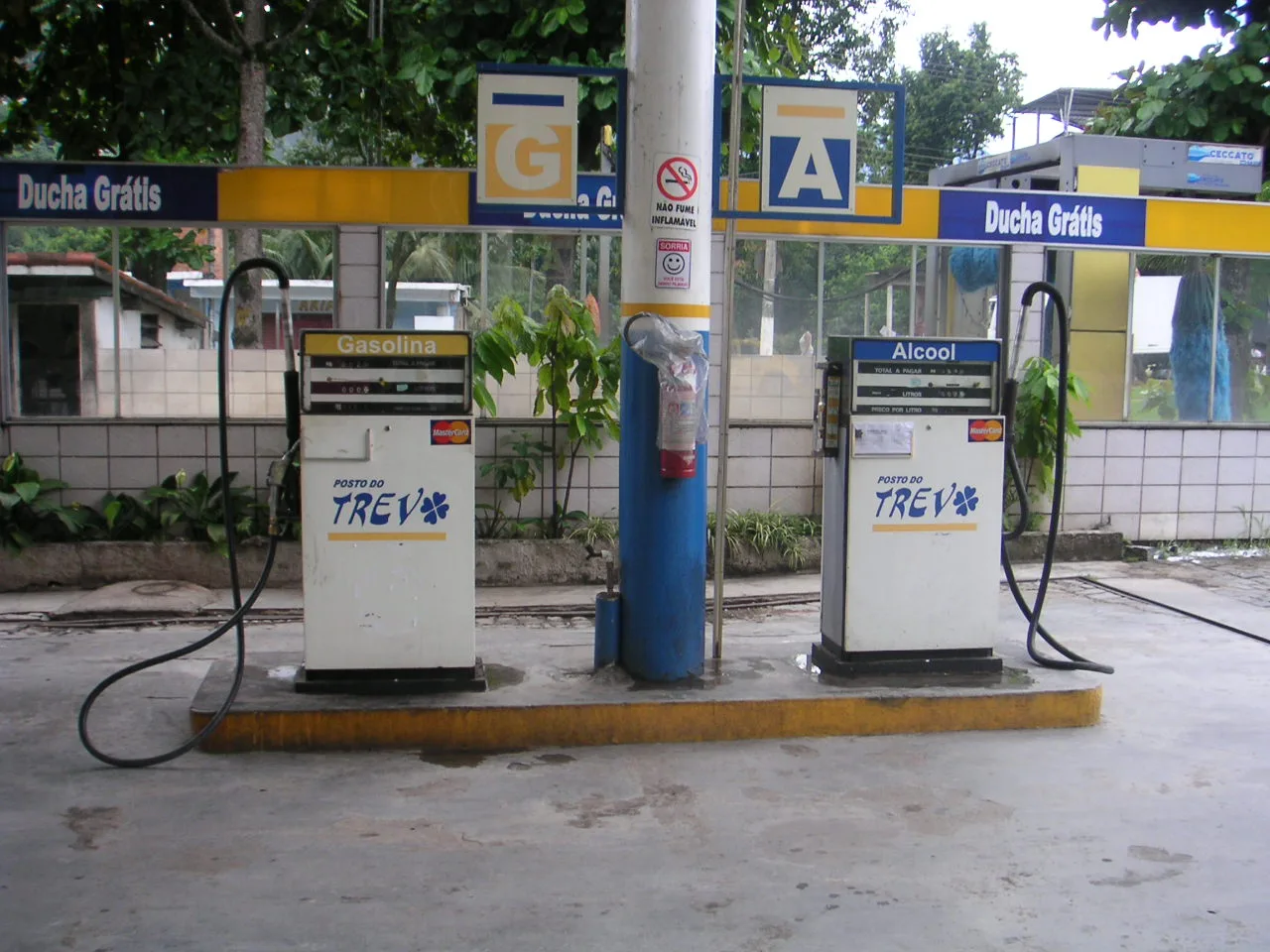
India is not inventing the idea. Officials told The Times of India that flex-fuel technology is already used in Brazil and the United States, where such vehicles take a range of ethanol and petrol blends from one tank. Depending on how a vehicle is built and certified, that range can go up to E85 or E100.
Why the government is pushing ethanol blending
The main reason given for ethanol blending is oil imports. Crude oil bought from abroad is one of the biggest contributors to India’s current account deficit, the gap between what the country pays the rest of the world and what it earns, PTI noted. In October the Indian crude basket topped $120 a barrel, its highest since March 2012. Officials also told The Times of India that ethanol has a lower fossil carbon footprint than petrol and that higher blends can cut tailpipe emissions of carbon monoxide and certain hydrocarbons.
Road Transport Minister Nitin Gadkari has made bigger claims. Earlier this year he said that a car running fully on ethanol could bring fuel costs down to the equivalent of about ₹25 a litre, IANS reported. That is his estimate, not a price anyone has announced for E100.
Supply is the other side of the ethanol blending question. Brickwork Ratings has estimated that India’s installed distillation capacity is 18.25 billion litres, according to IANS. In its base case for a 25% blend (E25), demand would reach 17.9 billion litres by the financial year 2030-31. By NewsPlainly’s arithmetic, that is about 98% of today’s capacity, leaving roughly 0.35 billion litres spare. If blending stays at E20, the agency’s bear case, its most cautious scenario, puts demand at 14.3 billion litres, about 78% of capacity. Earlier this month NewsPlainly reported a ₹3 fall in the maize ethanol price.
From draft to notification: the dates so far
- 27 April 2026: MoRTH publishes draft amendments to the Central Motor Vehicles Rules covering E85, E100, B100 biodiesel and HCNG, and invites objections.
- June 2026: Maruti Suzuki launches the Wagon R Flex Fuel, rated for E20 to E100.
- 26 October 2026: PTI, ANI and IANS report the final notification, G.S.R. 911(E), adding E100 to the emission rules for flex-fuel vehicles.
What has not been set out, in the reports read for this article, is when or where E100 will be sold to the public, or at what price. The rules settle which vehicles may use it. Getting the fuel to pumps is a separate step, and the notification as reported by ANI gave no timeline for it.
Frequently asked questions
Can I put E100 in my E20 petrol car?
No. Officials told PTI that vehicles running on E20 or normal petrol cannot use E85 or E100. Those fuels are only for vehicles designed and certified for them.
Do I have to modify my car for the new ethanol rules?
No. Officials quoted by The Times of India said the notification does not require owners of existing vehicles to switch fuel or modify their vehicles, now or in future.
What is E100 fuel?
E100 is fuel that is close to pure ethanol. E20 has 20% ethanol and 80% petrol, and E85 has 85% ethanol.
Which car in India runs on E100?
Maruti Suzuki's Wagon R Flex Fuel, launched in June 2026, can run on blends from E20 to E100, PTI reported. Toyota, Tata Motors and Hyundai are developing flex-fuel models.