Representative image. Subhrajyoti07, CC BY-SA 4.0, Wikimedia Commons

Why it matters
Most medicines in India are outside price ceilings, so their MRP is set by companies within a 10% yearly limit. If the court orders wider controls, what patients pay for many medicines and hospital consumables could change. For now only the 137 listed cancer drugs get a new cap, from 9 November.
The Supreme Court on 27 October 2026 reserved its order on a public interest petition that asks for medicine prices to be controlled far more widely than they are today. Before it did, a bench of Justices Vikram Nath and Sandeep Mehta pressed the Centre to explain why some medicines reach patients at many times the price retailers pay, Bar and Bench reported, as did Hindustan Times and the Times of India.
The Times of India reported that the bench said the pharmaceutical industry could not be allowed to “run amok” in the name of a free market, and that in some cases the maximum retail price (MRP) was over 1,000% of the price to retailer (PTR). The government’s lawyer said complete control of the market was not the answer and that India’s medicines are among the cheapest in the world. These were remarks and arguments at a hearing; the court has not yet ruled.
What the bench asked about medicine prices
The petition was filed by advocate Kishan Chand Jain; Hindustan Times reported that a second plea, by doctor Sanjay Kulshreshtha, was heard with it. According to Bar and Bench, the petition seeks generic prescriptions as a rule, price controls on non-scheduled medicines from the start, and statutory caps on the margins charged on medical devices under the Drugs (Prices Control) Order, 2013 (DPCO). The Times of India described the main prayer as bringing all non-patented medicines and medical consumables under price control, like scheduled drugs.
The bench repeatedly asked who benefits from a high MRP. Bar and Bench quoted it describing a medicine dealer whose wife was being treated for cancer at a private hospital: the dealer said the chemotherapy injection cost him ₹11,000 at dealer price, but the hospital would not use his supply and charged ₹1,30,000 for the same injection. Hindustan Times reported the dealer’s figure as ₹1,100. The bench also cited a saline drip line with a PTR of ₹15 that it said is billed to patients at ₹250, Bar and Bench reported.
According to Hindustan Times, the bench said the Centre’s affidavit was silent on three parliamentary committee reports on drug pricing, and asked what stopped the government from bringing all medicines under price control. Bar and Bench reported the bench’s remark that nearly 90% of medicines remain outside the DPCO even after the government’s recent step on cancer drugs.
The Centre’s reply: a 30% trade margin cap on 137 cancer drugs
Additional Solicitor General Aishwarya Bhati, appearing for the Centre, told the court the government had decided to cap trade margins on 137 anti-cancer drugs at 30% of the MRP, which it expects to save patients about ₹2,500 crore a year, Hindustan Times reported. The bench said that decision came only after the court stepped in. Bhati said discussions were already under way and the court’s intervention had sped them up, the Times of India reported.
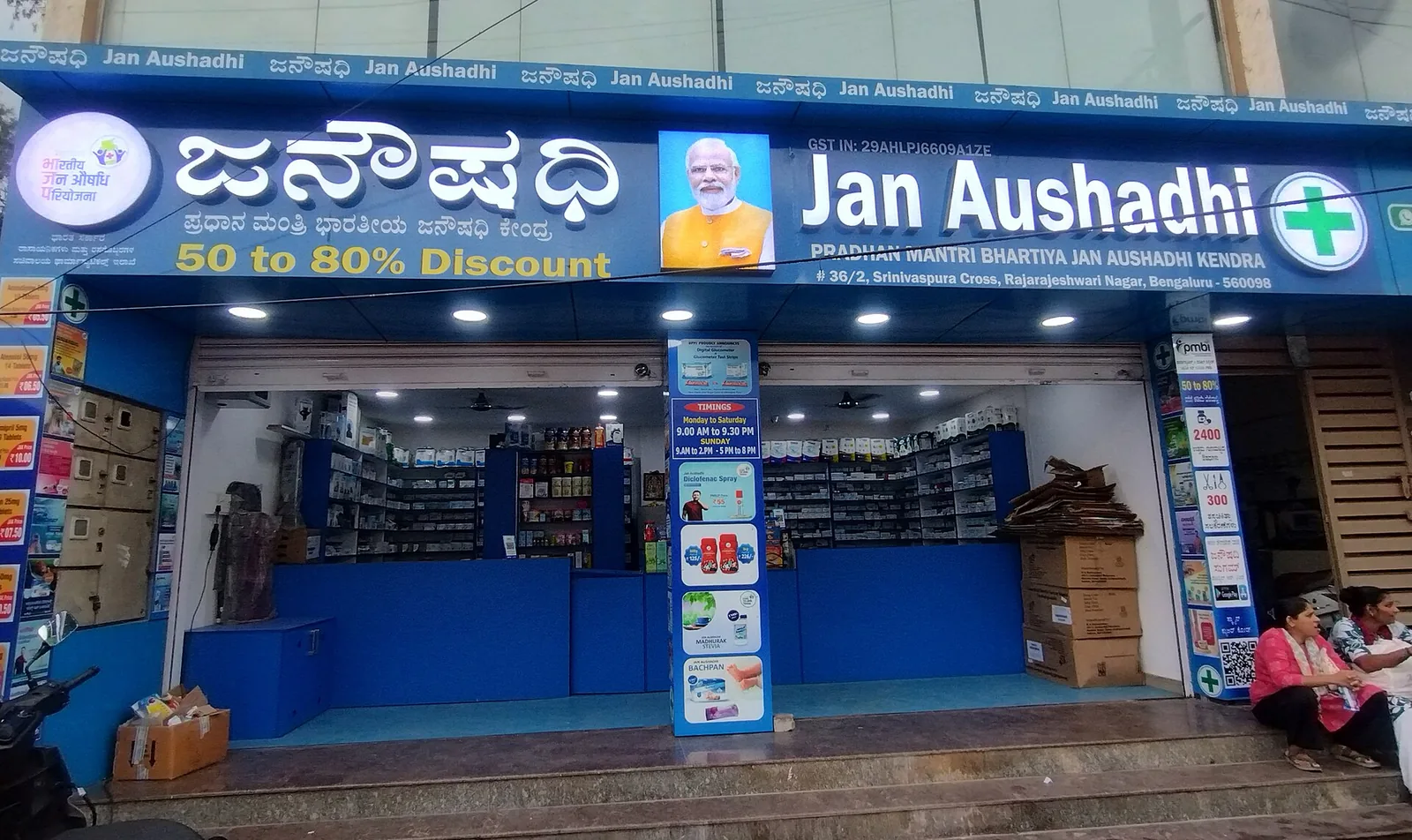
Bhati said the government does not back excessive trade margins but wants to protect investment and competition. Where there is real competition, she said, prices need no regulating, the market is not unregulated, and full control is not feasible. She argued that the matter was one of economic policy in which the court should not interfere, and pointed to generic medicines sold through Pradhan Mantri Bhartiya Janaushadhi Kendras, the government’s generic drug stores.
Senior advocate Mukul Rohatgi, appearing for a body of private hospitals, said private healthcare had to step in because public health services were overstretched, and argued that forcing them to cut drug margins would make hospitals collapse, given what it costs to keep facilities running around the clock, according to Bar and Bench. Hindustan Times reported that he offered a panel to find out whether hospitals were pocketing the margin. The bench replied that hospitals could survive by other means, Bar and Bench reported.
The cancer drug cap itself was announced on 17 October by the National Pharmaceutical Pricing Authority (NPPA), the regulator that fixes and monitors drug prices. The Press Trust of India (PTI) and All India Radio reported that it covers 137 non-scheduled cancer medicines under paragraph 19 of the DPCO, that revised prices apply from 9 November 2026, and that the government expects MRPs to fall by up to 70%, depending on each drug’s current price structure.
Price gaps cited in court, worked out
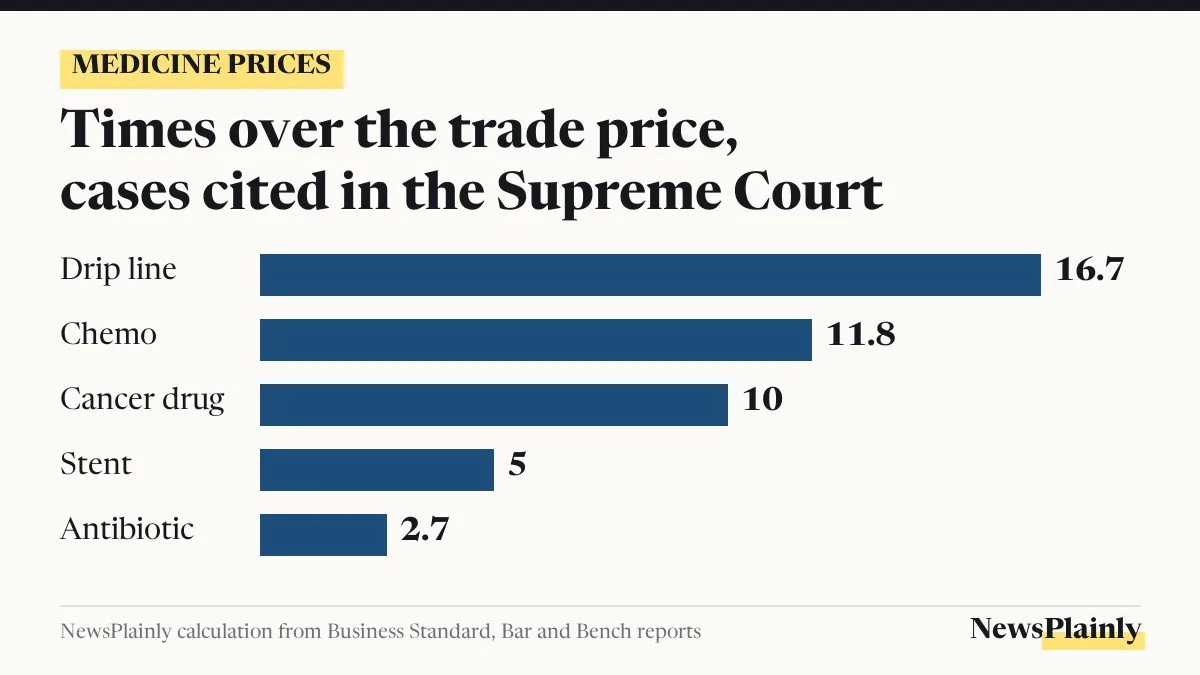
Over three hearings the bench put several price gaps on record. NewsPlainly divided the price charged by the trade price for each, using the reported figures.
| Product cited | Trade price | Price charged | Times over | Hearing |
|---|---|---|---|---|
| Cancer medicine | ₹2,700 (PTR) | ₹27,000 (MRP) | 10 | 29 Sep |
| Indian-made cardiac stent | ₹5,000 (PTR) | ₹25,000 (MRP) | 5 | 12 Oct |
| Azithromycin | ₹28.50 (price to stockist) | ₹78.29 (MRP) | 2.7 | 12 Oct |
| Chemotherapy injection | ₹11,000 (dealer price) | ₹1,30,000 (hospital bill) | 11.8 | 27 Oct |
| Saline drip line | ₹15 (PTR) | ₹250 (billed) | 16.7 | 27 Oct |
At the 29 September hearing the bench asked why the MRP of essential medicines such as cancer drugs could not be capped at 16% over the PTR, Business Standard reported. On 27 October it again said such products could simply be brought under a 16% trade margin, according to Hindustan Times. As an illustration only, NewsPlainly worked out what that would mean for the cancer medicine above: ₹2,700 plus 16% is ₹3,132, against the ₹27,000 MRP cited in court. The court has not ordered any such cap.
How drug price control works in India now
The DPCO is issued by the Centre under section 3 of the Essential Commodities Act, 1955, Hindustan Times noted. It splits medicines into two groups. For scheduled drugs, those in the first schedule of the order, the NPPA fixes a ceiling price. For non-scheduled drugs it only monitors prices, so that a company’s MRP does not rise by more than 10% in twelve months, according to a 2021 Department of Pharmaceuticals release on the Press Information Bureau (PIB) site.
The 16% figure the bench has cited comes from that system. Business Standard explained that it is the notional retailer margin the government adds when it works out the ceiling price of a scheduled medicine. Scheduled medicines make up only about 10% of the medicines on the market, the paper reported; the petitioner told the court that NPPA fixes ceilings for around 1,000 scheduled formulations, leaving nearly 82% of medicines outside that framework.
Trade margin rationalisation, the tool used for the 137 cancer drugs, works differently. Instead of fixing a price, it limits the trade margin on a medicine to a share of its MRP, 30% in the case of the cancer drugs. The 2021 PIB release says a 2019 pilot capped margins on 42 non-scheduled cancer medicines and cut the MRP of 526 brands by up to 90%. Business Standard reported on 12 October that the Department of Pharmaceuticals had told a parliamentary committee in August it was examining a proposal to make trade margin rationalisation part of the DPCO.
How the case reached this point
- 29 September 2026: The bench asks why essential medicines cannot be capped at 16% over the PTR. Solicitor General Tushar Mehta says a way that “balances equities” will have to be found (Business Standard).
- 12 October: The Centre tells the court cancer drug margins will be capped at 30%; the bench asks why only cancer drugs (Business Standard).
- 17 October: NPPA notifies the 30% cap for 137 cancer drugs (PTI, All India Radio).
- 27 October: Final hearing; the court reserves its order.
- 9 November: Revised prices for the 137 cancer drugs are due to take effect.
The reports read did not give a date for the verdict. The court is also hearing a separate dispute over lapsed permits for the antifungal amphotericin B.
Frequently asked questions
What did the Supreme Court decide on medicine prices?
Nothing yet. On 27 October 2026 a bench of Justices Vikram Nath and Sandeep Mehta heard the petitions and reserved its order.
Which cancer drugs will get cheaper?
NPPA capped trade margins on 137 non-scheduled cancer drugs at 30% of MRP from 9 November 2026.
What is the 16% margin the court mentioned?
It is the notional retailer margin added when the government calculates ceiling prices for scheduled medicines under the DPCO. The bench asked why it could not apply more widely.