Representative image. Sailko, CC BY 3.0, Wikimedia Commons

Why it matters
Growth decides jobs and incomes, and the RBI's reading of it shapes interest rates. Gupta's remarks put the gap between India's roughly 7% growth and 8% down mainly to outside shocks such as oil prices, while the RBI's own minutes show inflation projected to reach 6% and the repo rate already raised in October. That mix matters for anyone with a loan or savings.
India GDP growth would already be running at 8% if the economy had not been hit by a string of shocks from abroad, Reserve Bank of India (RBI) Deputy Governor Poonam Gupta said in Mumbai on 27 October 2026. Speaking in a fireside chat at the Business Standard BFSI (banking, financial services and insurance) Insight Summit, she said the economy had grown above 7% in what she called an “inconducive environment”, and that a calmer world could add between half a percentage point and one percentage point to growth.
Her remarks were a view given at a media event, not a new RBI growth forecast. The central bank’s official projection, set by its Monetary Policy Committee (MPC) earlier this month, puts India GDP growth at 7.1% for 2026-27.
What Poonam Gupta said about 8% growth
The news agency Press Trust of India (PTI) quoted her as saying that years of work since the 1991 reforms, including stronger systems, digital infrastructure and states acting as partners in growth, meant “we would have already been an 8 per cent growth economy”. The Times of India carried a version that tied the point directly to the shocks: India would already be an 8% economy “but for the external shocks”.
The Economic Times, which reported the event separately, listed the shocks she had in mind: high oil prices, deficient rainfall and El Nino, a periodic warming of the Pacific Ocean. In its account she said that if these had not happened over the last three years, the economy “would have been at our inflection point already”.
On the upside, PTI quoted her as saying that if the global environment gets better, “another 50 bps to 1 percentage point growth will come just from there”. A basis point (bps) is one hundredth of a percentage point, so 50 bps is half a point. The Times of India’s report placed that improvement “in the next one year” if conditions ease.
She also said the economy had become less sensitive to shocks that used to hurt it more, such as the volume of oil used or a shortfall in rain, and that not relying too much on one line of activity had helped, PTI reported.
Oil and foreign money are the pressure points
Poonam Gupta did not describe every risk the same way. According to PTI, she said fuel and external finance remain the challenges facing the country, while food is not: “Food is not a challenge; if anything, we are becoming an exporter. This year is El Nino, but even then it is managed very well.”
External finance here means the money India needs from abroad to pay for imports and investment. Her statement in the minutes of the October MPC meeting explains why it is a concern now: she pointed to the flare-up in the West Asia conflict, oil prices that have stayed high, and heavy borrowing by governments and companies in some rich economies, which pushes up the cost of funds for emerging markets such as India.
On the government’s role, PTI reported her as saying that fiscal policy can soften the first blow of a supply shock through targeted measures, as long as those measures stay consistent with fiscal prudence. She added that the gap between the interest the government pays on its borrowing and nominal GDP growth leaves India well placed, and that the debt-to-GDP ratio should fall in a business-as-usual scenario.
On artificial intelligence, the RBI deputy governor dismissed fears of large job losses, saying such a thing had not happened with earlier technology shifts, PTI reported. For a closer look at India’s oil purchases, see our report on Russian oil imports and Hardeep Puri’s comments.

India GDP growth: the RBI’s official numbers
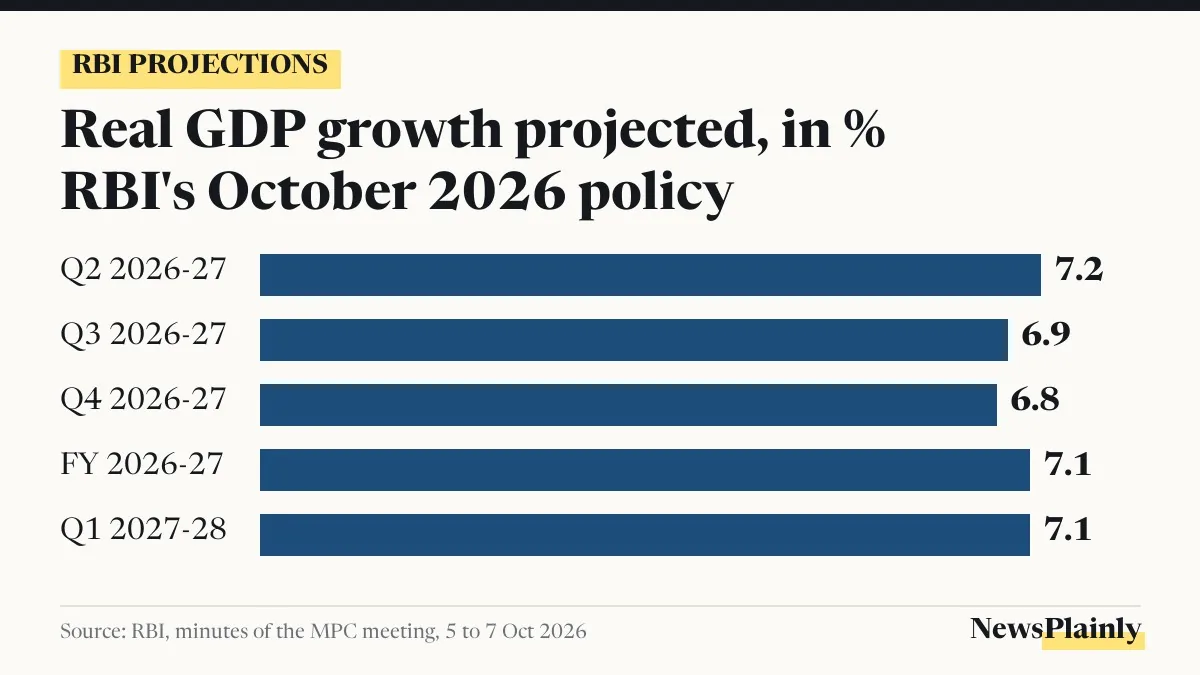
The detailed numbers sit in the minutes of the MPC meeting held from 5 to 7 October, which the RBI has since published. According to the minutes, real GDP grew 7.8% in April to June 2026, the first quarter of 2026-27, based on National Statistics Office (NSO) estimates. Poonam Gupta wrote that this was well above the August growth forecast.
The same meeting raised the repo rate, the rate at which the RBI lends to banks, by 25 basis points to 5.50%, and changed the policy stance to “calibrated tightening”. All six members voted for the increase.
| Period | GDP growth projection | Inflation projection (CPI) |
|---|---|---|
| July to September 2026 (Q2) | 7.2% | 4.9% |
| October to December 2026 (Q3) | 6.9% | 6.0% |
| January to March 2027 (Q4) | 6.8% | 5.7% |
| Full year 2026-27 | 7.1% | 5.2% |
| April to June 2027 (Q1 of 2027-28) | 7.1% | 5.6% |
Governor Sanjay Malhotra noted in the minutes that the 7.1% full-year figure is 40 basis points higher than the 6.7% projected in August. The table also shows why the RBI turned cautious: inflation, measured by the consumer price index (CPI), is projected to reach 6.0% in the October to December quarter, the upper limit of its tolerance band, while projected growth eases through the rest of the year.

How far 7.1% is from 8%, in numbers
Put the RBI deputy governor’s two remarks next to the official growth forecast and the size of the gap becomes clearer. This is NewsPlainly’s arithmetic on her comments, not an RBI growth forecast:
- 8% minus the official 7.1% projection for 2026-27 leaves a gap of 0.9 percentage points.
- Adding the 0.5 percentage point she mentioned to 7.1% gives 7.6%.
- Adding the full 1 percentage point gives 8.1%.
In other words, the upper end of the boost she described would take growth past 8% on paper, but only if the outside world improves. She gave no timeline beyond the next year and did not say which shock would need to ease first.
What comes next for India GDP growth and rates
The next official reading on growth is the GDP data for July to September, which The Economic Times said is due on 30 November. Poonam Gupta said high-frequency indicators such as tax collections, bank credit, merchandise exports, purchasing managers’ surveys and infrastructure activity suggest the momentum carried into that quarter, the paper reported.
On interest rates, her statement in the October minutes went further than her remarks at the summit. She wrote that weather problems and global oil and commodity prices may keep pushing headline inflation up, and that “it is conceivable that a further increase in the policy rate might be needed”. She added that the pace and size of any such step would depend on incoming data on inflation and whether price rises spread more widely.
Frequently asked questions
What did Poonam Gupta say about India's GDP growth?
On 27 October 2026 the RBI deputy governor said India would already be an 8% growth economy but for external shocks, and that better global conditions could add 0.5 to 1 percentage point to growth, PTI reported.
What is the RBI's GDP growth forecast for 2026-27?
7.1%, according to the minutes of the MPC meeting of 5 to 7 October 2026, up from 6.7% projected in August.
Which shocks held back India's growth?
According to The Economic Times, she named high oil prices, deficient rainfall and El Nino over the last three years. PTI reported her saying fuel and external finance remain the main challenges.
Did the RBI raise interest rates in October 2026?
Yes. The MPC raised the repo rate by 25 basis points to 5.50% and changed its stance to calibrated tightening, the minutes show.