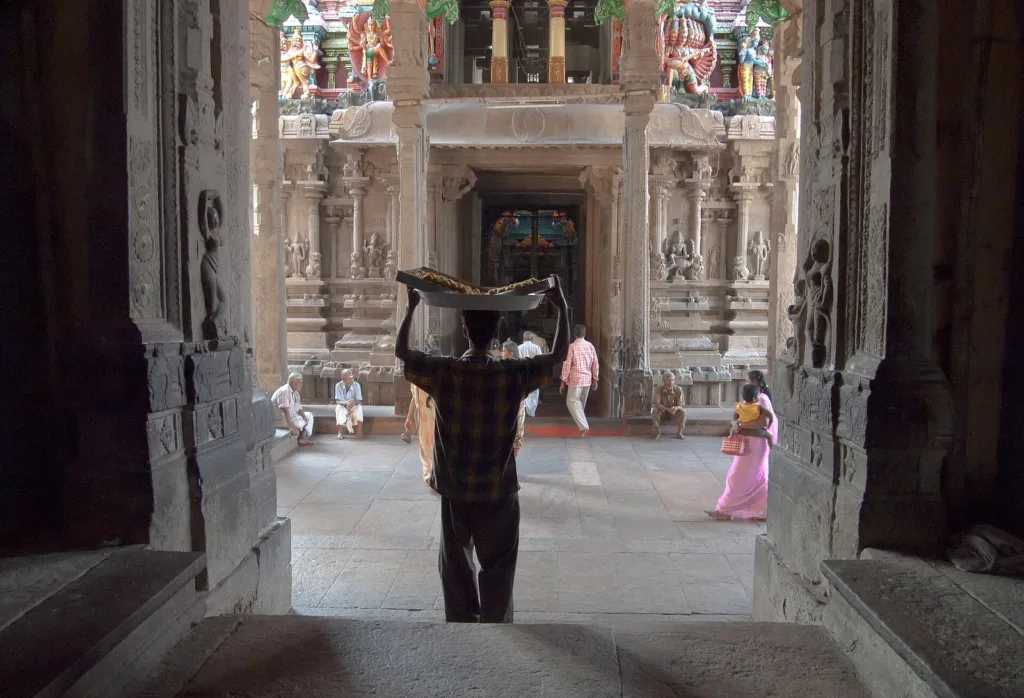
Representative image. Vyacheslav Argenberg, CC BY 4.0, Wikimedia Commons

Why it matters
The order turns a 2024 single-judge direction into a Division Bench ruling for Agamic temples across Tamil Nadu, and extends it from the area beyond the flagstaff to the temple premises for non-Hindus who display religious markers. It places the duty on temple trustees, but leaves the format of the undertaking to each temple and does not define a religious marker.
Non-Hindus who want to go beyond the flagstaff, or kodimaram, of Agamic temples in Tamil Nadu must first sign an undertaking affirming their reverence for the deity, and those who display the religious markers of another faith cannot enter the temple premises at all without one, the Madras High Court has ruled. A Division Bench of Justices G.R. Swaminathan and P. Murugan at the court’s Madurai Bench passed the order on 23 October 2026. It was uploaded to the court’s website on 27 October and reported that day by LiveLaw and The Hindu.
Agamic temples are those whose worship follows the Agamas, traditional texts that set the rules for rituals inside a temple. The bench said its ruling is limited to such temples, and the visits it cited were at the Meenakshi temple in Madurai, the Tiruchendur temple and the Arunachaleswarar temple in Tiruvannamalai.
What the Madras High Court order on Agamic temples says
The case was a writ petition filed by Thangam Venkatesh, a Madurai resident, against the Tamil Nadu government and three senior officers of its Hindu Religious and Charitable Endowments (HR&CE) department, which oversees Hindu temples under a 1959 state law. He asked the court to order an inquiry into people who, he said, had broken the Tamil Nadu Temple Entry Authorisation Act, 1947, based on a complaint he made on 17 October. He also sought inquiry committees and a complaints cell to keep people bearing other religious symbols out of restricted sanctums and mandapams, the pillared halls of a temple.
The state’s lawyer, Additional Advocate General P.V. Balasubramanian, told the bench that the procedure in the relevant laws and rules was being followed and would continue to be, the 19-page order records. Citing recent developments, the petitioner had asked for an authoritative pronouncement, and the two-judge bench gave one.
The operative part of the Madras High Court order comes in its last paragraph. The bench said the petitioner, as a Hindu, was entitled to insist that trustees of Agamic temples in Tamil Nadu do not let non-Hindus who have not signed the temple entry undertaking cross the flag-pole. It then went further: even entry into the temple premises cannot be allowed for non-Hindus who display their religious markers and do not affirm their reverence for the deity. The affirmation must be in the format each temple prescribes. The petition was allowed, with no costs.
For the meaning of “temple”, the judges used the wider definition in the 1947 Act, which covers subsidiary shrines and mandapams attached to the main shrine. They also cited the HR&CE Act, 1959: section 10 requires every person employed under the Act to profess Hinduism, and section 24(4) says nothing in that section allows a non-Hindu to enter the premises it covers.
Where the temple entry undertaking applies, place by place
The order sets rules for two parts of a temple: the premises, and the area beyond the flagstaff. The table below is NewsPlainly’s reading of its last two paragraphs.
| Visitor | Temple premises, before the flagstaff | Beyond the flagstaff |
|---|---|---|
| Hindus | Allowed | Allowed up to the sanctum, which the order says is open only to priests |
| Non-Hindus who sign the undertaking | Allowed | Allowed, on the undertaking |
| Non-Hindus who display religious markers and do not sign | Not allowed | Not allowed |
| Other non-Hindus who do not sign | The premises bar is worded for those who display markers | Not allowed |
The order does not define what counts as a religious marker. It does not give a format for the temple entry undertaking, a date by which temples must put one in place, or a penalty for a breach.
On caste, the bench drew a line. It said Agamic injunctions that once barred certain classes of Hindus from crossing the flag-pole cannot survive under the Constitution, which it said “ranks paramount”. Those same injunctions, it added, still hold good for non-Hindus who do not sign the undertaking.
The 1972 and 2024 rulings the bench built on
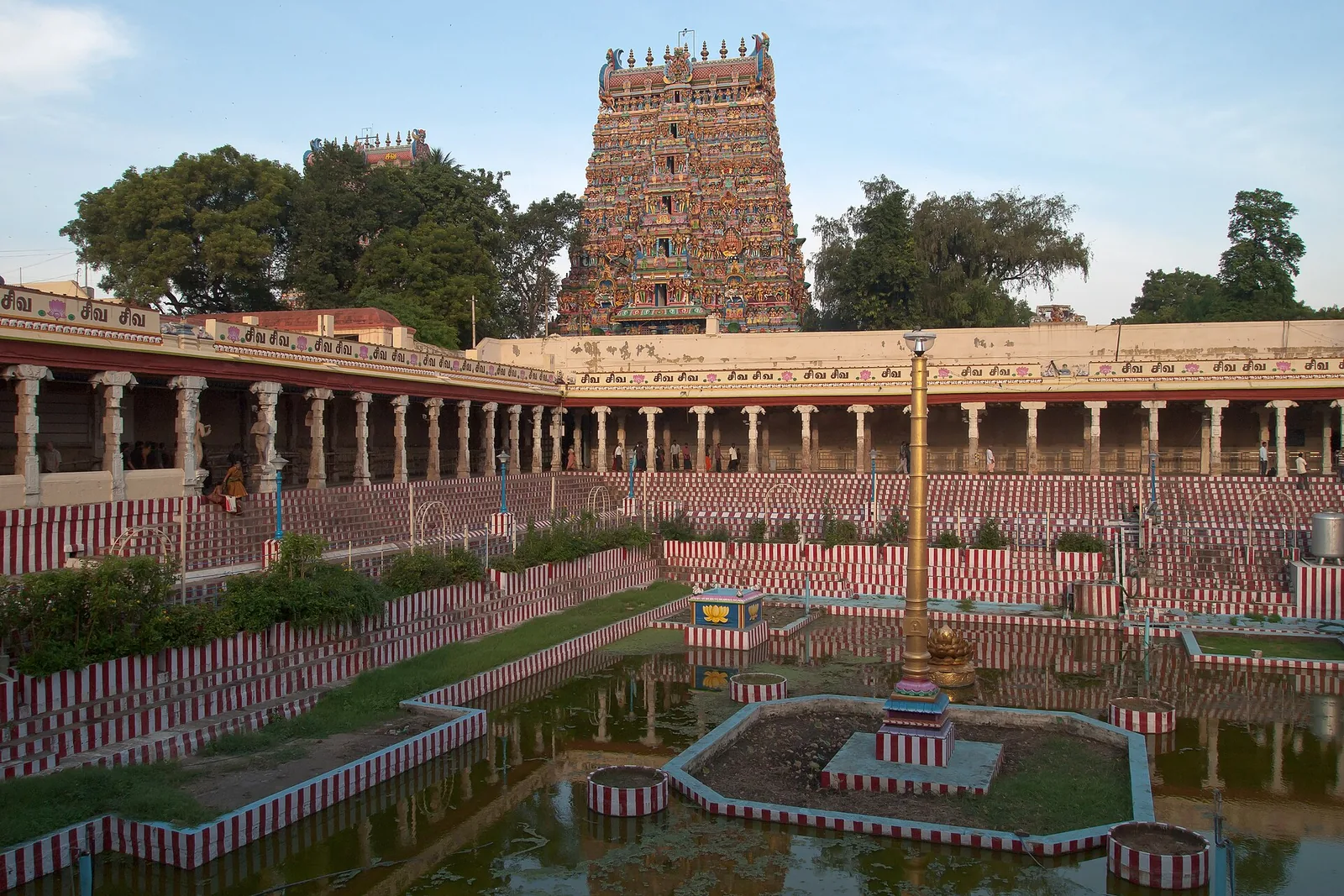
The judges said the question had already been answered by two single judges of the same court. In 1972, in Kalyan Dass v. State of Tamil Nadu, Justice T. Ramaprasada Rao struck down Rule 4A of the Temple Entry Authorisation Rules, which had provided for admitting non-Hindus into temple premises, holding that it went beyond the parent Act. The bench agreed with that conclusion but said it disapproved of one of the reasons given in 1972, a passage about music and processions near mosques.
In 2024, in D. Senthilkumar v. Government of Tamil Nadu, Justice S. Srimathy of the Madras High Court ordered boards saying non-Hindus are not allowed beyond the kodimaram. Her order allowed a non-Hindu to visit a deity after giving an undertaking of faith in the deity and of following Hindu and temple customs, with each such entry recorded in a register kept by the temple. That case arose at the Palani hill temple, according to the new order.
Visits the bench cited: an MLA, a minister and the Chief Minister
The bench said that although the law was clear, there had been what it called egregious breaches in recent times. It named Badrudeen Mustafa, the MLA for Madurai Central, the constituency that includes the Meenakshi temple. The order says he went inside the temple premises soon after his election, saying he had a right to check whether proper amenities were provided, and later went up the temple towers during the Kumbabishekam, the consecration ceremony. The reports read for this article did not carry a response from him.
The judges also took judicial notice, meaning they treated it as a known fact without formal proof, that a minister who is Christian by faith entered the Tiruchendur temple without giving the undertaking. The order does not name the minister. It also referred to a video circulating on social media from the Arunachaleswarar temple in Tiruvannamalai, saying people pushed their way in despite devotees’ protests while HR&CE staff “stood as mute spectators”.
By contrast, the bench pointed to Chief Minister C. Joseph Vijay, who it said worshipped at the Meenakshi temple after signing the temple entry undertaking. “The Hon’ble Chief Minister who is a Christian by faith was not asked to convert to Hinduism. He was only requested to affirm his reverence for the deity,” the order says, calling this an inclusive approach. Hindustan Times reported that Mr Vijay signed the undertaking at the Meenakshi Sundareswarar temple in September and followed a similar procedure at the Tiruchendur Murugan temple in April.
The judges also criticised political “Chamchagiri”, or sycophancy, by party workers who follow a leader into a temple. Temple customs, they wrote, “cannot kneel down” before such displays.
Timeline of the temple entry rules
- 1947: Tamil Nadu Temple Entry Authorisation Act; it defines a temple to include subsidiary shrines and mandapams.
- 1972: Justice T. Ramaprasada Rao strikes down Rule 4A, which provided for admitting non-Hindus.
- 2024: Justice S. Srimathy orders boards at the kodimaram, plus an undertaking and a register for non-Hindu visitors.
- April and September 2026: Chief Minister Vijay signs undertakings at Tiruchendur and Madurai, Hindustan Times reported.
- 17 October 2026: Thangam Venkatesh’s complaint to the authorities, cited in his petition.
- 23 October 2026: Division Bench order; uploaded on 27 October.
Who decides how the rule works at Agamic temples
The order puts the duty on temple trustees, with the HR&CE department as the respondent. Each of the Agamic temples is to prescribe the format of the temple entry undertaking. The bench made clear that places of worship whose devotees cut across religions are outside its ruling, naming the shrines of Lord Ayyappa and Shirdi Sai Baba as examples.
The order, the LiveLaw report and the Hindustan Times and The Hindu reports read for this article do not say whether the state government plans to appeal or how temples will put the undertaking into practice.
Frequently asked questions
What did the Madras High Court say about non-Hindus in Agamic temples?
In an order dated 23 October 2026, a Division Bench said non-Hindus who have not signed an undertaking of reverence for the deity must not be allowed beyond the flagstaff, and those who display religious markers cannot enter the premises without it.
What is an Agamic temple?
It is a temple whose worship follows the Agamas, traditional texts that set the rules for rituals. The court said its ruling applies only to such temples, not to shrines such as those of Lord Ayyappa or Shirdi Sai Baba.
Did Chief Minister Vijay sign the temple entry undertaking?
Yes. The order says Chief Minister C. Joseph Vijay, a Christian, worshipped at the Meenakshi temple after signing it, and Hindustan Times reported he did the same at Tiruchendur in April.
Who filed the case?
Thangam Venkatesh, a Madurai resident, filed a writ petition against the Tamil Nadu government and the HR&CE department seeking stricter enforcement of the 1947 Temple Entry Authorisation Act.