
Representative image. Doc Searls from Santa Barbara, USA, CC BY 2.0, Wikimedia Commons

Why it matters
Two wins from two put India one win from taking the series with three games left. The bowling, led by a young pace group, has carried both results, while India lost early wickets in both chases and needed rain and the DLS par to get home on Saturday. For fans, the Hamilton game on Tuesday is the chance to settle the series early.
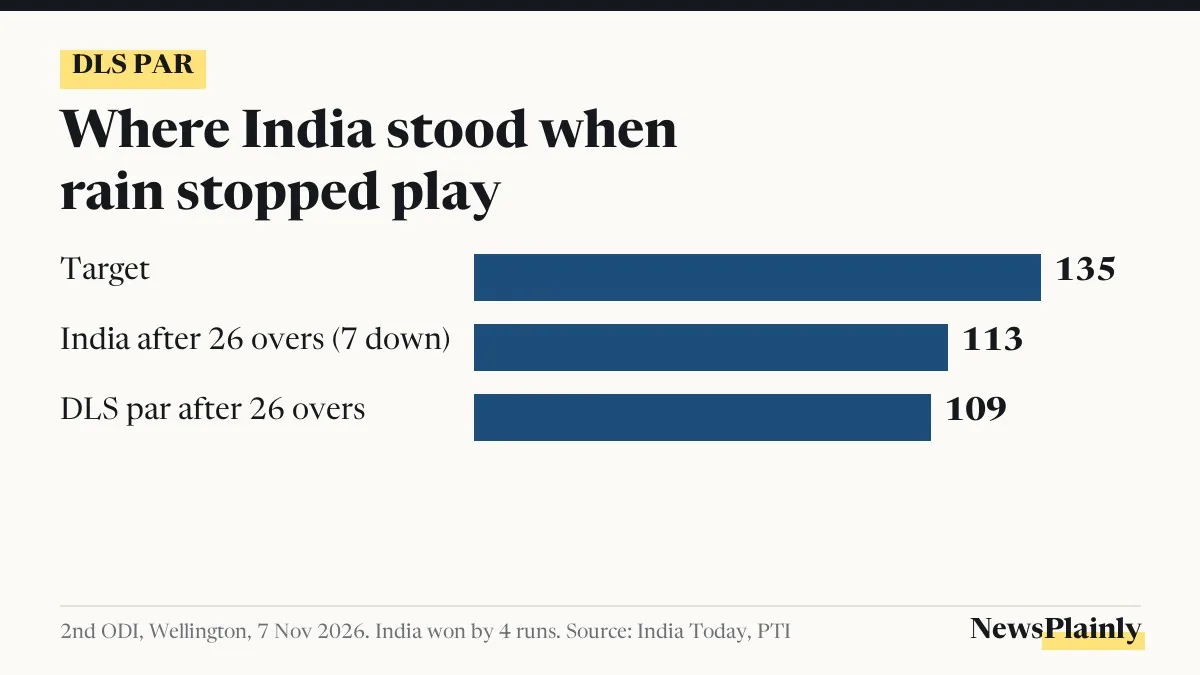
India beat New Zealand by four runs on the Duckworth-Lewis-Stern (DLS) method in the rain-hit second one-day international (ODI) in Wellington on Saturday, 7 November 2026, and lead the five-match series 2-0. In this India vs New Zealand DLS finish, India were 113 for 7 after 26 overs, chasing 135, when rain stopped play. The DLS par score at that point was 109, so India were four runs ahead, India Today reported, as did the news agency PTI (Press Trust of India).
The bowlers had done the hard part. New Zealand were bowled out for 134 in 41 overs, with Gurnoor Brar taking 4 for 30 and Auqib Nabi taking his first wickets for India. The chase then slipped from routine to nervy as wickets fell around KL Rahul, who was unbeaten when the rain came.
How Brar, Nabi and Kamboj bowled New Zealand out for 134
Rain delayed the start and cut the match to 47 overs a side. Shubman Gill won the toss and chose to bowl. Auqib Nabi, wicketless in the first ODI, removed both openers: Tim Seifert for a duck, his first wicket in international cricket, and Will Young for 6, according to reports by the Indian Express, India Today and Reuters. Anshul Kamboj then had Henry Nicholls play on for 11 in the ninth over.
Gurnoor Brar did the most damage. In a double-wicket maiden he removed Tom Latham and Glenn Phillips with short balls, leaving New Zealand at 53 for 5. Daryl Mitchell, dropped by Gill, made 55 off 104 balls and captain Mitchell Santner 31 off 38. Their stand of 59 was the only real resistance; the news agency ANI (Asian News International) puts the score at 112 for 5 before it ended, and 112 minus 53 gives the same 59 that PTI and India Today report.
Axar Patel broke it by having Mitchell caught off a mistimed lofted drive. Brar came back to dismiss Nathan Smith and then Santner, caught behind by Rahul.
The bowling figures, as PTI and India Today report them:
| Bowler | Overs | Runs | Wickets |
|---|---|---|---|
| Gurnoor Brar | 10 | 30 | 4 |
| Axar Patel | 9 | 28 | 2 |
| Anshul Kamboj | 8 | 25 | 2 |
| Auqib Nabi | 7 | 31 | 2 |
| Arshdeep Singh | 7 | 16 | 0 |
Both reports say the 4 for 30 is the best ODI return of Gurnoor Brar’s career, and that India’s bowlers sent down 176 dot balls. Arshdeep Singh went wicketless but gave away only 16 runs in his seven overs.
Why a chase of 135 turned nervy for India
The target looked small. It did not play that way. Jacob Duffy had Gill out first ball for a golden duck and removed Virat Kohli for 7 in his next over, Reuters reported. It also pointed to a tight spell from Kyle Jamieson, and India lost their fourth wicket before reaching 50, by both India Today’s and Reuters’ accounts.
Shreyas Iyer, with 30 off 46 balls, and Rahul steadied the innings. More wickets followed after Iyer fell, and by the time the rain returned India had lost seven. Rahul was still there, not out, with India needing 22 more runs from 21 overs.
India Today’s report blamed India’s shot selection, noting that the required rate never put the batters under pressure. New Zealand’s quick bowlers used the short ball on a pitch that gave them some help, it said.
India vs New Zealand DLS: what the par score of 109 meant
The DLS method decides a match that cannot be finished. It works out how much of the batting side’s resources, overs and wickets together, has been used, and sets a par score: the total the chasing side needed at that moment to be level. If they are above par when play ends for good, they win by the difference.
In the India vs New Zealand 2nd ODI, India had used 26 of their 47 overs, about 55% of them. On a straight share of overs, that would point to about 74 of the 135 runs. The DLS par score, though, was 109, about 81% of the target. That is NewsPlainly’s calculation from the reported figures, and the gap comes from the wickets: with seven down, India had only three left for the last 21 overs, so DLS counted most of their batting resources as spent. India’s 113 was four more than 109, which is the winning margin.
Had India lost an eighth wicket before the rain, the DLS par score for the same 26 overs would have been higher still.
India vs New Zealand ODI series 2026 so far, and the 3rd ODI in Hamilton
Rain has shaped both matches, and both chases were played to DLS figures. India won the first ODI at Eden Park in Auckland on 4 November by five wickets, chasing a revised 143 in 32 overs, as NewsPlainly reported from the series opener.
| Match | Date and venue | New Zealand | India | Result |
|---|---|---|---|---|
| 1st ODI | 4 Nov, Auckland | 185 (40.2 overs) | 143/5 (22.4 overs), DLS target 143 in 32 overs | India won by 5 wickets |
| 2nd ODI | 7 Nov, Wellington | 134 (41 overs) | 113/7 (26 overs), DLS par 109 | India won by 4 runs (DLS) |
| 3rd ODI | 10 Nov, Hamilton | Scheduled, 7.30 am IST | ||
| 4th and 5th ODIs | 13 and 15 Nov, Mount Maunganui | Scheduled, 7.30 am IST | ||
The series moves to Hamilton for the third ODI on Tuesday, 10 November, Reuters reported. The BCCI fixture list puts all five matches at 7.30 am IST. Gill captains in the first three games and Shreyas Iyer is to lead in the fourth and fifth, the Indian Express has reported. A win in Hamilton would give India the series with two games to spare.
Gurnoor Brar, Anshul Kamboj and Auqib Nabi have now taken 13 of the 20 New Zealand wickets across the two games: Brar 7, Kamboj 4 and Nabi 2, NewsPlainly’s count from the reported figures. At the top of India’s order, Gill and Kohli made 7 runs between them in Wellington, and Rohit Sharma was out for a duck in the opener.
Frequently asked questions
How did India win the 2nd ODI against New Zealand?
On the DLS method. Rain stopped play with India on 113 for 7 after 26 overs, four runs above the par score of 109, so India won by four runs.
What is a DLS par score?
It is the score the chasing side needs at a given point to be level, worked out from the overs used and wickets lost. A side above par when play ends wins by the difference.
When and where is the 3rd ODI between India and New Zealand?
On Tuesday, 10 November 2026, in Hamilton, scheduled to start at 7.30 am IST according to the BCCI fixture list.