Representative image. Captain avestar, CC0, Wikimedia Commons

हिन्दी में सारांश Summary in Hindi
- यूपी सरकार ने 7 नवंबर 2026 को राज्य कर्मचारियों का महंगाई भत्ता 60% से बढ़ाकर 63% किया।
- नई दर 1 जुलाई 2026 से लागू, नकद भुगतान नवंबर 2026 के वेतन के साथ होगा।
- क्टूबर का एरियर भविष्य निधि खाते में जाएगा, 1 नवंबर 2027 तक नहीं निकाला जा सकेगा।
বাংলায় সারাংশ Summary in Bangla
- উত্তরপ্রদেশ সরকার 7 নভেম্বর 2026 রাজ্য কর্মীদের মহার্ঘ ভাতা 60% থেকে বাড়িয়ে 63% করল।
- নতুন হার 1 জুলাই 2026 থেকে, নগদে মিলবে নভেম্বর 2026-এর বেতনের সঙ্গে।
- ক্টোবরের বকেয়া প্রভিডেন্ট ফান্ডে জমা হবে, 1 নভেম্বর 2027-এর আগে তোলা যাবে না।
Why it matters
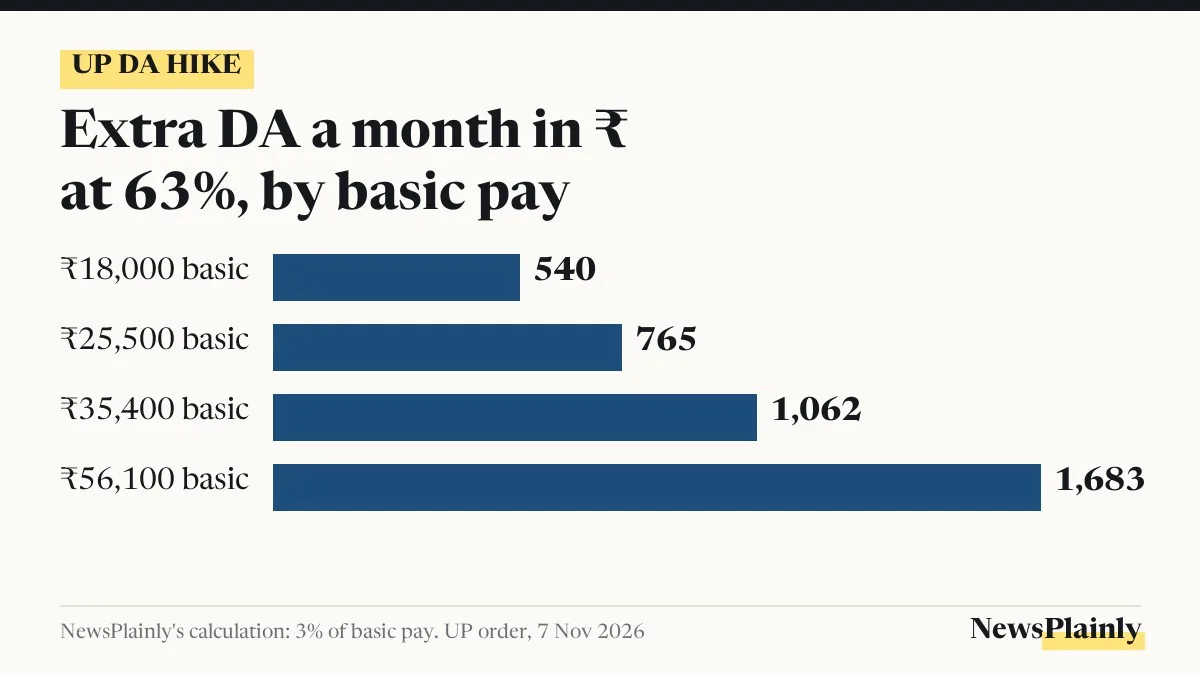
Take-home pay rises from the November salary by 3% of basic pay, which is ₹540 to ₹1,683 a month on the sample pay levels in our table. The four months of arrears are held as savings rather than paid out, so most employees will not have that money for festival spending.
Dearness allowance (DA) for Uttar Pradesh’s government staff is going up. In the UP DA hike ordered on 7 November 2026, the state government raised dearness allowance for its employees by 3 percentage points, from 60% to 63% of basic pay, with effect from 1 July 2026. The government order issued by the state finance department says the higher rate will be paid in cash with the November 2026 salary, while four months of arrears go into provident fund accounts.
Dearness allowance is the extra amount, worked out as a share of basic pay, that governments add to salaries to make up for rising prices. Today’s order says the state is following the rate the Centre set for its own staff, and in May the state likewise matched the central rate of 60%.
What the UP DA hike order says
The order is numbered 7/2026 and signed by Alok Kumar, Principal Secretary, in the Finance (Pay Commission) Section-1 in Lucknow. It refers to the Union finance ministry’s office memorandum of 29 October 2026, which gave central government employees DA at 63% from 1 July 2026, and to the state’s own order of 21 May 2026 that set the previous rate.
That May order took UP’s DA from 58% to 60% from 1 January 2026, Bhaskar English reported at the time. Live Hindustan’s report on Saturday described today’s change as a rise from 58%, but the new order builds on the May order, and India Today and Amar Ujala both reported the step as 60% to 63%.
India Today reported that Chief Minister Yogi Adityanath announced the increase ahead of Diwali, a few months before the 2027 Uttar Pradesh Assembly election. Live Hindustan put the number of employees who benefit at more than 14 lakh; the order itself gives no head count.
Which UP government employees get the higher dearness allowance
The order lists five groups of staff who get DA at 63% from 1 July 2026:
- full-time regular employees of the state government;
- regular, full-time staff of government-aided educational and technical educational institutions;
- regular, full-time staff of urban local bodies, such as municipal corporations (nagar nigams);
- work-charged employees (karyaprabharit karmchari), staff engaged on a works budget;
- post holders working on University Grants Commission (UGC) pay scales.
The order is about serving staff. It does not deal with dearness relief, the matching increase for pensioners.
The decision follows the 30-day Diwali bonus that the state announced earlier this week, of which most of the money also goes into provident fund accounts, as NewsPlainly reported on the UP Diwali bonus.
How much more a month: NewsPlainly’s calculation
Because DA is a percentage of basic pay, a 3-point rise adds 3% of basic pay to the monthly salary of UP government employees. The table below is NewsPlainly’s calculation on four sample basic pay figures. Inputs: the new rate of 63%, the old rate of 60%, and four months of arrears for July to October 2026. Arrears are shown before income tax, which the order says will be deducted.
| Basic pay a month | Extra DA a month | DA at 63% | Arrears, July to October |
|---|---|---|---|
| ₹18,000 | ₹540 | ₹11,340 | ₹2,160 |
| ₹25,500 | ₹765 | ₹16,065 | ₹3,060 |
| ₹35,400 | ₹1,062 | ₹22,302 | ₹4,248 |
| ₹56,100 | ₹1,683 | ₹35,343 | ₹6,732 |
To work out your own figure, multiply your basic pay by 0.03 for the monthly rise and by 0.12 for the gross arrears. On ₹40,000 basic pay, for example, the rise is ₹1,200 a month and the arrears come to ₹4,800 before tax.
The dearness allowance amounts are the same as those central government staff on the same basic pay get after the Centre’s decision last month, because both now pay 63%. Neighbouring Haryana also moved to 63% from 1 July, covering staff and pensioners, as NewsPlainly reported on the Haryana DA hike.
Where the July to October arrears will go
For most staff, only the rise from November onwards is paid in cash. For the four months from 1 July to 31 October 2026, the order sets out different routes depending on the employee’s pension scheme and service status:
| Employee | What happens to the arrears |
|---|---|
| Member of the provident fund (GPF) | Credited to the provident fund account after income tax and surcharge are deducted; cannot be withdrawn before 1 November 2027, except where final withdrawal is due under the fund rules |
| Not a provident fund member | Deposited in a Public Provident Fund (PPF) account or given as National Savings Certificates (NSC); any part that cannot be covered by a certificate is paid in cash |
| Under the National Pension System (NPS) | 10% of the arrears goes to the Tier-1 pension account and the state adds 14% of the arrears as its share; the remaining 90% goes to PPF or NSC |
| Service ended, retired since 1 July, or retiring within 6 months | Full arrears paid in cash |
Amar Ujala’s report on the order also noted that the provident fund credit stays locked until 1 November 2027. So an employee on ₹35,400 basic pay sees about ₹1,062 more a month from the November salary, but the ₹4,248 of arrears, less tax, is savings for now rather than spending money for Diwali.
What happens next for UP government employees
The order asks for the 63% rate to be paid in cash with the regular November 2026 salary. It does not give a date for when the November salary will be credited, and it names no separate deadline for the provident fund deposits.
UP government employees who want to check the rule can read the order on the state’s official Shasanadesh portal (shasanadesh.up.gov.in), where, the order notes, its authenticity can be verified. Today’s order does not change the dearness relief paid to pensioners.
Frequently asked questions
What is the new DA rate for UP government employees?
63% of basic pay from 1 July 2026, up from 60%, under the finance department order of 7 November 2026.
When will UP employees get the increased DA?
The order says the higher rate is paid in cash with the regular salary for November 2026. It does not give a credit date.
Will UP employees get DA arrears in cash?
Mostly not. Arrears for July to October go to the provident fund, or PPF or NSC, and stay there until 1 November 2027. Those who retired since 1 July or retire within 6 months get them in cash.
Does the UP DA hike cover pensioners?
This order covers serving staff only. It does not deal with dearness relief for pensioners.