
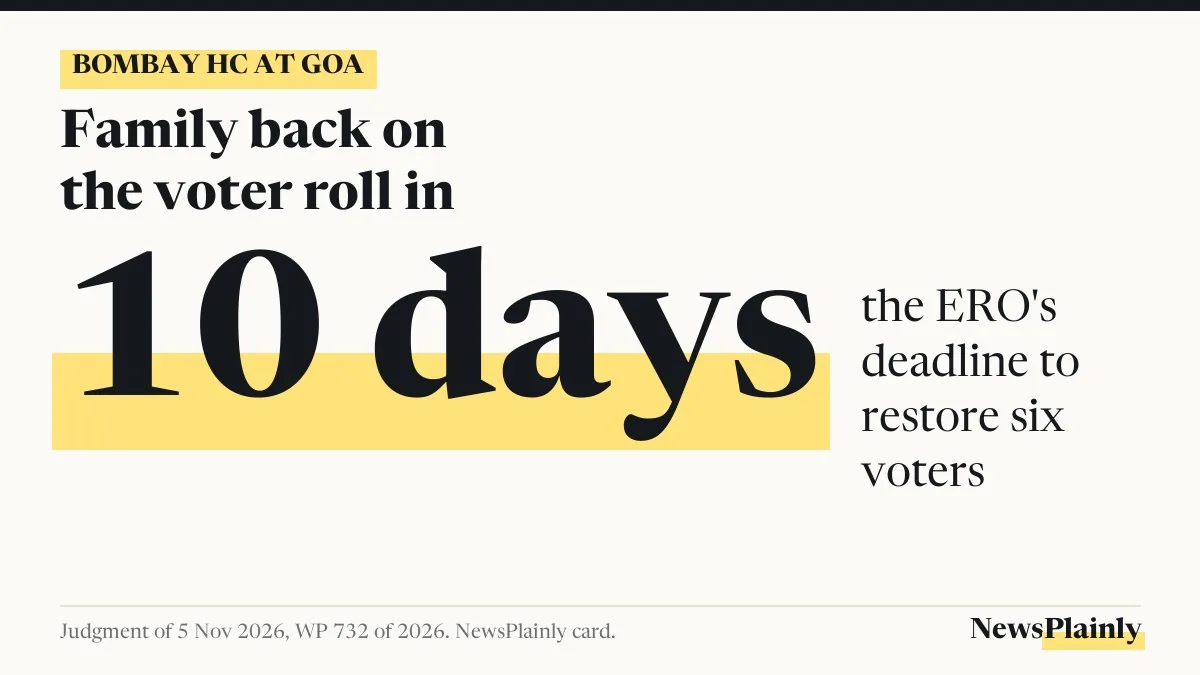
Illustration: NewsPlainly. Not a photograph of the event.
Why it matters
Voters who moved house can be told, as this family was, to file Form 6 as if they were new. The ruling says that would make them sign something untrue and risk prosecution, and that Form 8 is the right route, at least in this case before the Goa bench.
Form 8 for shifted voters is the correct route: a voter who has only shifted house should file Form 8 during the Special Intensive Revision (SIR) of voter lists, not Form 6 or the pre-filled enumeration form, the Bombay High Court at Goa has ruled. Filing those other forms would mean signing a false declaration that could expose the voter to prosecution, the court said in a judgment pronounced on Thursday, 5 November 2026.
A bench of Justices Valmiki Menezes and Amit S. Jamsandekar ordered the electoral registration officer (ERO) of Santa Cruz constituency in Goa to put a family of six back on the roll within ten days, and refused the Election Commission of India’s (ECI) request to put the order on hold while it appeals.
Why Form 8 for shifted voters, not Form 6
The case turned on what each form makes the voter declare. The judgment sets out the differences, drawing on the Registration of Electors Rules:
| Form | Who files it | What the voter declares |
|---|---|---|
| Form 6 | A new voter | That they are applying to be enrolled for the first time and are not on any voter list |
| Form 7 | Anyone objecting to a name, or seeking deletion | A reason such as death, shifting or double entry |
| Form 8 | A voter already on a list who has shifted house, or wants a correction | Their voter ID (EPIC) number and new address, with address proof |
| SIR enumeration form | Existing voters during the SIR | That they still live at the address printed on the pre-filled form |
For a voter who has moved, the judges said, the Form 6 declaration would be false twice over: they are not applying for the first time, and their name was already on a roll. The enumeration form would also be false, because it carries their old address. “A voter shifting from one residence to another can only file an application in Form 8,” the court said.
Section 31 of the Representation of the People Act, 1950, makes a false declaration about the voter list a criminal offence. The court held that the declarations the family were asked to sign, on the enumeration form, Form 6 or the SIR’s Annexure D declaration, “would all result in the same being false”.
What happened to the Santa Cruz family
The six petitioners had voted in Part 29 of Santa Cruz constituency, in Tiswadi taluka, since 1995, the judgment records. Before the SIR began, they moved to a house in Part 25 of the same constituency.
- 12 November 2025: they hand Form 8 for the change of address to the booth level officer (BLO) of their new area.
- 8 December 2025: the BLO uploads it; the family get an acknowledgement SMS.
- 11 December 2025: the SIR enumeration phase ends.
- 16 December 2025: the draft roll is published. Their names are gone from Part 29 and missing from Part 25.
- 21 January 2026: the ERO rejects their Form 8, two days after the window for claims and objections closed on 19 January.
- 2 March and 16 April 2026: the district election officer and then the chief electoral officer uphold the rejection.
- 5 November 2026: the High Court sets the orders aside.
The election officials argued that, during the SIR, people missing from the draft roll counted as new voters and had to file Form 6 with the Annexure D declaration, and that the portal for processing forms was frozen during enumeration. A letter from the assistant ERO, quoted in the judgment, said the system showed “no record to EPIC details was found” and offered only one option: “reject”.
The judges said there was no reason why the Form 8 could not have been dealt with on paper, overriding the system, and noted that the ERO gave no reason for finding the family ineligible at their new address.
Election Commission’s request to wait for the Supreme Court
The ECI asked the court to keep the case pending until the Supreme Court decides the challenges to the SIR in several states, citing the Supreme Court’s order of 11 November 2025 in Dola Sen’s case. The bench declined. It said the family had not challenged the SIR or the ECI’s guidelines at all, only the rejection of their own Form 8, and that waiting would affect their right to be on the roll.
After the judgment was read out, the ECI’s counsel asked for a stay of at least two weeks so it could appeal to the Supreme Court. The court refused, because the order concerns putting names on the voter list.
How this sits with the ECI’s 3 November letter
Two days before the judgment, the ECI told state chief electoral officers that voters left out of SIR draft rolls who file Form 6 should not face Section 31 action merely because they were on an earlier roll, as we reported in our story on Form 6 for deleted voters. The High Court reserved its judgment on 13 October and does not refer to that letter. Its ruling deals with a narrower group: existing voters who have only changed address, for whom it says Form 8 is the correct form.
The order is a High Court ruling in one family’s case, and the ECI has said it wants to challenge it in the Supreme Court. By NewsPlainly’s count, the ten days given to the ERO run to about 15 November if counted from the date of the judgment. LiveLaw’s report on the ruling is here.
Frequently asked questions
Which form should a voter file after shifting house during SIR?
Form 8, according to the Bombay High Court at Goa's judgment of 5 November 2026. Form 8 is for existing voters who change address or need a correction.
Is filing Form 6 a false declaration for an existing voter?
The court held that for a voter already on a roll who has only moved, the Form 6 declaration of first-time enrolment would be false and could attract Section 31 of the RP Act.
What did the Election Commission say on 3 November?
It told states that deleted voters filing Form 6 should not face Section 31 action merely for having been on an earlier roll. The High Court ruling does not refer to that letter.