
Representative image. Robert Linsdell from St. Andrews, Canada, CC BY 2.0, Wikimedia Commons

Why it matters
Many Indians in Canada on work permits have waited for years with shrinking chances of permanent status. This measure adds real places, but mostly through provincial nominations and files already in the system, so it changes the odds for some, not everyone.
Canada PR (permanent residence) is opening up for up to 2 lakh (200,000) people who already live in Canada. The Canadian government announced on 5 November 2026 a one-time measure to give them permanent status in 2027, on top of its regular yearly target, according to a news release from Immigration, Refugees and Citizenship Canada (IRCC), the country’s immigration department.
The Indian Express reported that Indians, who are one of the largest groups among Canada’s temporary foreign workers and former international students, are expected to be among those who gain most. The release itself does not mention any country.
The measure came with Canada’s Budget and its 2027 to 2029 Immigration Levels Plan, the yearly document that sets how many newcomers the country will admit.
Who the Canada PR measure covers
IRCC split the 2 lakh places into two groups, which it calls cohorts, of up to 1 lakh each. One is for workers, the other for humanitarian and family cases.
| Cohort | Places | Who it is for |
|---|---|---|
| Workers | Up to 1 lakh, plus families | People already in Canada nominated by provinces and territories through bigger Provincial Nominee Program quotas, and some who already applied under the Atlantic Immigration Program, Start-up Visa, Self-Employed Persons, Agri-Food Pilot and home care worker programs |
| Humanitarian | Up to 1 lakh | Remaining Hong Kong and Ukraine family pathway cases, people already found eligible on humanitarian grounds, and spouses, partners and dependent children of Canadians and PRs living in Canada |
The Provincial Nominee Program (PNP) lets each province pick immigrants to fill its own job gaps. Under this measure Ottawa will give provinces extra nomination space so they can choose workers who are already living there.
Several of the programs named in the workers cohort are closed to new applications, the release says. So for those programs, the extra space goes to people whose files are already in the system, not to fresh applicants.
The Indian Express described the workers cohort as aimed at people eligible for Express Entry, Canada’s points-based system for skilled workers. The IRCC release does not name Express Entry for this measure; it names the PNP and the programs listed above.
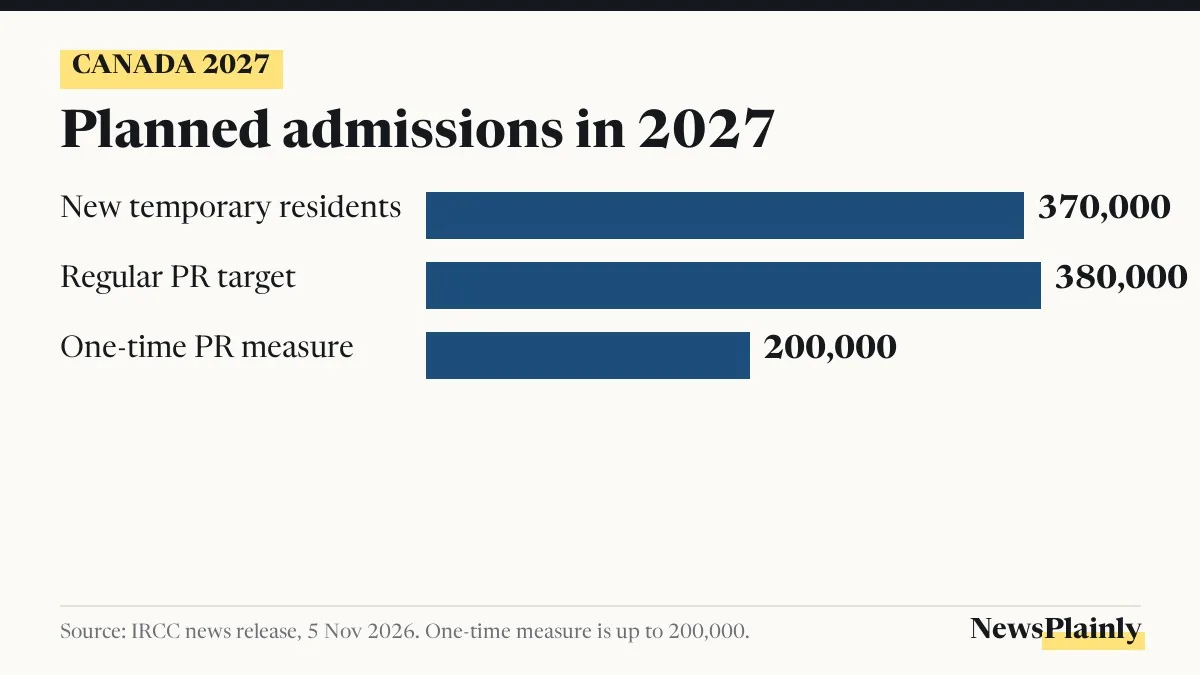
Canada’s immigration targets for 2027 to 2029
The regular targets stay flat. Canada plans to admit 3.8 lakh (380,000) new permanent residents a year in 2027, 2028 and 2029, and more than 64% of them will come in through the economic class, the stream for workers and their families.
New temporary residents are held at 3.7 lakh (370,000) a year: 2.2 lakh (220,000) workers and up to 1.5 lakh (150,000) international students, IRCC said.
The one-time measure sits outside these numbers. By NewsPlainly’s arithmetic, 2 lakh extra places equal just over half (52.6%) of a full year’s regular PR target. Canada also wants to keep yearly PR admissions under 1% of its population beyond 2027, and to cut the number of temporary residents, the release says.
The government presented the measure as a matter of fairness to people who have already settled in Canadian communities. It also says the extra space should clear old files and bring the wait for spousal sponsorship closer to 12 months outside Quebec.
What Indian workers and students in Canada should know
The details that matter most to an individual applicant are not out yet. The Indian Express reported that IRCC has not released eligibility rules, language requirements, occupation lists or the application process. IRCC has described the measure as time-limited extra processing space for people already covered by select pathways, not an open call for new applications, the paper said.
For a student or worker on a temporary permit, that means there is no application to make under this measure yet, going by what IRCC and the Indian Express have said. The likeliest route, going by the release, is a nomination from the province where the person lives and works, as provinces get more PNP places to hand out.
Families are a second route. A spouse or dependent child of a Canadian citizen or permanent resident who is already living in Canada falls in the humanitarian cohort, which IRCC says will help process those applications faster.
Why Canada changed course now
Canada cut its immigration targets over the last two years amid worries about housing shortages and inflation, the Indian Express reported. The release says Canada’s population is now growing at its slowest annual rate in over a century, citing Statistics Canada, and that the number of non-permanent residents has fallen for two years.
Finance Minister François-Philippe Champagne said the Temporary Foreign Worker Program would be reformed to match regional job needs and avoid areas with high unemployment, according to the Indian Express. The Conservative Party’s immigration critic, Michelle Rempel Garner, criticised the plan, saying it would keep giving low-wage employers access to temporary workers and could hurt job chances for young Canadians, the paper reported.
Readers can see the full IRCC release. For more on overseas jobs and Indian workers, see our World section.
Frequently asked questions
Can I apply for the new Canada PR measure?
Not directly yet. IRCC calls it extra processing space for select existing pathways, not an open call, and the application details are not out.
Will Indians benefit from Canada's 2 lakh PR plan?
The Indian Express reported that Indians are expected to be among the main beneficiaries because they are one of the largest groups of temporary workers. The IRCC release names no country.
What is Canada's PR target for 2027?
3.8 lakh (380,000) a year for 2027 to 2029, plus up to 2 lakh under the one-time measure in 2027.