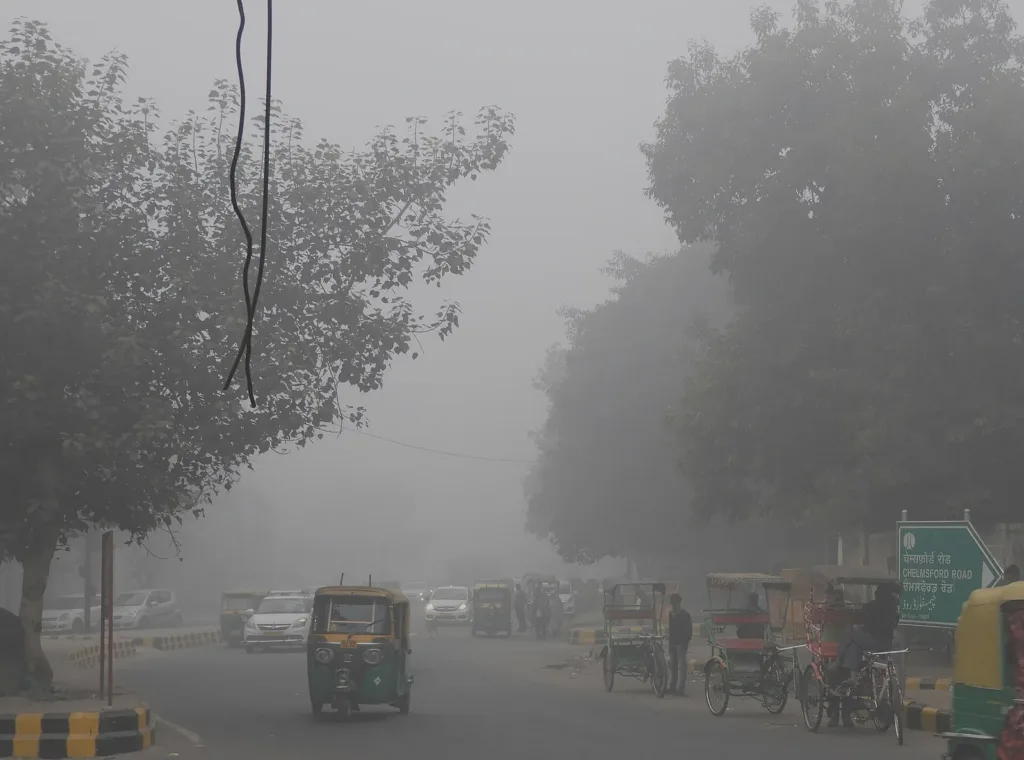
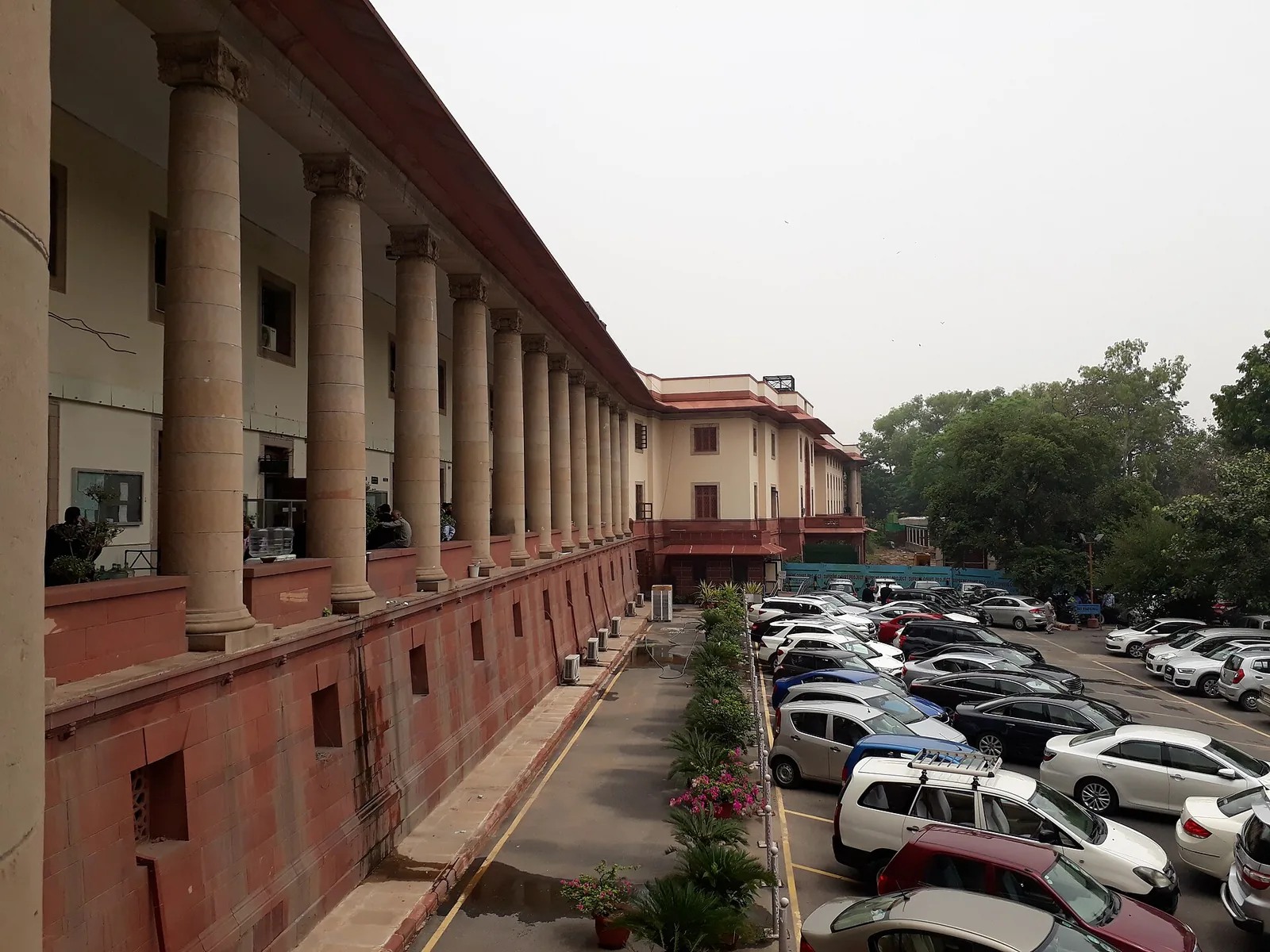
Representative image. Sumita Roy Dutta, CC BY-SA 4.0, Wikimedia Commons

हिन्दी में सारांश Summary in Hindi
- सुप्रीम कोर्ट में CJI सूर्यकांत की बेंच ने 6 नवंबर 2026 को दिल्ली-NCR प्रदूषण मामले की सुनवाई की।
- CJI ने कहा कि दिल्ली को NCR से जोड़ने वाली सड़कों पर गाड़ियां सबसे बड़ी वजह हैं और AQI 400 छू रहा है।
- बेंच ने कहा कि सिर्फ नई पाबंदियों से काम नहीं चलेगा, लोगों का व्यवहार बदलना होगा।
বাংলায় সারাংশ Summary in Bangla
- সুপ্রিম কোর্টে প্রধান বিচারপতি সূর্য কান্তের বেঞ্চ ৬ নভেম্বর ২০২৬ দিল্লি-এনসিআর দূষণ মামলার শুনানি করে।
- প্রধান বিচারপতি বলেন, দিল্লি ও এনসিআরের সংযোগকারী রাস্তার গাড়িই প্রধান কারণ, AQI ৪০০ ছুঁইছুঁই।
- বেঞ্চ বলে, শুধু নতুন নিষেধাজ্ঞায় কাজ হবে না, মানুষের আচরণ বদলাতে হবে।
Why it matters
The hearing comes two days before Diwali, when experts quoted by PTI expect the air to turn severe. The court's view that vehicles matter more than any single curb, and its preference for GRAP's expert rules on schools, shape what NCR residents can expect in the days ahead.
Delhi pollution reached the Supreme Court on Friday, 6 November 2026, with the city’s air index at 389 and some monitoring stations already past 470. A three-judge bench led by Chief Justice of India (CJI) Surya Kant said vehicles were the main cause and questioned whether more restrictions would help, two days before Diwali on 8 November.
The bench, with Justices Joymalya Bagchi and V Mohana, was hearing a case on air pollution that the court took up on its own (suo motu) in the National Capital Region (NCR), the Times of India reported. The CJI opened with a dry remark, telling those in court he hoped they were enjoying Delhi’s weather, according to LiveLaw’s account as carried by the Times of India and the Hindustan Times.
What the Supreme Court said about Delhi pollution
The court’s sharpest point on Delhi pollution was about traffic. The CJI pointed to the roads linking Delhi with Ghaziabad, Greater Noida, Gurugram and Faridabad, and said bumper-to-bumper vehicles on them were the major problem, the Hindustan Times and the Times of India reported. “We keep talking, sometimes make statements and suggestions, but the point is that AQI is already touching 400,” he said, according to the Hindustan Times.
India Today reported a second part of the same argument. Vehicles come into Delhi from across the country, the CJI said, and nobody can check their condition or emissions. Even two hours on the city’s roads does the damage, he said, adding that the length of time a vehicle stays on the road matters more than how many there are.
The bench was doubtful that more orders would work. “No restriction is going to work. The more orders we pass, the more violations will multiply,” it said, according to the Hindustan Times, and spoke instead of changing behaviour and raising awareness.
Diwali and Delhi pollution came up together. The CJI said people who could afford it had turned firecrackers and festive gifts into a status symbol, India Today and the Times of India reported, while poor people working on the roads breathed the worst air. “Poor people do not generate any pollution. They are the sufferers,” he said, according to the Times of India. The bench also noted that the festival season is when many poorer families earn their living.
Delhi AQI on Friday morning: where it was worst
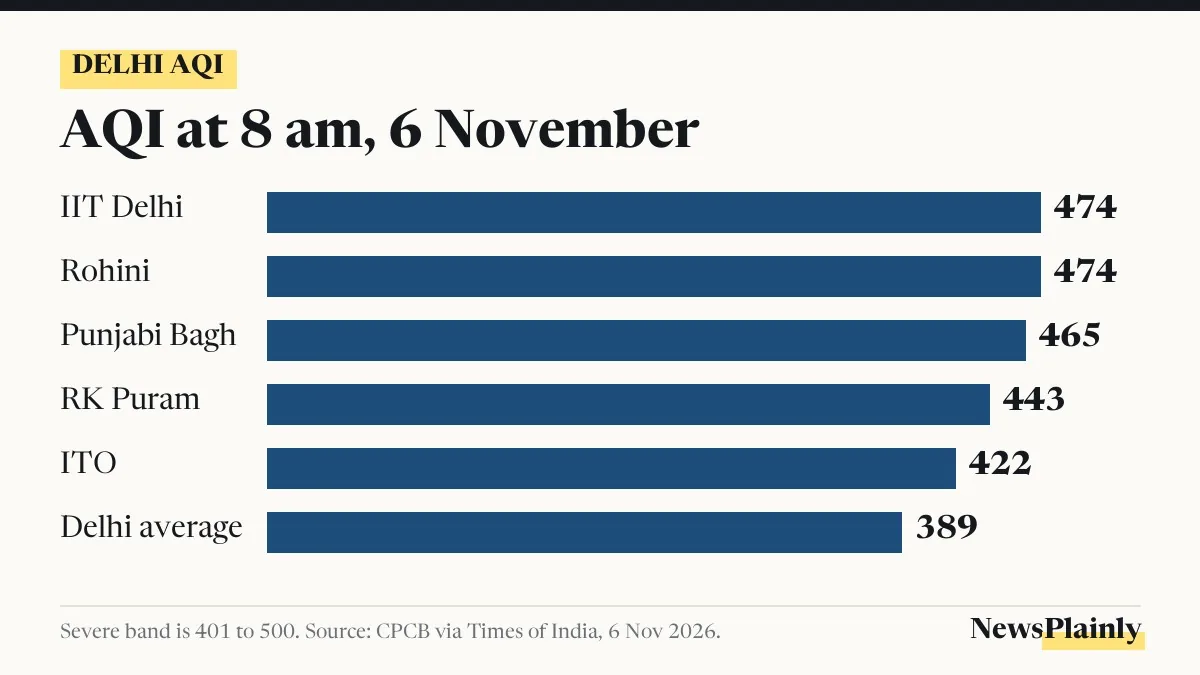
The Central Pollution Control Board (CPCB) put Delhi’s overall Air Quality Index (AQI) at 389 at 8 am, the Times of India reported. That is the top of the “very poor” band. The AQI is a single number from 0 to 500 that sums up several pollutants; CPCB calls 301 to 400 “very poor” and 401 to 500 “severe”.
The Delhi AQI average hides the worst spots. Of the 12 station readings the Times of India listed, these were the highest and lowest:
| Station | AQI, 8 am, 6 Nov | CPCB band |
|---|---|---|
| IIT Delhi | 474 | Severe |
| Rohini | 474 | Severe |
| Punjabi Bagh | 465 | Severe |
| RK Puram | 443 | Severe |
| ITO | 422 | Severe |
| Firoz Shah Road | 420 | Severe |
| India Gate | 403 | Severe |
| Aya Nagar | 393 | Very poor |
| Chandni Chowk | 391 | Very poor |
| IGI Airport T3 | 385 | Very poor |
| Anand Vihar | 359 | Very poor |
| Akshardham | 359 | Very poor |
NewsPlainly’s count from that list: seven of the 12 stations were in the severe band at 8 am, including India Gate in the heart of the city. The lowest readings on the list, at Anand Vihar and Akshardham, were 359.
Experts quoted by the news agency Press Trust of India (PTI) expect Delhi AQI to reach the severe level on Diwali, the Indian Express reported, as weaker winds trap pollutants over the city. Stage 2 of the Graded Response Action Plan (GRAP), the set of pollution curbs that tightens as the AQI rises, is already in force, India Today reported.
What the Centre told the court
Additional Solicitor General (ASG) Aishwarya Bhati, appearing for the Centre, set out the measures against Delhi pollution in five areas: industry, vehicles, construction and demolition dust, road dust and stubble burning, the Hindustan Times reported. On vehicles, she listed curbs on some vehicles entering the city, geo-tagging of Pollution Under Control (PUC) certificates at the place where the test is done, and action against vehicles giving off visible smoke, with complaints from mobile apps and social media used to find them.
According to the Times of India, the ASG also cited the phasing out of diesel autorickshaws and rules for buses from other cities entering Delhi. When the CJI asked whether scientific methods were being used, calling other steps “tried and failed tools”, the ASG said GRAP controls activity by pollution level and added: “We are only doing management.”
The amicus curiae, senior advocate Aparajita Singh, who assists the court in the case, raised one gap that the Centre accepted. An earlier court order on toll plazas has not been fully carried out, she said, so vehicles are still stopped at NCR borders with engines idling. The ASG conceded the order was not fully implemented, the Times of India reported.
Stubble burning: machines for panchayats, a price in advance
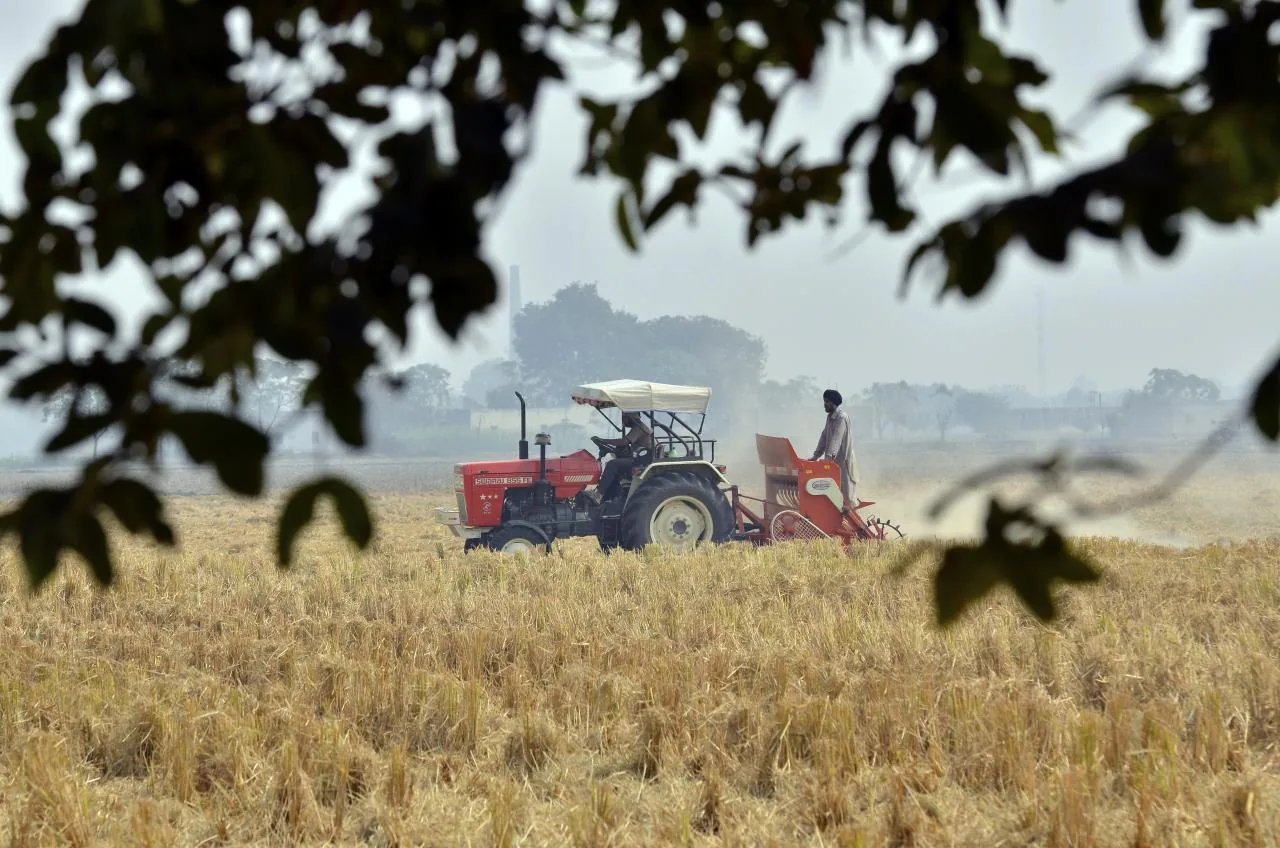
Singh told the bench that stubble burning made up 14% of Delhi’s pollution on 5 November, but that the city was already polluted before the farm fires began. “Transport is the biggest problem,” she said, according to the Times of India. She also said many farmers given machines cannot afford the fuel to run them, and that the machines do not work well on small plots.
On stubble burning, the bench offered ideas rather than orders. Justice Bagchi referred to a plan by the authorities to buy stubble at a fixed rate. The CJI said that rate should be announced in advance, that the machines should go to gram panchayats because single farmers cannot afford them, and that storage for collected stubble could become a source of income. The ASG said a scheme already existed and agreed to take the suggestions to the Agriculture Ministry, the Times of India reported.
Schools, and what comes next in the case
On a plea to shut physical classes for all ages if the AQI rises further, the court said it would go by the expert advice behind GRAP, not by separate studies or personal opinions, the Hindustan Times and the Indian Express reported.
None of the reports read gave the date of the next hearing or said whether the bench passed a written order on Friday. With Diwali on Sunday and PTI’s experts expecting a worse Delhi AQI after it, the GRAP stage itself is set by the Commission for Air Quality Management (CAQM), the body that runs the plan.
For the curbs already in force, read our report on GRAP Stage 2 in Delhi-NCR. The Hindustan Times account of the hearing is here.
Frequently asked questions
What did the Supreme Court say about Delhi pollution on 6 November 2026?
The CJI said vehicles on roads linking Delhi with the NCR were the major cause, that AQI was touching 400, and that more restrictions alone would not work.
What was Delhi's AQI on 6 November 2026?
389 at 8 am, according to CPCB data reported by the Times of India. IIT Delhi and Rohini were at 474.
Will Delhi schools close because of pollution?
The court said it would go by the expert advice behind GRAP on any plea to shut physical classes, not by separate studies.