Illustration: NewsPlainly. Not a photograph of the event.
Why it matters
The forged report reached X as a police request to remove the groups' posts and accounts, and was exposed only after the groups went to court. The court did not rule on how such requests should be checked.
Fake takedown notices, not the Delhi Police, were behind the demand to block the X accounts of two digital rights groups, the platform told the Delhi High Court on Friday, 6 November 2026. X said an imposter had sent the notices against the Internet Freedom Foundation (IFF) and the Software Freedom Law Centre (SFLC), that it had complained to the police, and that the groups’ accounts would not be taken down, the Times of India and Amar Ujala reported.
Justice Amit Mahajan disposed of the two groups’ petitions after recording X’s statement. The case had begun a week earlier with a legal notice that claimed to come from the Rashtriya Swayamsevak Sangh (RSS) and turned, by Scroll’s reporting, into what looked like a two-step hoax.
What X told the Delhi High Court about the fake takedown notices
X’s lawyer said the company had run an internal check after the notices came in and found they were sent by someone pretending to be the police. “It was an imposter. We have done an internal investigation and it turn out this was an imposter. We have filed a complaint with Delhi Police,” the counsel told the court, according to the Times of India.
Amar Ujala reported two more points from the hearing. X said it had taken no action against IFF’s or SFLC’s accounts or posts on the strength of the notices, and that the complaint to find the imposter was filed the night before. Senior Advocate Akhil Sibal, appearing for both groups, told the court the notices were issued in the name of a Special Commissioner of Police and that the groups had written to ask whether they were real but got no confirmation.
The Delhi High Court disposed of the petitions after taking note of X’s submission, the Times of India reported.
How the hoax unfolded: a timeline
The fake takedown notices came in two steps. The details below come from Scroll’s reporting, the groups’ own public statements as Scroll carried them, and Friday’s hearing.
| Date | What happened |
|---|---|
| 29 October, about 9.54 pm | IFF gets an emailed “legal notice” claiming to act for the RSS, asking it to stop opposing government content-blocking orders. Similar notices reach SFLC and an X account called Geo Blocked in India. |
| 30 October | IFF makes the notice public and calls it legally deficient. Two people linked to the RSS deny on X that the organisation sent it. |
| 31 October and 2 November | X receives what it describes as requests from Delhi Police flagging 23 posts by the groups, and their handles, as unlawful. |
| 3 November | X emails IFF and SFLC about these requests. |
| 5 November | With no reply from the police to their letters, both groups go to the Delhi High Court. |
| 6 November | X tells the court the police notices were sent by an imposter; petitions disposed of. |
Scroll found that the first notice was sent from a Proton Mail address that was likely created at 3.57 pm on 29 October, about six hours before the notice went out. The address and phone number printed on the notice led, Scroll said, to the Delhi office of a different, similarly named group, the Rashtriya Seva Sangh. Its president told Scroll his organisation had sent no such notice and would act against whoever used its details.
The RSS did not issue an official comment, according to Scroll, but two people associated with it, Kanchan Gupta, an adviser to the information and broadcasting ministry, and the author Ratan Sharda, denied on X that it had sent the notices.
Why the fake takedown notices looked official
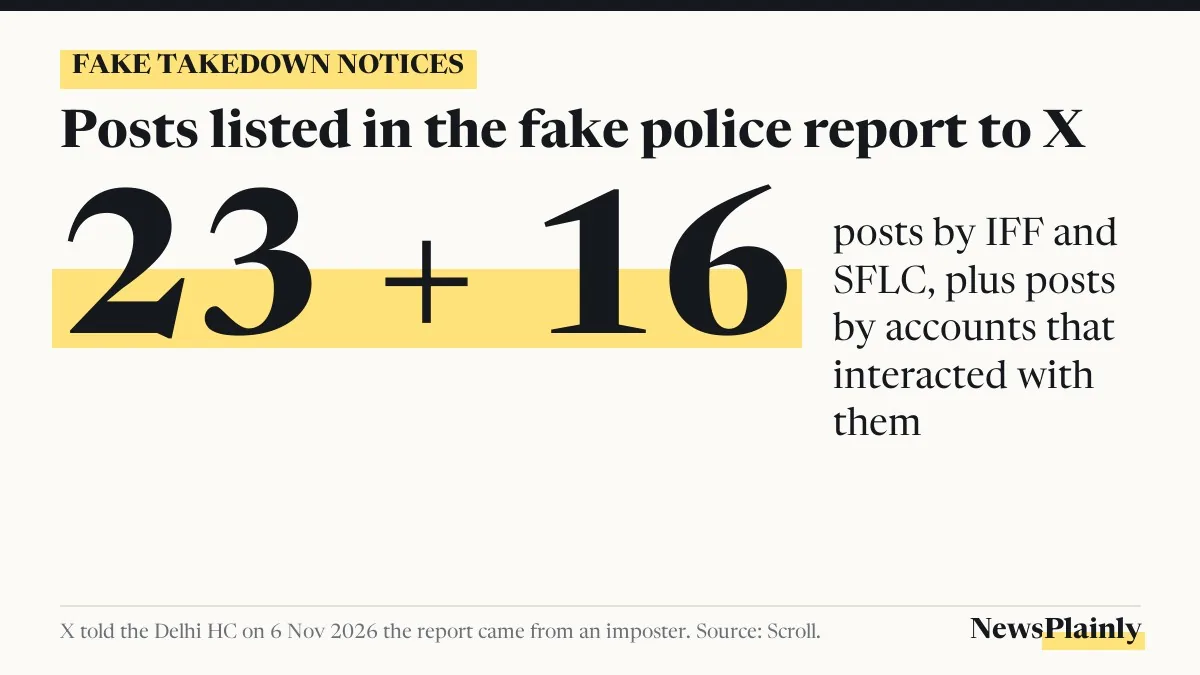
The second step was more serious than the first. According to the emails X forwarded, quoted by Scroll, the report sent to the platform said the posts were defamatory towards the RSS under Section 356 of the Bharatiya Nyaya Sanhita (BNS), the criminal law that replaced the Indian Penal Code. In all, 23 posts by the groups and 16 posts from accounts that interacted with them were listed.
SFLC pointed out a flaw in its own posts on 4 and 5 November, Scroll reported: criminal defamation is a non-cognisable offence, meaning police cannot act on it without a court’s order, and the report cited no such order.
What happens next in the fake takedown notices case
X’s complaint asks Delhi Police to find out who sent the notices. None of the reports read said whether a First Information Report (FIR), the formal start of a police case, has been registered on it, or which offences the complaint names. Nobody has been publicly identified as the sender.
For users of IFF’s and SFLC’s work, nothing changes: both accounts and their posts stay up, X told the court. The Delhi High Court did not rule on the wider issue of how such requests are checked, because the petitions ended once X said the notices were fake.
For more from the courts, see our Tech section. Scroll’s full reconstruction of the hoax is here.
Frequently asked questions
Who sent the takedown notices against IFF and SFLC?
X told the Delhi High Court on 6 November 2026 that they were sent by an imposter, not the Delhi Police. Nobody has been publicly identified.
Will the IFF and SFLC X accounts be blocked?
No. X told the court it took no action on the notices and the accounts would not be taken down.
Did the RSS send a legal notice to IFF?
A 29 October notice claimed RSS authority. The RSS made no official comment, Scroll reported, but two people associated with it denied on X that it was sent by the organisation.