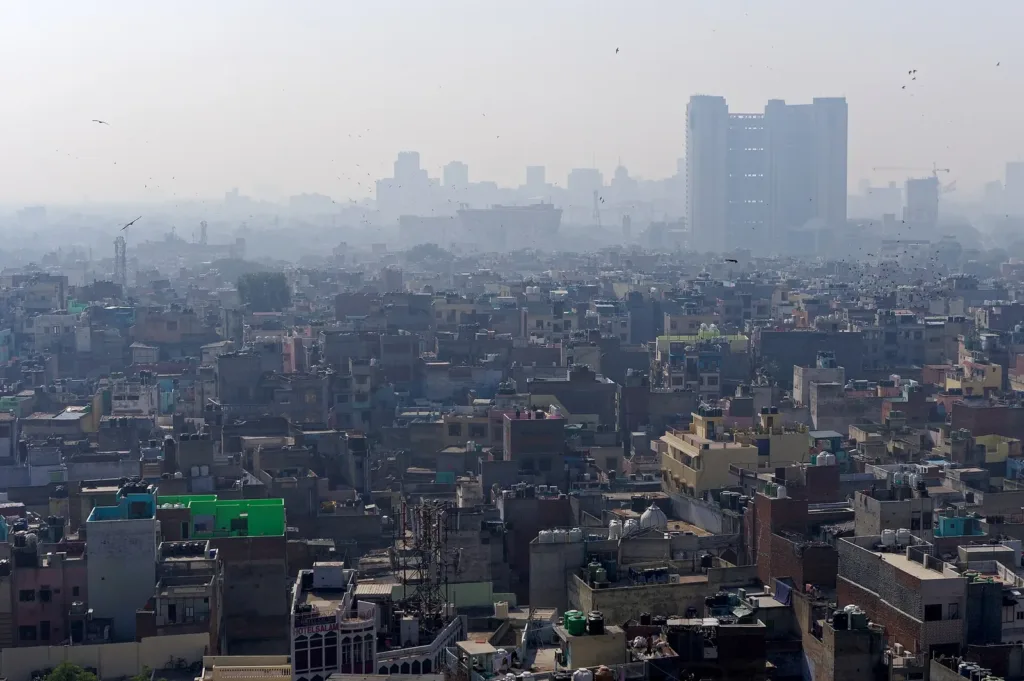
Representative image. Jakub Hałun, CC BY-SA 4.0, Wikimedia Commons

हिन्दी में सारांश Summary in Hindi
- नुमान नहीं है; आसमान मुख्य रूप से साफ रहेगा और सुबह कोहरा रहेगा।
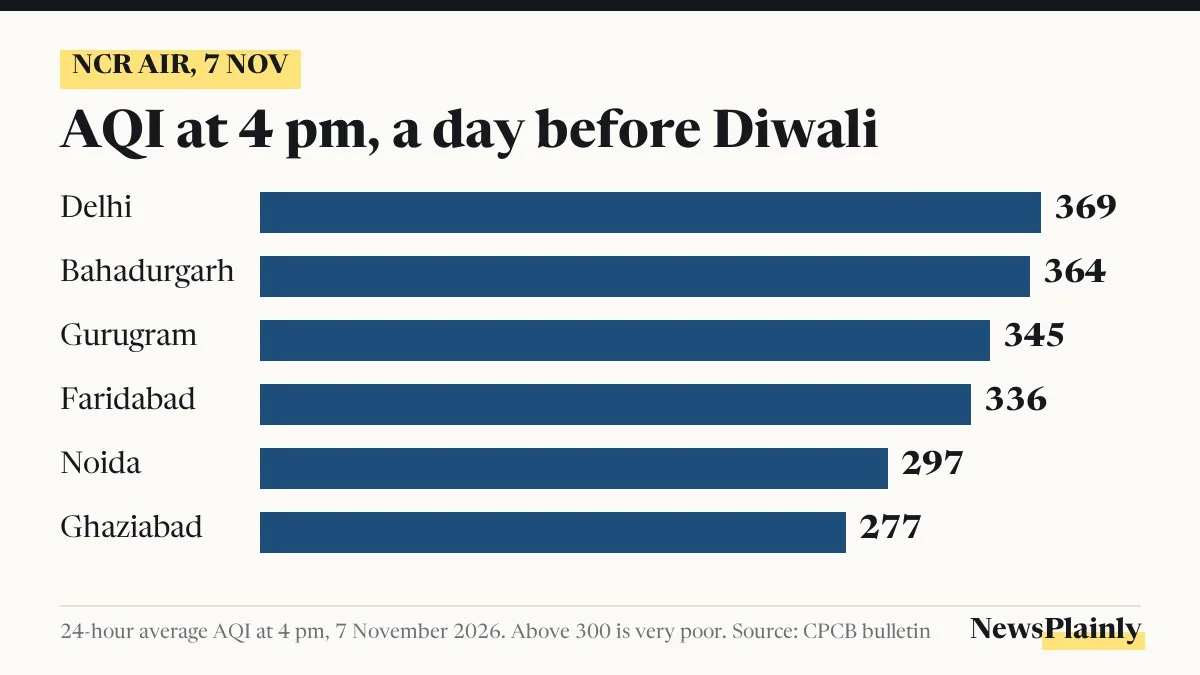
- CPCB के मुताबिक 7 नवंबर शाम 4 बजे दिल्ली का AQI 369 (बहुत खराब) रहा, जो एक दिन पहले 382 था।
- CPCB बुलेटिन के 12 NCR शहरों में से 6 की हवा बहुत खराब रही, जिनमें बहादुरगढ़ 364 और गुरुग्राम 345 पर रहे।
বাংলায় সারাংশ Summary in Bangla
- নুযায়ী দীপাবলির দিন, ৮ নভেম্বর দিল্লিতে বৃষ্টির পূর্বাভাস নেই; আকাশ মূলত পরিষ্কার, সকালে কুয়াশা থাকবে।
- CPCB জানিয়েছে, ৭ নভেম্বর বিকেল ৪টায় দিল্লির AQI ছিল 369 (খুব খারাপ), আগের দিন ছিল 382।
- CPCB বুলেটিনের 12টি NCR শহরের মধ্যে 6টিতে বাতাস খুব খারাপ ছিল, যেমন বাহাদুরগড় 364 ও গুরুগ্রাম 345।
Why it matters
A dry, foggy Diwali means plans outdoors are unlikely to be washed out, but it also means no rain to clear the air. The city starts the festival in the very poor band, and IITM's early warning bulletin of 6 November put Diwali's ventilation index, a measure of how well the air can carry pollution away, at 3,000; the bulletin calls values below 6,000 with light winds unfavourable.
Delhi Diwali weather on Sunday, 8 November 2026, is set to stay dry: the India Meteorological Department (IMD) forecasts no rain, a mainly clear sky and shallow to moderate fog in the morning, in a bulletin issued at 6 pm on Saturday. The air going into the festival is already heavy. The Central Pollution Control Board (CPCB) put the Delhi AQI (air quality index) at 369 at 4 pm on 7 November, in the “very poor” band.
That reading is a 24-hour average from all 59 of the city’s monitoring stations, and it is slightly lower than the 382 recorded a day earlier. NCR air quality was no better: six of the 12 National Capital Region (NCR) cities in the same CPCB bulletin were also very poor, and the rest were poor.
What IMD’s Delhi Diwali weather forecast says
The daily forecast bulletin from IMD’s Regional Meteorological Centre in New Delhi, the official IMD forecast for the city, gives Diwali a maximum of 28 to 30°C and a minimum of 14 to 16°C. It lists “no rain” for the day and expects fog at most places in the early hours. In its impact column for 7 and 8 November, the bulletin lists the expected impact as “nil”.
Winds are forecast to come from the southwest at 5 to 10 kmph in the morning and turn westerly at 15 to 20 kmph in the afternoon. Between 5.30 pm and 11.30 pm on Sunday, the evening hours of the festival, IMD expects a southeasterly wind of 10 to 15 kmph. The sun sets at 5.31 pm on 8 November, the bulletin says.
Saturday itself was dry and a little warm for early November. Safdarjung, the city’s main weather station, recorded a high of 30.5°C, 1°C above normal, and a low of 16.2°C, 1.9°C above normal, with no rain. Dainik Jagran reported on Saturday evening that all of Delhi’s districts were on IMD’s green list, meaning no warning, and that Noida, Ghaziabad, Gurugram and Faridabad were also expected to stay clear.
Will the western disturbance bring rain to Delhi?
The bulletin opens with one line on a change in the weather pattern: a fresh western disturbance is “likely to affect northwestern Himalayan region from 10th November”. A western disturbance is a weather system that moves in from the west and usually brings rain or snow to the hills of Jammu and Kashmir, Himachal Pradesh and Uttarakhand.
For Delhi, the same IMD forecast does not show rain on any of the next seven days, up to 13 November. What changes is the sky and the mornings: partly cloudy from Monday, with moderate fog at most places on 9 and 10 November. IMD says it expects no large change in maximum temperatures over the week; its own table shows the high dipping to 26 to 28°C on 10 November before rising again.
| Day | Max (°C) | Min (°C) | Sky | Rain |
|---|---|---|---|---|
| Sun 8 Nov (Diwali) | 28 to 30 | 14 to 16 | Mainly clear; shallow to moderate fog in the morning | No rain |
| Mon 9 Nov | 27 to 29 | 14 to 16 | Partly cloudy; moderate fog in the morning | No rain |
| Tue 10 Nov | 26 to 28 | 13 to 15 | Partly cloudy; moderate fog in the morning | No rain |
| Wed 11 Nov | 27 to 29 | 14 to 16 | Partly cloudy; shallow to moderate fog in the morning | No rain |
| Thu 12 Nov | 27 to 29 | 15 to 17 | Partly cloudy; shallow to moderate fog in the morning | No rain |
| Fri 13 Nov | 28 to 30 | 15 to 17 | Partly cloudy; shallow to moderate fog in the morning | No rain |
Delhi AQI today: 369, and how NCR air quality compares
AQI turns the levels of several pollutants into one number from 0 to 500. A reading of 201 to 300 is poor, 301 to 400 is very poor and 401 to 500 is severe. On Saturday the main pollutants behind the Delhi AQI were PM10 (particulate matter up to 10 micrometres across) and PM2.5 (finer particles up to 2.5 micrometres, small enough to reach deep into the lungs), according to CPCB.
Bahadurgarh in Haryana came closest to Delhi at 364. Gurugram eased from 368 to 345, while Faridabad rose to 336 and Sonipat crossed into very poor at 304. Among the Uttar Pradesh cities, Noida stayed just under very poor at 297, and Bulandshahr saw the sharpest rise, 53 points to 283. The table below sets the two days side by side.
| City | AQI 6 Nov | AQI 7 Nov | Band on 7 Nov | Change |
|---|---|---|---|---|
| Delhi | 382 | 369 | Very poor | -13 |
| Bahadurgarh | 328 | 364 | Very poor | +36 |
| Gurugram | 368 | 345 | Very poor | -23 |
| Faridabad | 313 | 336 | Very poor | +23 |
| Hapur | n/a | 307 | Very poor | not listed on 6 Nov |
| Sonipat | 270 | 304 | Very poor | +34 |
| Noida | 303 | 297 | Poor | -6 |
| Bulandshahr | 230 | 283 | Poor | +53 |
| Greater Noida | 316 | 281 | Poor | -35 |
| Ghaziabad | 257 | 277 | Poor | +20 |
| Baghpat | 296 | 249 | Poor | -47 |
| Meerut | 265 | 245 | Poor | -20 |
Ghaziabad: Loni and Wave City in the red
CPCB’s bulletin gives Ghaziabad city an average of 277. Inside the district, some stations were far worse. Dainik Jagran, citing CPCB station data on Saturday afternoon, reported a reading of 328 at Loni and 315 at Wave City, both in the very poor band. Govindpuram, which had been in the moderate band at 152 on Friday, rose to 238, the first time in 13 days that its air turned poor, the paper said.
Jagran also reported dust over main roads such as the Grand Trunk Road and fires in garbage heaps in parts of the district. Ankit Singh, regional officer of the Uttar Pradesh Pollution Control Board (UPPCB), told the paper that all areas were being watched and that anyone found breaking the rules of the Graded Response Action Plan (GRAP) would be fined.
What the forecast means for air on Diwali night
Delhi Diwali weather matters for the air because wind and the depth of mixing decide how quickly smoke and dust clear. The air quality early warning system for Delhi, run by the Indian Institute of Tropical Meteorology (IITM) under the Ministry of Earth Sciences, measures this with a ventilation index: how high the air mixes multiplied by wind speed. Its bulletin dated 6 November put the index at 13,500 square metres per second on 7 November, 3,000 on 8 November and 4,000 on 9 November. The bulletin says a value below 6,000 with average wind under 10 kmph is unfavourable for the dispersal of pollutants.
The same 6 November bulletin said Delhi’s air was likely to be severe from 7 to 9 November, with a severe to very poor outlook for the six days after. Saturday’s 4 pm Delhi AQI stayed in the very poor band at 369, below the severe mark of 401. The early warning page had not posted a newer bulletin when NewsPlainly checked at about 6.10 pm on 7 November.
Curbs under Stage 3 of GRAP, the emergency pollution plan for the NCR, have applied since 6 November. NewsPlainly’s earlier report explains what the GRAP 3 rules ban and who is exempt. Indian Express reported on Saturday that Delhi’s Directorate of Education has told schools to hold classes up to Class 5 in hybrid mode under that order.
CPCB publishes its next city bulletin at 4 pm on 8 November, Diwali day, and the IMD forecast for Delhi is updated every evening at 6 pm.
Frequently asked questions
Will it rain in Delhi on Diwali 2026?
No rain is forecast. IMD's bulletin issued at 6 pm on 7 November gives 8 November a mainly clear sky, a high of 28 to 30°C and shallow to moderate fog in the morning.
What was Delhi's AQI on 7 November 2026?
369 at 4 pm, a 24-hour average in the very poor band, according to CPCB. It was 382 on 6 November.
Will the western disturbance bring rain to Delhi?
IMD says the system is likely to affect the north-western Himalayan region from 10 November. Its Delhi forecast up to 13 November shows no rain, only partly cloudy skies and morning fog.
Which NCR city had the worst air on 7 November?
Delhi, at 369. Bahadurgarh was next at 364, followed by Gurugram at 345 and Faridabad at 336, in CPCB's 4 pm bulletin.