Representative image. Daksh Sammi, CC BY-SA 4.0, Wikimedia Commons

हिन्दी में सारांश Summary in Hindi
- गुरुग्राम में 50% वर्क फ्रॉम होम नियम तोड़ने पर करीब 15 कंपनियों को कारण बताओ नोटिस मिला है, द ट्रिब्यून ने बताया।
- चानक जांच के बाद नोटिस दिए; सेक्टर 42 की दो लॉ फर्मों में 117 में से करीब 87 और 262 में से करीब 160 कर्मचारी मिले।
- दफ्तरों को 24 घंटे में स्टाफ की संख्या, हाजिरी रिकॉर्ड और रोस्टर देना है।
বাংলায় সারাংশ Summary in Bangla
- গুরুগ্রামে ৫০% ওয়ার্ক ফ্রম হোম নিয়ম না মানায় প্রায় ১৫টি সংস্থাকে শোকজ নোটিস দেওয়া হয়েছে, জানিয়েছে দ্য ট্রিবিউন।
- বাদশাহপুরের SDM ৫ নভেম্বর আচমকা পরিদর্শনের পর নোটিস দেন; সেক্টর ৪২-এর দুটি আইনি সংস্থায় ১১৭ জনের মধ্যে প্রায় ৮৭ জন এবং ২৬২ জনের মধ্যে প্রায় ১৬০ জন ছিলেন।
- ফিসগুলিকে ২৪ ঘণ্টার মধ্যে কর্মী সংখ্যা, হাজিরার রেকর্ড ও রোস্টার জমা দিতে হবে।
Why it matters
The notices show Gurugram's half-strength office rule being checked on the ground. Inspections and a 24-hour deadline for attendance records mean employers who keep calling in full teams can face proceedings under the CAQM Act, and employees have been asked to report offices that do.
The Gurugram WFH (work from home) rule in Haryana is now being enforced. The district administration has served show-cause notices on private offices that called in more than half their staff, after surprise inspections found desks far fuller than the anti-pollution order allows. About 15 firms have received notices so far, The Tribune reported on 6 November 2026, and the Indian Express reported on 7 November that at least two corporate law firms in Sector 42, off Golf Course Road, are among them.
The notices were issued on 5 November, the first day the 50% cap was in force, by the Sub-Divisional Magistrate (SDM) of Badshahpur, one of Gurugram’s administrative subdivisions. Each show-cause notice gives the office 24 hours to explain itself.
What the Gurugram WFH inspections found
The cap comes from an order Gurugram Deputy Commissioner Uttam Singh issued on 3 November, following directions from the Commission for Air Quality Management (CAQM), the body that sets pollution rules for the National Capital Region. From 5 to 20 November, private offices in the district may have no more than 50% of their employees working on site. The rest are to work from home. NewsPlainly explained that order and the construction ban that came with it in our report on the Gurugram work from home rules.
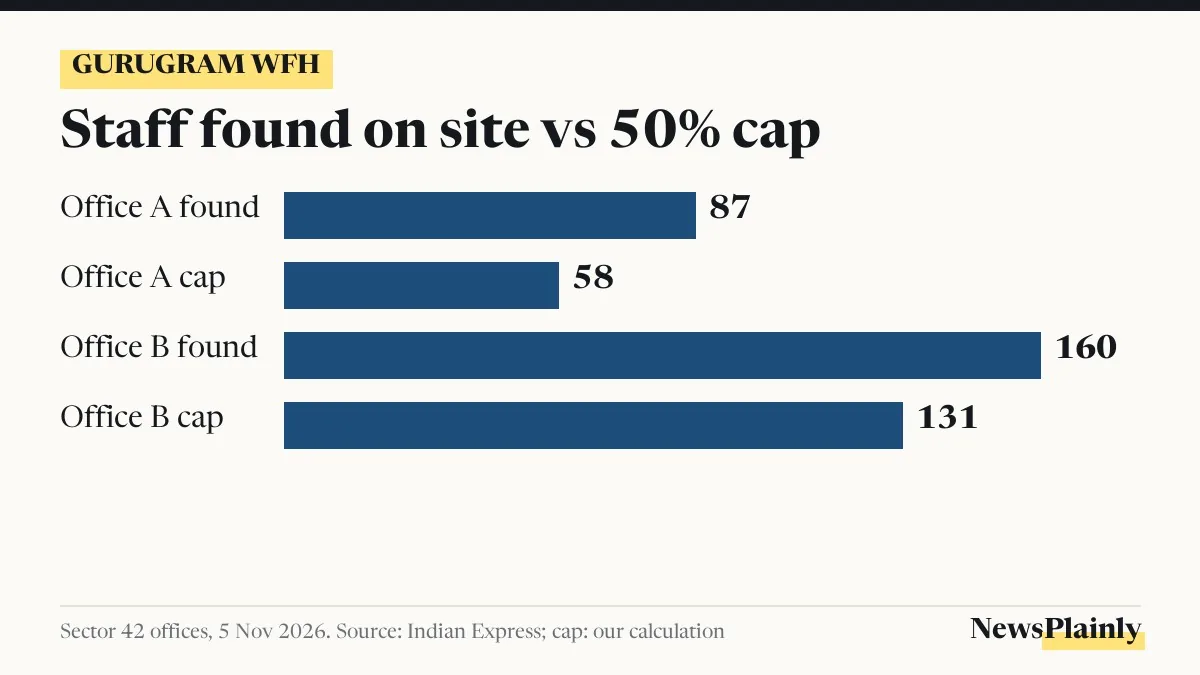
Inspection teams then visited offices without warning. According to the notices, which the Indian Express said it had accessed, inspectors counted about 87 people at one law firm’s office, which has 117 staff in total, and about 160 at the other, which has 262. Both offices are in the same building in Sector 42. The Tribune reported the first of those figures from a notice dated 5 November and put the attendance at nearly 74%.
Here is how far over the line each office was, worked out from the figures in the notices.
| Office | Total staff | 50% cap | Found on site | Over the cap |
|---|---|---|---|---|
| Law firm A, Sector 42 | 117 | 58 | about 87 (74%) | about 29 |
| Law firm B, Sector 42 | 262 | 131 | about 160 (61%) | about 29 |
So both offices had roughly 29 more people at their desks than the order permits, though the smaller office was further over in percentage terms.
What a show-cause notice asks offices to send in 24 hours
The notices ask each management for a written explanation with documents, within 24 hours, both reports said. The list is specific:
- the actual staff strength of the office;
- biometric or attendance records for the day of the inspection;
- the roster drawn up to keep attendance at half;
- details of employees allowed to work from home;
- any grounds for claiming an exemption, according to The Tribune.
If no reply comes, or the reply is not satisfactory, the administration can start proceedings under Section 14 of the Commission for Air Quality Management in National Capital Region and Adjoining Areas Act, 2021 (the CAQM Act), the reports said. The Tribune added that this can happen without any further notice. Neither report said what penalty under the CAQM Act the district would seek, and a show-cause notice is not a finding: it asks the office to explain before any action is decided.
The Indian Express said it had asked both law firms for comment and had no reply by the time it went to print. NewsPlainly is not naming the firms, since it has not seen the notices itself.
How Gurugram WFH complaints are reaching officials
Much of the checking is being driven by employees. The Tribune reported that the administration asked staff who were being made to come in at full strength to flag their workplaces, and that it has since received a flood of complaints. Officials told the Indian Express that teams are carrying out surprise inspections based on public complaints on social media, where employees and residents have been tagging the Deputy Commissioner.
The firms served so far do not include any multinational company, The Tribune said.
Deputy Commissioner Singh said on Friday, 6 November, that directions issued by the CAQM “must be followed in letter and spirit”, according to the Indian Express. He added that teams across all subdivisions were monitoring institutions and private units and that notices would continue to be issued to violators.
What the Gurugram WFH cap means until 20 November
The cap runs until 20 November. Counting from today, 7 November, that is 14 more days, including the Diwali weekend.
The rule applies to private offices in Gurugram district. In the order as Hindustan Times and the Times of India reported it on 3 November, industrial units and essential services where remote work is not practical were left out, and SDMs and Haryana State Pollution Control Board officials were tasked with daily inspections. A back office in Cyber City falls under it; a hospital or a factory floor in Manesar generally does not.
For employees, the practical point is that the order puts the duty on the employer, not on individual staff. It is the office management that has to keep a roster and produce attendance records if inspectors come. The administration has asked employees whose offices call in everyone to flag them, The Tribune reported. Neither report gave a dedicated helpline number or portal.
Why Gurugram pollution rules are being enforced now
The order came as Gurugram pollution worsened and the air turned “very poor”. As NewsPlainly reported on 4 November, the Central Pollution Control Board’s 4 pm bulletin on 3 November put Gurugram’s Air Quality Index (AQI) at 305, on the day the Deputy Commissioner signed the order. A half-strength office rule is meant to cut the number of people commuting into office towers during the worst weeks of the season.
The Tribune noted that the real test comes now, with the Diwali weekend, when both offices and the administration’s teams will be watched to see whether the cap holds. The district has said more show-cause notices will follow wherever inspectors find offices above half strength.
Frequently asked questions
Is work from home mandatory in Gurugram?
Private offices in Gurugram district must keep at most 50% of staff on site from 5 to 20 November 2026, under the Deputy Commissioner's order of 3 November. Industrial units and essential services where remote work is not practical were left out.
What happens to an office that breaks the Gurugram WFH rule?
It gets a show-cause notice and 24 hours to send staff strength, attendance records and its roster. If the reply is missing or unsatisfactory, proceedings can start under Section 14 of the CAQM Act, 2021.
How many offices have got notices?
About 15 firms, The Tribune reported on 6 November 2026. None of them is a multinational company, it said.