Representative image. Chanduclicks, CC BY-SA 4.0, Wikimedia Commons

Why it matters
More than 30 crore two-wheelers and 4 crore four-wheelers run on E20, the ministry says, so whether the blend holds to 20% matters for mileage and engine wear. The state and the Centre are relying on different tests and labs, so motorists in Karnataka have no settled answer yet on what is in their tank.
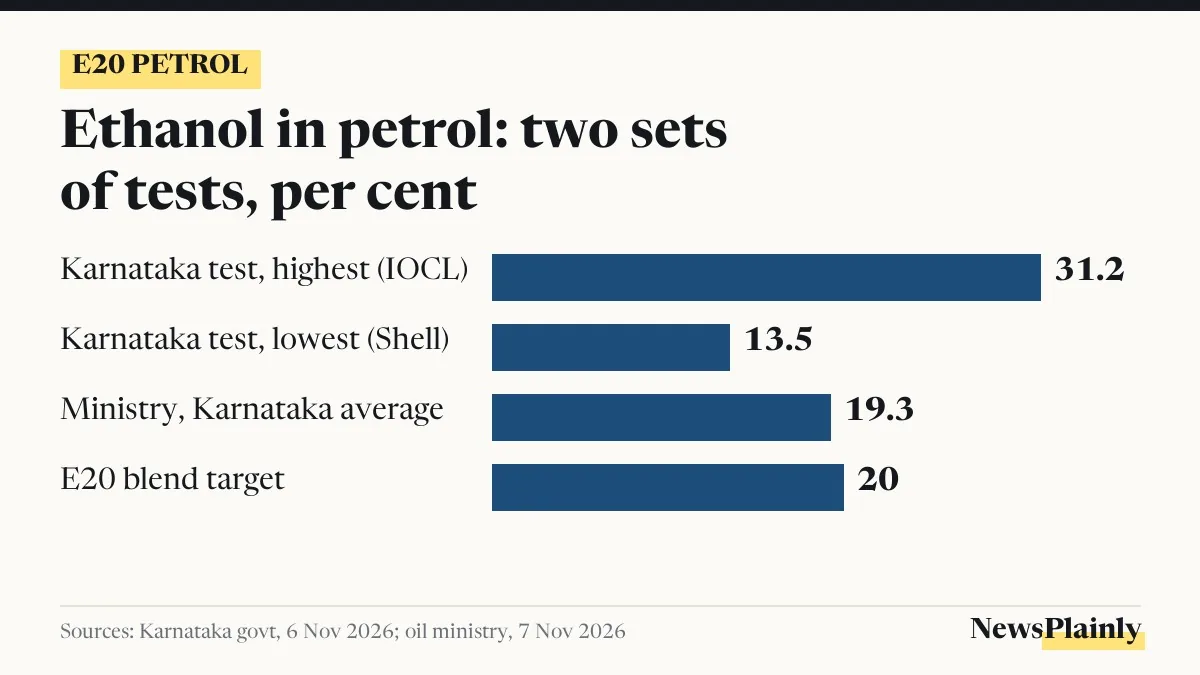
E20 petrol quality is within the national standard, the Ministry of Petroleum and Natural Gas (the oil ministry) said on Saturday, 7 November 2026, citing tests on 893 samples drawn from 27 states and Union territories. All of them had between 19% and 21% ethanol, the range allowed for E20, it said. The statement answers the Karnataka government, which said a day earlier that the ethanol in petrol at some pumps in the state was as high as 31.2%, as NewsPlainly reported on 6 November.
The oil ministry also set out objections from the three public sector oil companies, Indian Oil (IOCL), Bharat Petroleum (BPCL) and Hindustan Petroleum (HPCL), to how Karnataka drew and tested its samples. The two sets of results are far apart, and each side is relying on its own testing.
What the oil ministry’s 893 E20 petrol samples showed
The tests were run under the Quality Coordination Cell (QCC), a joint exercise of the oil companies and the Centre for High Technology (CHT), the oil ministry’s technical body that monitors fuel quality, according to the ministry’s statement as published by DD News, the public broadcaster’s news service. Samples came from depots and petrol pumps of the three companies: 330 from IOCL, 280 from BPCL and 283 from HPCL. They were tested in refinery and company quality-control laboratories under IS 17021, the Indian Standard set by the Bureau of Indian Standards (BIS) for ethanol-blended petrol.
Fifty-six of the samples were from Karnataka. The ethanol in petrol from those pumps and depots ranged from 19% to 20%, with an average of 19.30%, the oil ministry said. The statement as reported did not say on which dates the samples were drawn or which districts the Karnataka ones came from.
The oil ministry called for a transparent testing exercise that both sides could verify, to settle the gap between the two sets of findings.
Why oil companies question Karnataka’s E20 tests
The companies’ main complaint is about procedure. Fuel sampling is governed by the Motor Spirit and High Speed Diesel Control Order of 2005 and the Marketing Discipline Guidelines of 2024. Under these, six one-litre samples are drawn at a pump: two go to the dealer, two are kept by the oil company or the department, and two go to an authorised laboratory. The labels are signed jointly, the ministry’s statement said.
According to the companies, samples from a September 2026 round in Karnataka went through the state’s coordinator to their laboratories. The October round, they said, was drawn without their representatives present. They said they had not received the retained samples, outlet-wise details or full lab reports, despite asking for them. Without counterpart samples, neither they nor the dealers could get a retest, they said.
They also took issue with the lab certificates Karnataka relied on. These came from a third-party laboratory rather than one listed under the Control Order. The BIS standard allows three ways to measure ethanol in petrol of the E20 grade: an infrared method, a water extraction method and gas chromatography, a method that separates fuel into its parts. When gas chromatography is used, the companies said, the sample must first be diluted one to one with petrol that has no oxygen-bearing additives, and the result corrected against a certified E10 reference. Karnataka’s certificates said only “Ethanol % by Gas Chromatography”, without the standard, the dilution or the reference used, they said.
The companies also pointed to density. The certificates showed 0.742 to 0.749 grams per cubic centimetre for samples said to hold 26% to 31% ethanol. Their own E20 petrol samples measured 0.752 to 0.760. Ethanol is denser than petrol, so more ethanol should ordinarily raise the figure, not lower it, the companies said, adding that this needed further examination through standard tests. These are the companies’ arguments; the reports read describe no independent retest of the disputed samples.
Karnataka’s tests and the ministry’s tests side by side
The two exercises differ in who collected the fuel, how much was tested and where. The table puts the details from each side’s own account next to each other.
| Detail | Karnataka government (6 Nov) | Ministry and oil companies (7 Nov) |
|---|---|---|
| Who ran it | State Legal Metrology officials, samples from pumps | Oil company and CHT quality cell, samples from depots and pumps |
| Where | 7 Karnataka districts | 27 states and UTs, 56 samples in Karnataka |
| Samples in results | 14 (6 companies, incl. Nayara, Shell, Mangalore Refinery) | 893 (IOCL, BPCL, HPCL only) |
| Lab and method | Shriram Research Institute, Bengaluru (accredited private lab); gas chromatography | Refinery and oil company labs; IS 17021 Annex C |
| Result | 11 of 14 above 20%; highest 31.2% (IOCL) | All within 19% to 21%; Karnataka average 19.30% |
Two points stand out. Karnataka’s results covered six companies, including private sellers Nayara Energy and Shell and the public sector Mangalore Refinery and Petrochemicals, while the oil ministry’s figures cover only IOCL, BPCL and HPCL. And Annex C of IS 17021 is the water extraction method, not gas chromatography, so, going by the two accounts, the two sides did not use the same test. The reports read describe no joint test of the same fuel.
The oil ministry’s own volume figures give a national picture of ethanol in petrol. In the ethanol supply year that ended on 31 October 2026, public sector companies blended 1,134 crore litres of ethanol into about 5,673 crore litres of petrol sold, it said. By NewsPlainly’s calculation, that works out to 19.99%, or about 20%, on average. An average across the country cannot show what is in one pump’s tank, which is the question Karnataka raised.
Karnataka’s side and the political row
Karnataka’s Food and Civil Supplies Minister Rizwan Arshad released the state’s findings on 6 November. He said the samples were first sent to IOCL and BPCL laboratories, whose reports did not state the ethanol content, which led the state to use a private accredited lab. He asked Union ministers Hardeep Singh Puri and Nitin Gadkari to explain who was responsible, Maktoob Media reported.
Congress leader Rahul Gandhi took up the state’s findings on social media, describing the situation as “petrol theft from the public’s vehicles!”, Business Today reported. None of the reports NewsPlainly read by 6.20 pm on 7 November carried a response from the Karnataka government to the oil ministry’s statement.
The oil companies, for their part, rejected any suggestion that they gain from putting in extra ethanol, saying more ethanol would raise their buying costs, the Press Trust of India (PTI) reported.
What E20 petrol quality means for mileage and repair costs
Karnataka had put the cost to motorists at ₹62,000 crore a year in lost mileage plus ₹39,000 crore in repairs, assuming a 10% drop in mileage. The oil ministry said applying a flat 10% loss to every vehicle was not scientifically established and that the repair estimate needed real data on vehicle performance and repair bills.
Its own figures, from a response published on 12 August 2025, put the mileage drop at about 1% to 2% for vehicles tuned for E20 and 3% to 6% for some others, depending on the vehicle. More than 30 crore two-wheelers and 4 crore four-wheelers have run on E20 petrol for over three years with no widespread breakdowns reported that could be blamed on the fuel, the ministry said.
What happens next in the ethanol dispute
The oil companies have asked Karnataka for full sampling records, outlet-wise lab reports and the method used. They want counterpart samples tested at an authorised laboratory by the prescribed referee method, with state officials and company staff present. They said they would cooperate in joint sampling, and that any deviation found through the prescribed procedure would be dealt with under the rules.
Karnataka said on 6 November that it would keep testing fuel and publish the results. Until both sides test the same fuel by the same method, the 31.2% and 19.30% figures stand as competing claims.
Frequently asked questions
Is E20 petrol meeting the standard?
The petroleum ministry says yes: all 893 samples tested by the oil companies' quality cell in 27 states and UTs had 19% to 21% ethanol, the range allowed under BIS standard IS 17021. Karnataka's own tests found up to 31.2% in some samples.
Why do the oil companies dispute Karnataka's results?
They say the October samples were drawn without their staff, retained samples and full reports were not shared, the lab was not one listed under the Control Order, and the certificates did not state the dilution or reference used for gas chromatography.
How much ethanol was in Karnataka's samples according to the ministry?
The ministry said 56 samples from Karnataka had between 19% and 20% ethanol, with an average of 19.30%.