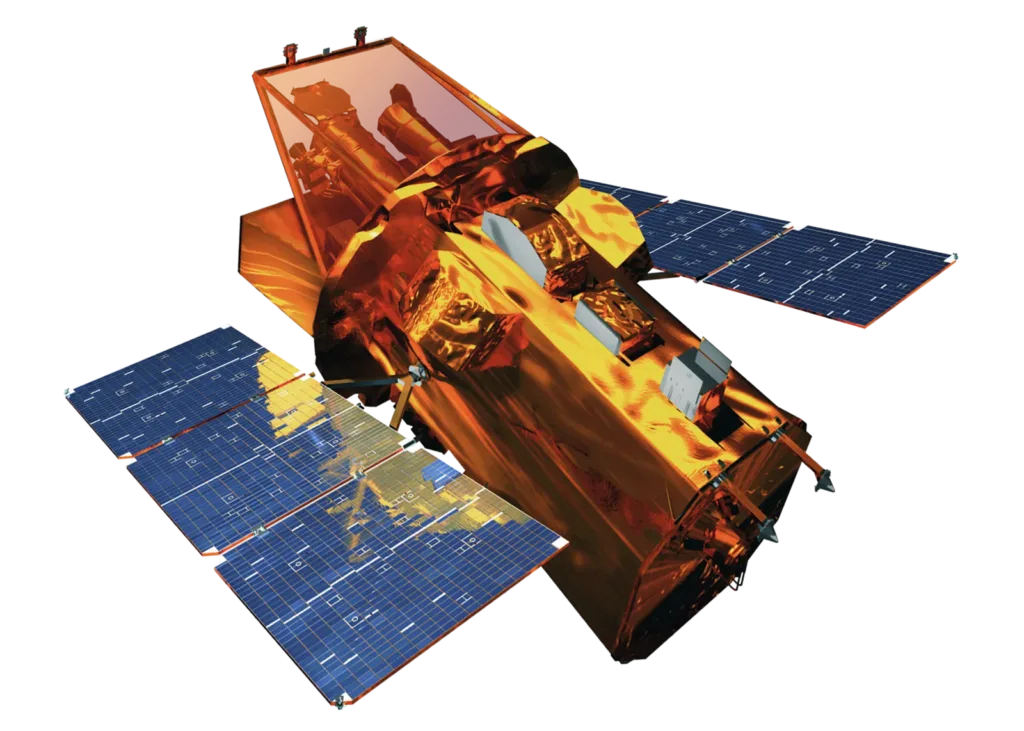
Representative image. NASA E/PO, Sonoma State University/Aurore Simonnet, Public domain, Wikimedia Commons

Why it matters
Swift's path crosses India south of about Nagpur, so readers in Mumbai, Hyderabad, Chennai, Bengaluru and Kochi live under its path. NASA's own figure says harm to anyone is unlikely, and the chance for any one person is far smaller. The fall also ends a telescope NASA treated as a first responder that pointed Hubble and Webb at new cosmic explosions, AP reported.
The NASA Swift observatory, a space telescope weighing about 1,450 kg that was launched almost 22 years ago, is expected to fall out of orbit on Wednesday, 4 November 2026. The NASA Swift re-entry will be uncontrolled, and the US Space Force’s central estimate, published by NASA, puts it at about 2 pm IST, with an uncertainty of 11 hours either way. As of 6.15 am IST, NASA’s Swift blog had not reported that the spacecraft had come down.
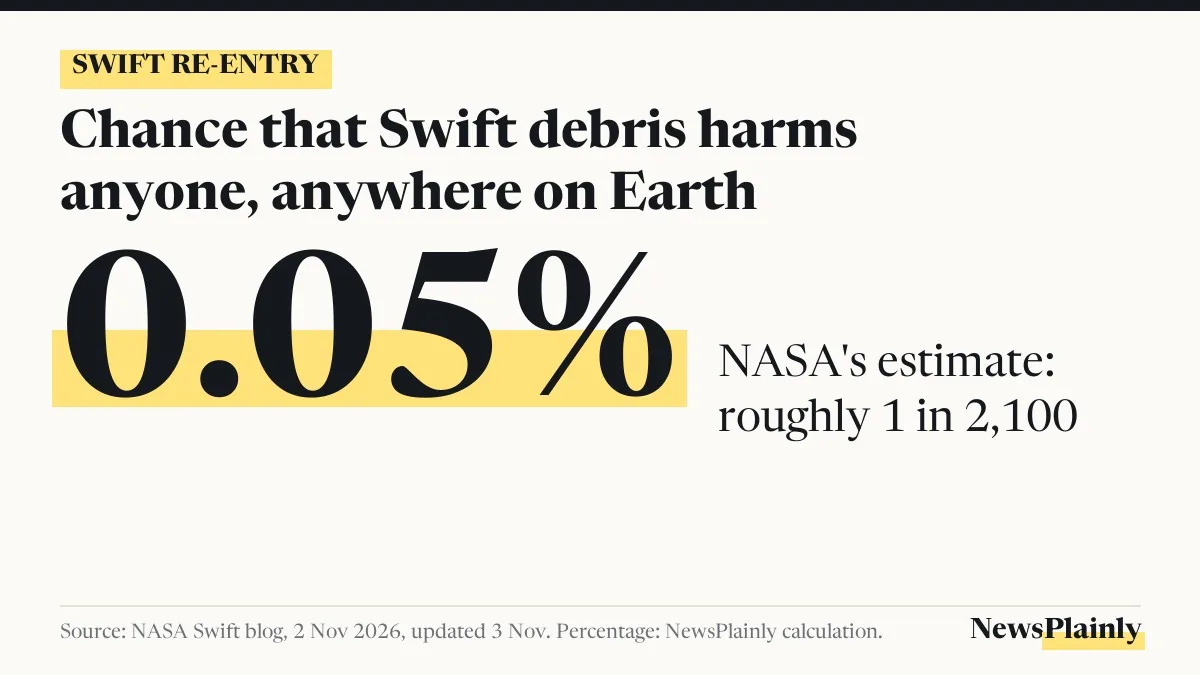
Most of the spacecraft should burn up, NASA says, but some parts are expected to survive. Any Swift debris can only land between 20.6 degrees north and 20.6 degrees south of the equator, a band that takes in most of peninsular India as well as large stretches of ocean, Africa, Southeast Asia, northern Australia and Latin America. NASA put the risk of harm to anyone on Earth at roughly 1 in 2,100.
When the NASA Swift re-entry is expected, in IST
Forecasts for an uncontrolled Swift re-entry keep shifting until the last few orbits, because the drag on the spacecraft changes with solar activity and the state of the upper atmosphere. Two sets of numbers were public at the time of writing. NASA’s own post, first published on 2 November and updated on 3 November, carries the Space Force prediction. The Aerospace Corporation, a US nonprofit that tracks objects in orbit, has published its own estimates, which Live Science reported in an update at 6 pm EST on 3 November (4.30 am IST on 4 November).
| Forecast | Central time (IST) | Stated uncertainty | Window in IST |
|---|---|---|---|
| US Space Force, via NASA | 2.00 pm, 4 Nov | plus or minus 11 hours | 3.00 am 4 Nov to 1.00 am 5 Nov |
| Aerospace Corporation, earlier estimate (Live Science) | 3.42 pm, 4 Nov | plus or minus 8 hours | 7.42 am 4 Nov to 11.42 pm 4 Nov |
| Aerospace Corporation, latest (Live Science, 3 Nov update) | 3.49 pm, 4 Nov | plus or minus 2 hours | 1.49 pm to 5.49 pm, 4 Nov |
The two forecasters overlap on the afternoon of 4 November IST, but neither gives a place. At roughly 8 km a second, the speed ABC News (the Australian Broadcasting Corporation) reported, each minute of error shifts the point of re-entry by about 480 km along the track, by NewsPlainly’s arithmetic. NASA said it and the Space Force would keep monitoring and update the prediction.
Could Swift debris fall in India?
It is possible but not likely, on the figures published so far. The Swift observatory circles Earth on a low-inclination orbit, so it never flies north of about 20.6 degrees latitude. That is why NASA can limit where surviving pieces could land to the tropical belt, and also why most of that belt is sea.
The Times of India listed Mumbai, Hyderabad, Bengaluru, Chennai, Bhubaneswar and Kochi as cities inside the band. NewsPlainly checked the latitudes of some large Indian cities against NASA’s 20.6 degree limit.
| City | Latitude (approx.) | Inside the 20.6 N band? |
|---|---|---|
| Delhi | 28.6 N | No |
| Lucknow | 26.8 N | No |
| Kolkata | 22.6 N | No |
| Nagpur | 21.1 N | No, just north of it |
| Bhubaneswar | 20.3 N | Yes, near the edge |
| Mumbai | 19.1 N | Yes |
| Hyderabad | 17.4 N | Yes |
| Chennai | 13.1 N | Yes |
| Bengaluru | 13.0 N | Yes |
| Kochi | 9.9 N | Yes |
Australian National University astrophysicist Brad Tucker gave ABC News a rough way to think about it: with about 70 per cent of the planet covered by ocean, roughly three times in ten a falling object comes down over land rather than water.
The Times of India report said the Indian Space Research Organisation (ISRO) had not said whether it was tracking the observatory. A search by NewsPlainly around 6 am IST on 4 November found no ISRO statement on Swift.
What NASA’s 1 in 2,100 Swift re-entry risk figure means
NASA’s number is the chance that anyone, anywhere on Earth, is hurt by surviving Swift debris. It is not the chance for a particular person or a particular city. Put another way (NewsPlainly’s calculation), 1 in 2,100 is about 0.05 per cent, so NASA’s estimate leaves about a 99.95 per cent chance that no one is harmed at all. The individual risk for someone in Mumbai or Chennai is a tiny fraction of that, because the risk is shared across the whole populated belt.
The figure is still higher than the limit in NASA’s debris rules. Dean Sladen, an aerospace engineer at UK components supplier Accu Components, told Space.com that NASA’s orbital debris requirements cap the casualty risk from surviving debris at 1 in 10,000, and that a satellite which cannot meet that is expected to make a controlled descent. By NewsPlainly’s arithmetic, Swift’s 1 in 2,100 is about 4.8 times that limit (10,000 divided by 2,100). The Swift observatory has no propulsion to guide it down, as ABC News noted, and its operations have ended.
What Swift debris could survive the fall
Most of the Swift observatory is aluminium, wiring and electronics, which melt away early, Sladen told Space.com. Brad Cenko, the mission’s chief scientist at NASA, told the Associated Press that a few pieces made of tungsten, a metal denser than lead, and some mirror parts could survive. He said the likeliest survivors were the six reaction wheels Swift used to point itself, along with lenses and mirrors from its telescopes, and that only a handful of small, scorched fragments were expected to reach the surface.
The end comes quickly. Once the spacecraft drops to about 120 km, the air ahead of it heats up and it starts to glow, according to experts quoted by ABC News and Space.com. Tucker told ABC that whether anyone sees the Swift re-entry depends on luck: a final pass in daylight or over open sea would go unnoticed, while a night pass over a populated area could be filmed.
How Swift went from gamma-ray hunter to falling satellite
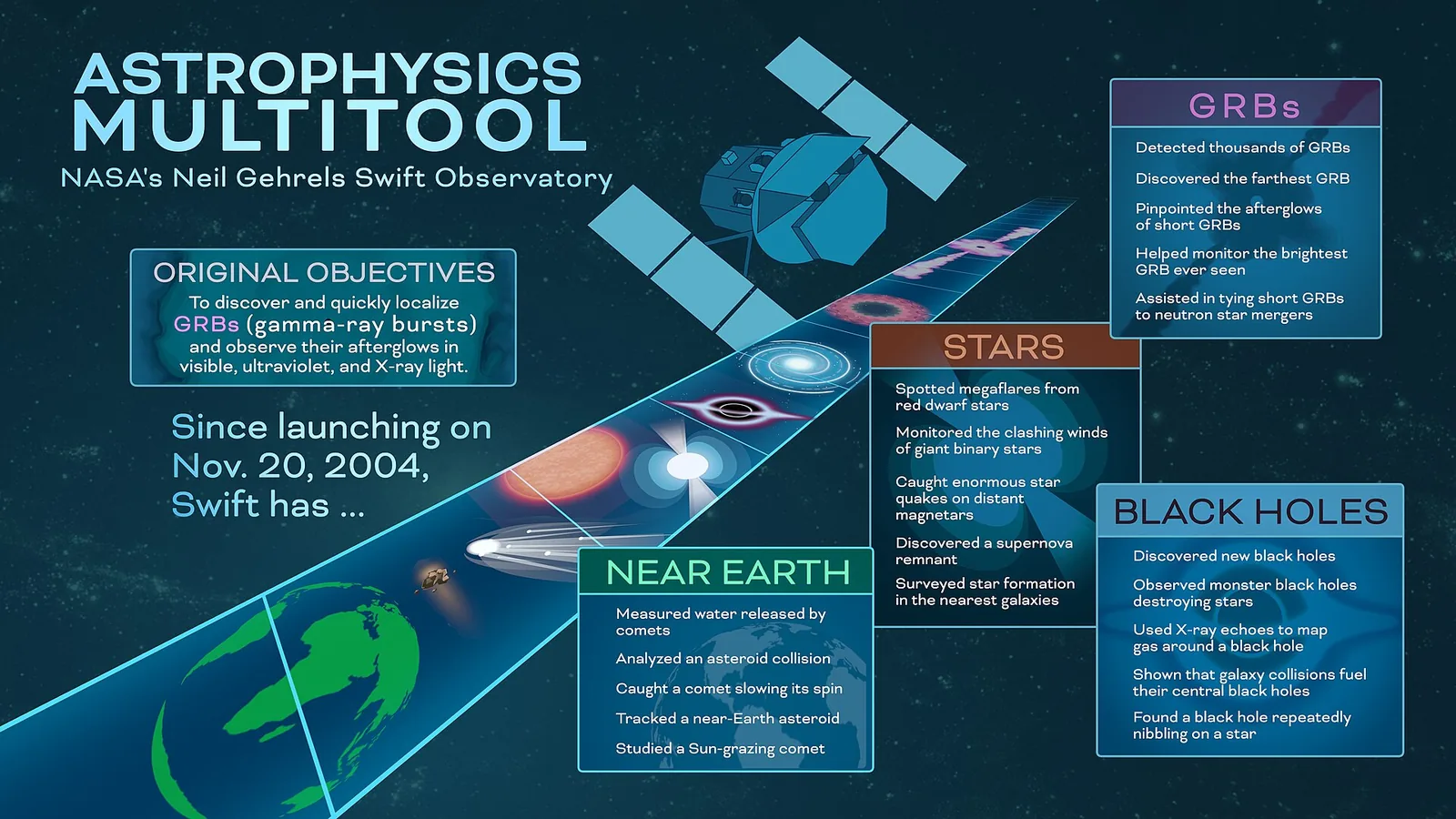
The Swift observatory, named after NASA astrophysicist Neil Gehrels, was built to catch gamma-ray bursts, the most powerful explosions known, and to swing its telescopes towards them within moments. It was designed for a two-year prime mission and worked for almost 22 years. The timeline below comes from NASA’s Swift blog and the Associated Press.
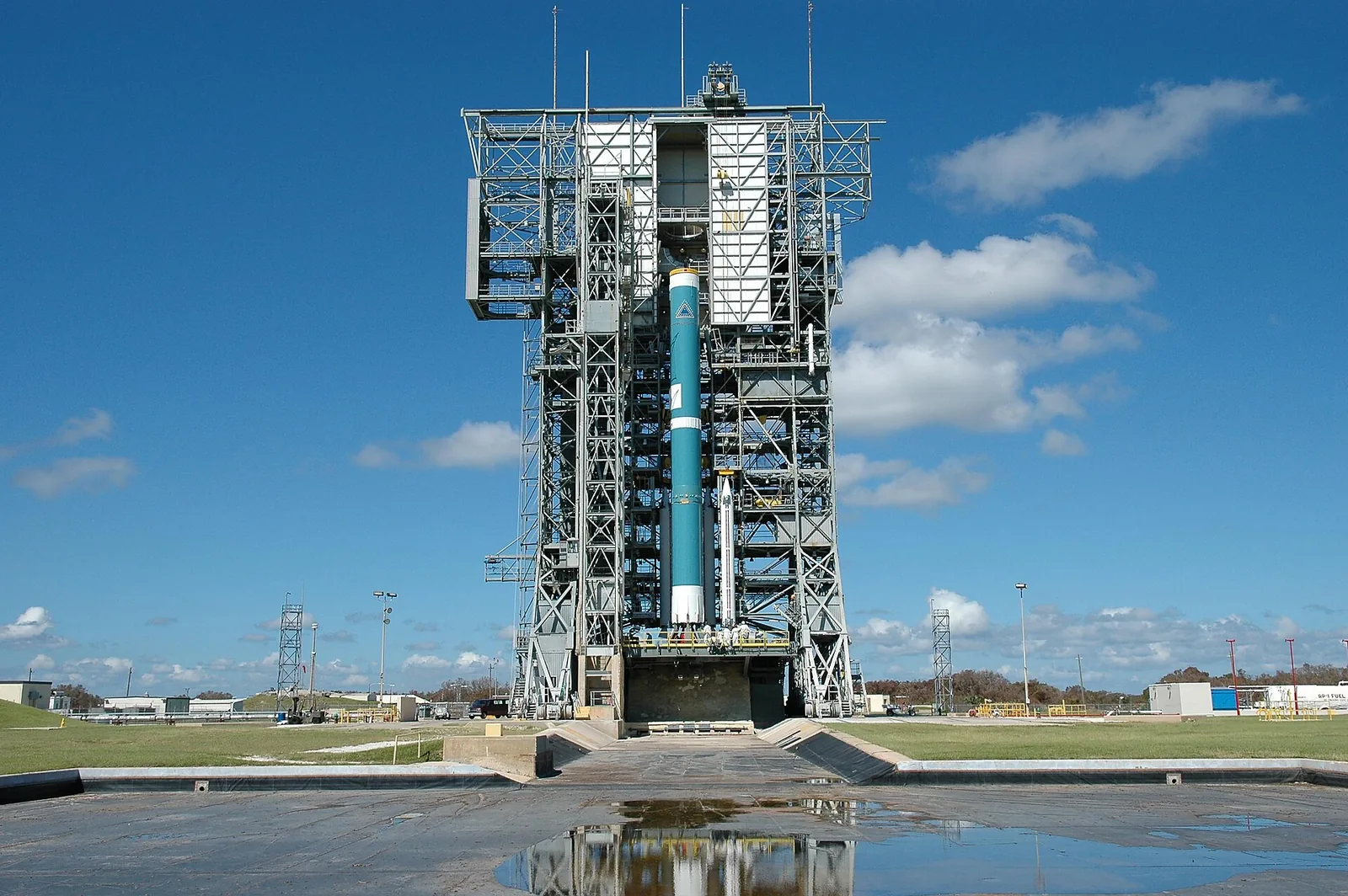
- 20 November 2004: Swift launches from Cape Canaveral, Florida.
- 2004 to 2026: it records more than 2,000 gamma-ray bursts and about 1,400 exploding stars, according to AP, and sends alerts that steer other telescopes, including Hubble and Webb, to new events.
- Recent years: strong solar activity increases atmospheric drag on Swift, and it starts to sink faster than usual, according to NASA and AP.
- About a year ago: NASA hires Arizona company Katalyst Space to boost Swift to a higher orbit with a robotic spacecraft called LINK (the servicing craft’s name), AP reported.
- July 2026: LINK launches but runs into attitude control trouble. It gets no closer than 12 to 15 km from Swift, according to AP.
- 19 August 2026: NASA and Katalyst say LINK will not capture or boost Swift.
- 20 October 2026: Swift sinks to 275 km, can no longer cope with the drag and enters safe mode. The operations team at Penn State then sends the command that ends its operations, NASA said.
- 4 November 2026: predicted day of re-entry.
Once the NASA Swift re-entry is confirmed, the Space Force and NASA are expected to give the time and approximate place. NewsPlainly’s Health and Science section will carry that update.
Frequently asked questions
When will NASA's Swift fall to Earth?
The US Space Force, in a forecast NASA published, expects re-entry at about 2 pm IST on 4 November 2026, give or take 11 hours. The Aerospace Corporation's latest estimate, reported by Live Science, is about 3.49 pm IST, give or take 2 hours.
Will Swift debris fall in India?
It could, but it is not likely. Surviving pieces can land anywhere between 20.6 degrees north and south, which includes India south of about Nagpur, but most of that band is ocean and NASA says most of the craft will burn up.
How dangerous is the Swift re-entry?
NASA puts the risk of harm to anyone on Earth at roughly 1 in 2,100, about 0.05 per cent. That is the total for the whole world, not the chance for one person.
Why is Swift falling?
Strong solar activity increased atmospheric drag on Swift. A commercial spacecraft meant to boost it to a higher orbit ran into control problems, and NASA ended Swift's operations on 20 October 2026.