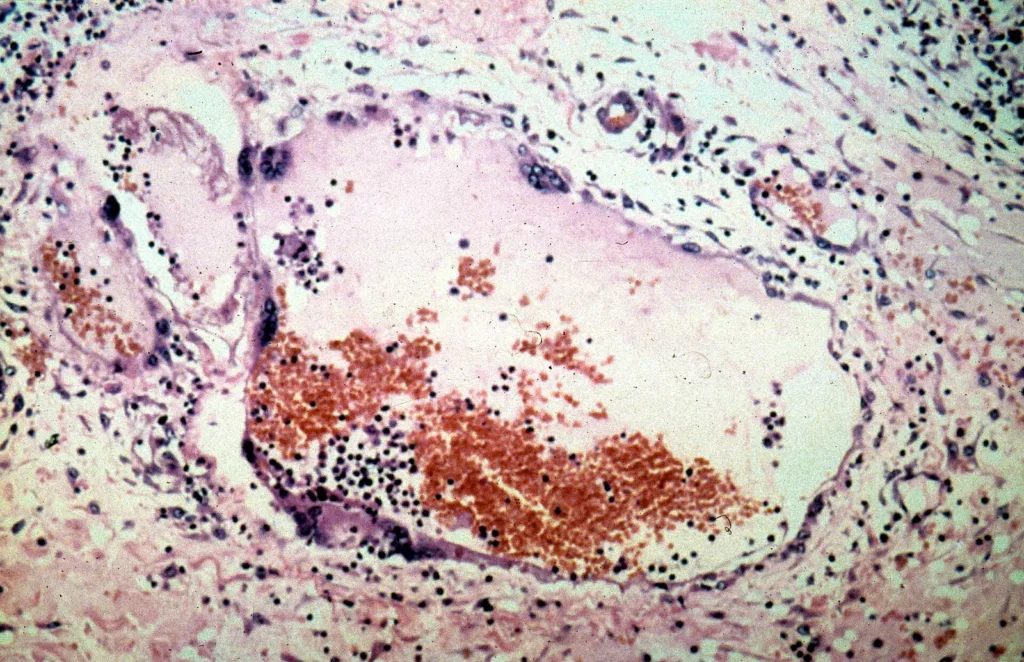
Representative image. Dr Peter Hooper, CSIRO, CC BY 3.0, Wikimedia Commons

Why it matters
Six of the 11 Nipah patients in Kerala from 2023 to 2025 died, by the minister's figures, and families need to know whether treatment given at a government hospital was sound. The probe also tests how the state's medicine agency tracks expiry dates, which affects every patient in government hospitals.
Kerala’s government has asked an expert committee to find out whether Nipah patients treated at Government Medical College Hospital, Kozhikode, between 2023 and 2025 were given expired remdesivir, that is, doses used after the antiviral’s expiry date. Health Minister K. Muraleedharan told the Legislative Assembly on 29 October 2026 that hospital records raised that suspicion, The Indian Express reported. The Nipah remdesivir question for Kozhikode Medical College is now with the committee, and the minister said on 30 October that the government would act only after it reports.
Nothing has been established yet. The committee is to examine whether any deaths were linked to expired doses, and a doctor who treated Nipah patients has disputed that the patients who died received the drug at all.
What the minister told the Assembly about Nipah remdesivir
Muraleedharan was replying to a submission by Congress MLA Mathew Kuzhalnadan. According to The Indian Express, he said remdesivir reaches state hospitals only through the Kerala Medical Services Corporation Limited (KMSCL), the state agency that buys and distributes medicines for government institutions.
KMSCL’s last purchase of the drug was on 3 June 2021, he said: 3,000 vials for ₹42 lakh, with an expiry date of 30 May 2023. That works out to ₹1,400 a vial, by NewsPlainly’s calculation. Yet Kozhikode Medical College reported using remdesivir in each of the following years, which is why the records raised suspicion, he said.
The Hindu’s account of the same reply puts it slightly differently: remdesivir bought in 2021, with a May 2023 expiry, might have been given to patients admitted to the Kozhikode hospital until 2025. Both reports present it as a possibility in the records, not a finding. “There are several doubts regarding the medicine, including whether it was administered after its expiry date. We will investigate and take a decision,” Muraleedharan said in Kozhikode on 30 October, according to The Hindu.
The directorate of medical education, which runs the medical colleges, and the directorate of health services, which runs other government hospitals, have been asked to collect details of every patient who received remdesivir, the minister said.

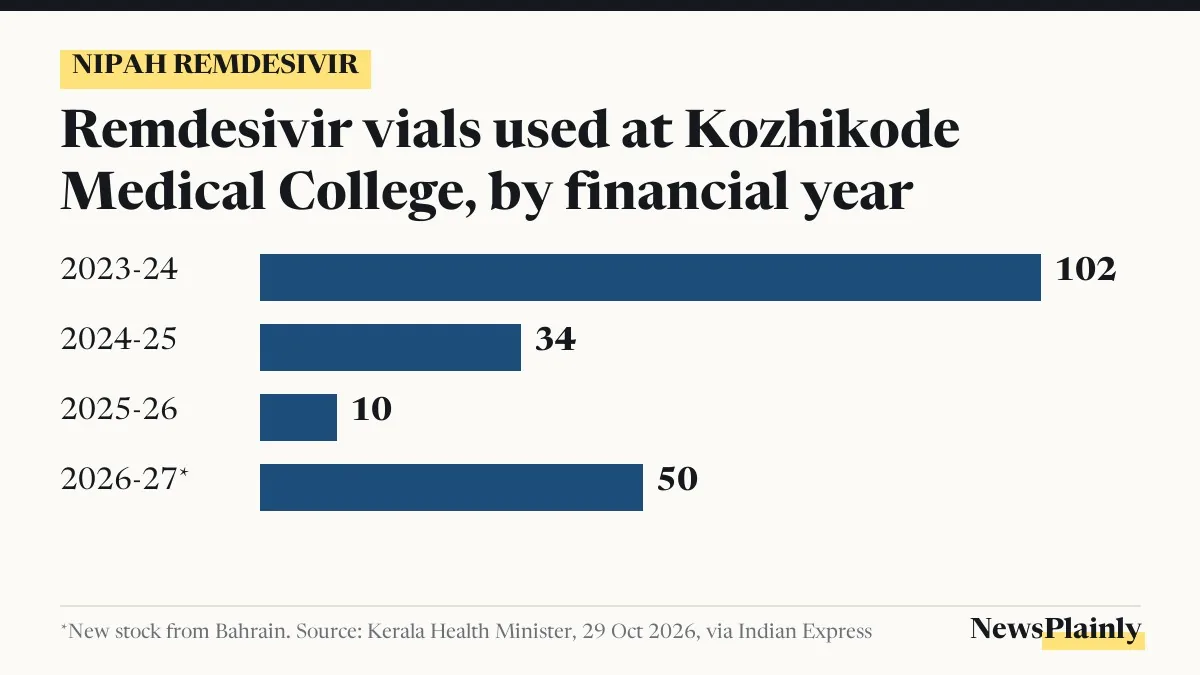
Kerala Nipah deaths and vials used at Kozhikode, year by year
The minister gave the Assembly two sets of numbers: vials used at the Kozhikode hospital by financial year, and Nipah cases and deaths by calendar year. NewsPlainly has put them side by side.
| Year | Remdesivir vials used at Kozhikode MCH (financial year) | Nipah cases (calendar year) | Deaths |
|---|---|---|---|
| 2023 | 102 (2023-24) | 6 | 2 |
| 2024 | 34 (2024-25) | 2 | 2 |
| 2025 | 10 (2025-26) | 3 | 2 |
| 2026 | 50 (2026-27, bought from Bahrain on 12 June 2026) | 1 | 0 |
Across 2023 to 2025, that is 11 Nipah cases and 6 deaths, by our count of the minister’s figures. The 50 vials used in 2026-27 were a fresh supply, given to the one Nipah patient of 2026, who survived.
The financial years in the table matter. The 2023-24 year began on 1 April 2023, about two months before the 2021 batch expired on 30 May 2023. So the yearly totals alone cannot show how many of those 102 vials were used after the expiry date. The figures also do not say how many vials went to Nipah patients rather than others treated at the hospital. That is part of what the committee has been asked to establish.
Who disputes the expired remdesivir suspicion
Two people quoted by The Hindu on 30 October questioned the minister’s account. Dr A.S. Anoop Kumar, a critical care specialist who treated several Nipah patients at a private hospital, said the patients who died of Nipah had not been given remdesivir.
Former health minister Veena George said the allegations were suspicious, because the medicine has an expiry period of 2.5 to 5 years, The Hindu reported. Her remarks as reported did not go into the specific 2021 batch or the 30 May 2023 date the minister cited.
Muraleedharan, speaking to reporters in Kozhikode, said the information he gave the Assembly came from responsible Health Department officials and that he would make no further comment until the committee reported. He said there was no concern about the quality or effectiveness of remdesivir itself; the question was only whether expired remdesivir was used. Patients who received the drug within its validity had recovered, he said.
What the expert committee will examine
The committee is headed by Dr R. Aravind, head of the infectious diseases department at Government Medical College, Thiruvananthapuram, the minister said, according to The Hindu. It will look at:
- whether the deaths of Nipah patients were linked to expired medicine;
- whether other patients given the drug had side effects;
- how the drug was bought and supplied, including any role of intermediaries or agents;
- how KMSCL functioned.
The minister also said the Kozhikode hospital superintendent had told him the remdesivir packaging showed an expiry date but no manufacturing date. Medicine packs normally carry both, and that gap will be examined, he said.
Describing this year’s supply, he said the drug could not be found in time elsewhere in India during the 2026 Nipah case, because stocks available in Mumbai had expired. KMSCL then found it in Bahrain, and it was brought in within 48 hours.
Remdesivir and Nipah in brief
The Kerala Nipah figures the minister gave show how deadly the infection has been: 6 of the 11 patients from 2023 to 2025 died. Remdesivir is an antiviral that was prescribed in India during the Covid-19 pandemic. It is a patented drug made in India under voluntary licences from Gilead, The Indian Express noted.
The minister did not give a date for the committee’s report in the remarks reported by The Hindu and The Indian Express. Until it reports, the Nipah remdesivir records from Kozhikode Medical College remain a suspicion raised by the government, disputed by a treating doctor and by the former health minister.
Frequently asked questions
Was expired remdesivir given to Nipah patients in Kerala?
That is not established. Health Minister K. Muraleedharan said hospital records raise the suspicion for 2023 to 2025, and an expert committee is examining it. A doctor who treated Nipah patients said those who died were not given the drug.
When did Kerala's remdesivir stock expire?
The minister said the last purchase, 3,000 vials bought on 3 June 2021, had an expiry date of 30 May 2023.
Who is heading the Nipah remdesivir probe?
Dr R. Aravind, head of the infectious diseases department at Government Medical College, Thiruvananthapuram, according to the minister.
How many Nipah deaths did Kerala record from 2023 to 2025?
Six deaths among 11 cases, according to the minister's figures: two of six in 2023, both cases in 2024 and two of three in 2025.