Representative image. Prabhat1729, CC BY-SA 4.0, Wikimedia Commons

Why it matters
Punjab says agencies have paid ₹20,713.24 crore to 4.71 lakh farmers for paddy this season, so the pace of government buying decides when farmers are paid. Officials blame wet grain for the slower start. Central pool rice stocks are about 3.7 times the buffer norm, so the slowdown is a question for farmers and mandis rather than for ration supplies, on the figures Mint reported.
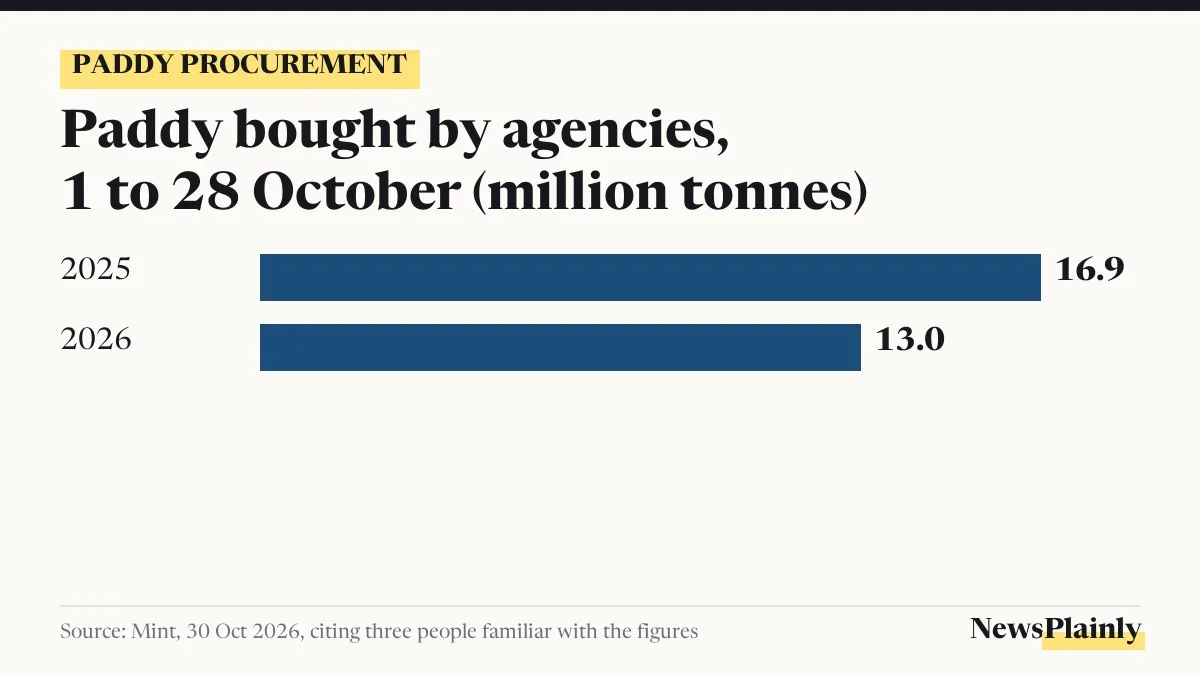
Paddy procurement by government agencies is running well behind last year. Between 1 and 28 October 2026, the Food Corporation of India (FCI) and state agencies buying on its behalf purchased 13 million tonnes of paddy, against 16.9 million tonnes in the same weeks of 2025, Mint reported on 30 October, citing three people familiar with the figures. Officials in Punjab, the biggest supplier, blamed rain that left grain too moist to harvest and early delays in moving bought grain out of the mandis.
By NewsPlainly’s calculation, the gap of 3.9 million tonnes is a fall of about 23%. The Department of Food and Public Distribution and FCI did not answer Mint’s emailed questions before publication, the paper said.
How far paddy procurement has fallen behind
Paddy procurement for the 2026-27 kharif marketing season (KMS) runs from October 2026, when the monsoon rice crop reaches the mandis, the regulated wholesale markets where agencies buy at the minimum support price (MSP). The MSP is the floor price the Centre guarantees. For 2026-27 it is ₹2,441 a quintal for common paddy, up from ₹2,369, and ₹2,461 for Grade A, according to Mint. That is a rise of ₹72, or about 3%, for common paddy.
In the paddy procurement data Mint said it reviewed, Punjab was far ahead, at 8.86 million tonnes by 28 October. Haryana followed with 3.60 million tonnes, then Tamil Nadu with 418,987 tonnes and Uttarakhand with 81,681 tonnes. All of these states had bought more at the same point last season, Mint said, citing the Central Food Grains Procurement Portal.
The 13 million tonnes of paddy procurement so far is about 18% of the season’s target of 71.95 million tonnes reported by Mint, by our arithmetic.
Punjab paddy figures: two counts a day apart
The Punjab government gives a higher number for Punjab paddy bought at the minimum support price. On 29 October the state’s Food, Civil Supplies and Consumer Affairs Minister, Lal Chand Kataruchak, said after a review meeting that agencies had bought more than 101.96 lakh tonnes (10.2 million tonnes) in Punjab’s mandis. His department said ₹20,713.24 crore had been paid into the bank accounts of more than 4.71 lakh farmers, 70 lakh tonnes had been lifted from the mandis, and more than 2,500 mandis were open. The minister said Punjab would reach its target of 180 lakh tonnes.
That state count is about 13.4 lakh tonnes above the 8.86 million tonnes Mint reported for Punjab a day earlier. Neither the Punjab release nor Mint’s report explains the gap.
| Punjab measure | Figure | What it means |
|---|---|---|
| Paddy bought (state count, 29 Oct) | 101.96 lakh tonnes | About 57% of the 180 lakh tonne target |
| Paddy bought (Mint, 28 Oct) | 88.6 lakh tonnes | About 49% of the target |
| Lifted from mandis | 70 lakh tonnes | About 69% of the state’s bought figure; the state puts lifting at 86% on its 72-hour measure |
| Paid to farmers | ₹20,713.24 crore | About ₹4.4 lakh on average for each of 4.71 lakh farmers |
The per-farmer figure is a simple average. The release does not break payments down by farm size or district.
Why rain slowed the Punjab paddy harvest
Uneven rain raised moisture in the standing crop, so farmers held back their harvest, Punjab State Agricultural Marketing Board chairman Harchand Singh Barsat told Mint. He said lifting grain from the mandis had been a problem at first but had since been sorted out, and that the crop was in good condition.
Kataruchak gave Mint a similar account. He said erratic weather across the north-west had hit harvesting and arrivals in the mandis, slowing procurement for both farmers and agencies, and that things should improve as arrivals steady. Mint reported that the north-western region, which covers Punjab, Haryana, Himachal Pradesh, Delhi, Uttarakhand, Uttar Pradesh and Rajasthan, received 20 mm of rain between 1 and 21 October against a normal 18.9 mm, about 6% more.
Tarsem Singh Saini, president of the Federation of All India Rice Millers’ Association, told Mint that operations were now running smoothly after early hiccups.
Paddy targets, storage and the stock cushion
The kharif marketing season started with less paddy in the ground. Rural Voice reported in September that the area sown was 414.10 lakh hectares as of 28 August, 3.35% below the 428.46 lakh hectares of a year earlier, citing the government’s UPAJ crop-sowing data portal. Mint puts the season’s fall in area at 3.5%, or 1.55 million hectares.
The two outlets also report different paddy procurement targets. Rural Voice said a 1 September meeting of state food secretaries, chaired by Food Secretary Sanjeev Chopra, fixed the target at 708.64 lakh tonnes (70.86 million tonnes). Mint reports 71.95 million tonnes, close to last year’s 72 million tonnes. Last season the government bought 81 million tonnes, well above its target, Mint said.
Mint’s state-wise estimates for this season show where the rest of the paddy is expected to come from:
| State | Planned for central pool (million tonnes) | Bought by 28 Oct (Mint) |
|---|---|---|
| Punjab | 18.0 | 8.86 |
| Chhattisgarh | 10.9 | not given |
| Odisha | 6.4 | not given |
| Uttar Pradesh | 6.2 | not given |
| Haryana | 5.8 | 3.60 |
| Telangana | 5.7 | not given |
Storage is the other pressure point. In September the Centre reviewed a New Storage Policy that plans 131 lakh tonnes of extra capacity, 111 lakh tonnes by states and 20 lakh tonnes by FCI, Rural Voice reported. That capacity is a plan, not yet built.
Grain in the central pool is well above what the rules require. Central pool rice stocks stood at 37.76 million tonnes on 1 October 2026, Mint reported, against a buffer norm of 10.25 million tonnes. That is about 3.7 times the norm. The rice goes to ration-card holders under the Pradhan Mantri Garib Kalyan Anna Yojana (PMGKAY), the free foodgrain scheme.
What farmers selling paddy can expect next
Millers and Punjab officials quoted by Mint expect paddy procurement to speed up as the weather improves and more grain reaches the mandis. The material read gives no new national figure after 28 October. Payment for Punjab paddy goes straight to farmers’ bank accounts, according to the state. The paddy harvest in Punjab runs alongside the stubble-burning season, on which NewsPlainly reported earlier this month.
Frequently asked questions
How much paddy has the government procured in 2026-27 so far?
About 13 million tonnes between 1 and 28 October 2026, according to Mint, which cited three people familiar with the figures. A year earlier it was 16.9 million tonnes.
What is the paddy MSP for 2026-27?
₹2,441 a quintal for common paddy and ₹2,461 for Grade A, according to Mint. Common paddy was ₹2,369 last season.
Why is paddy procurement slow this year?
Punjab's food minister and its Mandi Board chairman told Mint that uneven rain raised moisture in the crop and delayed harvesting, and that lifting grain from mandis was slow at first.
How much paddy has Punjab bought?
The Punjab government said on 29 October that 101.96 lakh tonnes had been bought, against a target of 180 lakh tonnes. Mint reported 8.86 million tonnes as of 28 October.