Representative image. Pinakpani, CC BY-SA 4.0, Wikimedia Commons

Why it matters
The order will settle who registers an FIR over the 8 January events and which agency investigates a former Chief Minister and police officers. In August the Centre also asked the court to rule on whether the CBI should probe a sitting Chief Minister accused of a crime. The order will not decide whether anyone is guilty.
The I-PAC raid case is now waiting for a ruling. On 29 October 2026, a Supreme Court bench of Justices Prashant Kumar Mishra and N.V. Anjaria reserved its order on the Enforcement Directorate’s plea for an FIR and a Central Bureau of Investigation (CBI) probe against former West Bengal Chief Minister Mamata Banerjee and three police officers. The ED, the central agency that investigates money laundering, says they obstructed its search of the Kolkata office of I-PAC (Indian Political Action Committee), the Trinamool Congress’s political consultant, on 8 January.
The question left for the judges is narrow, LiveLaw reported: should the court itself send the case to the CBI, or leave that call to West Bengal’s new state government?
What each side told the court on 29 October
Senior Advocate Kapil Sibal, appearing for Banerjee, said no court order was needed. With Banerjee no longer in office, he argued, the state can refer any matter to the CBI on its own. “Now the State government is in the hands of another political party,” he said, according to LiveLaw, adding that nobody could stand in the way of such a referral.
Justice Mishra pointed to a concern raised in earlier hearings: if the new state government made the referral, it could be accused of acting from political motives. Sibal replied that there would be no such allegation from his side, LiveLaw reported.
Additional Solicitor General S.V. Raju, for the ED, opposed leaving it to the state. He said a referral by the state would invite claims of mala fide (bad faith) action, and that senior police officers named as accused could influence any probe. IANS, a news agency, reported that he also said cross-cases in the matter needed a single agency.
LawBeat, a legal news site, also reported Sibal’s argument that the changed state government had the power to transfer the case itself. None of the reports read gave a date for the order.
What the ED alleges, and Banerjee’s reply
The ED’s searches on 8 January were part of a money laundering probe linked to an alleged coal smuggling scam, IANS reported. Officers searched I-PAC’s office in Kolkata and the home of one of its directors.
According to the ED’s case as reported by LiveLaw, Banerjee, then the Chief Minister, arrived at the I-PAC office with senior party leaders, confronted the officers and took away some files. The agency says this hurt its investigation. These are allegations; no court has ruled on them.
Mamata Banerjee denies wrongdoing. She has said she went to the office to retrieve confidential data belonging to the Trinamool Congress, IANS reported. LawBeat reported that she later told the court the ED had allowed her to take devices and physical files during the search.
Besides Banerjee, the ED’s petition names the then Director General of Police Rajeev Kumar, the then Kolkata Police Commissioner Manoj Kumar Verma and the then deputy commissioner of South Kolkata, LiveLaw reported.

Why the change of government matters in the I-PAC raid case
When the ED filed its petition, Banerjee was the sitting Chief Minister; Raju has described her as also holding the Home portfolio at the time, which put the state police under her. The ED filed directly in the Supreme Court under Article 32 of the Constitution, which allows a person to approach the court directly over fundamental rights, and whether that petition can be heard there has been argued alongside the merits, LawBeat reported.
The state government has since changed hands. The reports describe a “newly appointed” government run by another party, and Banerjee as the former Chief Minister. Her lawyers have argued since August that this removes the reason for the court to step in.
The ED and the Centre see it differently. At the 18 August hearing, Solicitor General Tushar Mehta told the bench the agency did not want to face allegations that the new state government had sent the case to the CBI for political reasons, and asked the court to decide the larger issue, LiveLaw reported. Raju put that issue as whether the CBI can investigate a sitting Chief Minister who is also Home Minister if she is accused of committing a crime.
Banerjee’s side has also argued that the petition should not have been filed in the Supreme Court at all. Senior Advocate Menaka Guruswamy cited the 2007 Sakiri Vasu judgment, under which a person whose complaint the police fail to register or investigate properly should go to a judicial magistrate.

The case from search to reserved order
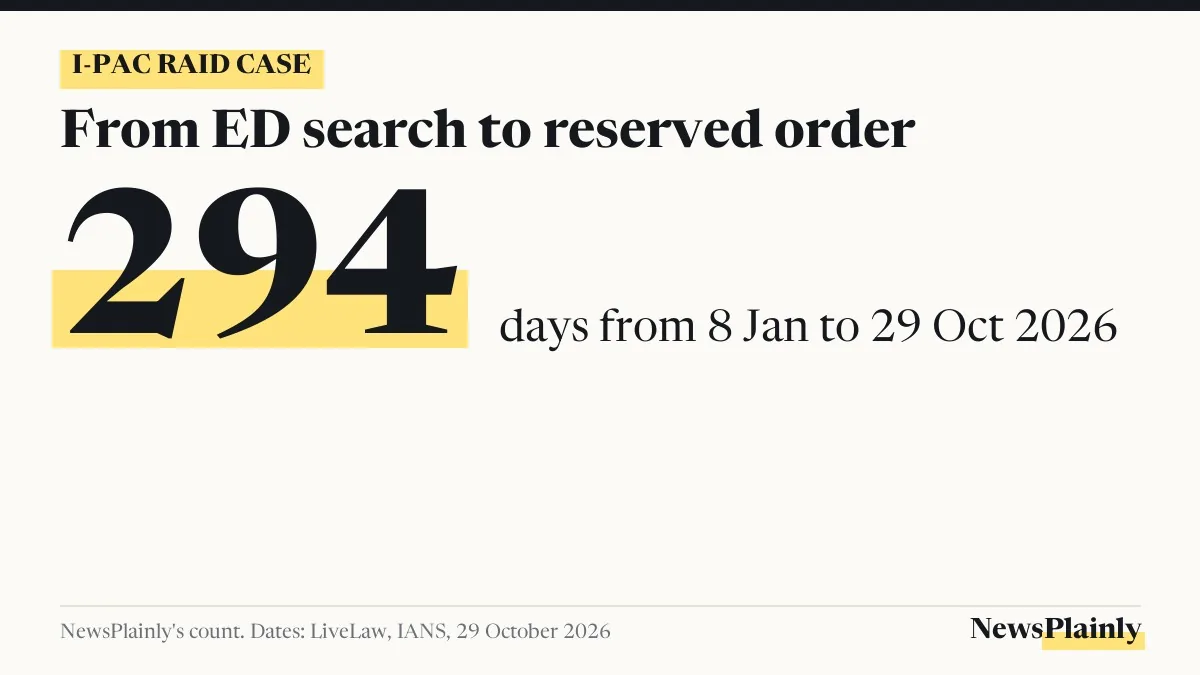
The ED’s petition, W.P.(Crl.) No. 16/2026, has run for almost 10 months. By NewsPlainly’s count, 294 days passed between the 8 January search and the 29 October hearing.
| Date (2026) | What happened |
|---|---|
| 8 January | ED searches I-PAC’s Kolkata office and a director’s home in a coal smuggling money laundering probe |
| 15 January | Supreme Court issues notice, stays West Bengal Police FIRs against ED officers and orders closed-circuit camera (CCTV) footage and digital records preserved |
| 18 August | Bench says it is inclined to let the probe go to the CBI; the Centre asks it to decide the larger issue; hearing continues on 2 September |
| 29 October | Arguments end; order reserved on whether the court or the state should send the case to the CBI |
Earlier in the case, the court had said that alleged interference by a sitting Chief Minister could put democracy in peril, IANS and LawBeat reported. At the 18 August hearing, Justice Mishra also told Guruswamy that the court would decide maintainability and merits together rather than in two rounds.
Who should order a CBI probe: the two positions
On 29 October, the argument was over who should make the referral to the CBI, as LiveLaw and IANS reported it.
| Question | ED and the Centre | Mamata Banerjee |
|---|---|---|
| Who should refer the case to the CBI? | The Supreme Court | The state government, which now can |
| Main reason given | A state referral would draw bad-faith allegations; accused officers could influence a probe | The court need not act now that she is out of office |
| Other point raised | Cross-cases need one agency (IANS) | Police inaction goes to a magistrate first (Sakiri Vasu, 2007) |
What the Supreme Court bench decides will set out who registers the FIR and which agency runs the investigation into the 8 January events. It will not, by itself, decide whether anyone did anything wrong; that is a matter for any investigation and trial that follows.
Frequently asked questions
What is the I-PAC raid case?
The ED says Mamata Banerjee, then West Bengal Chief Minister, and senior police officers obstructed its 8 January 2026 search of I-PAC's Kolkata office in a coal smuggling money laundering probe. It wants an FIR and a CBI probe. Banerjee denies wrongdoing.
What did the Supreme Court decide on 29 October?
It reserved its order. The question left is whether the court should send the case to the CBI or leave that decision to West Bengal's new government.
What did Kapil Sibal argue for Mamata Banerjee?
He said no court order was needed because the state government, now run by another party, can refer the case to the CBI itself.
Why does the ED want the court to decide?
ASG S.V. Raju said a referral by the state would draw allegations of bad faith, and senior police officers named as accused could influence the probe.