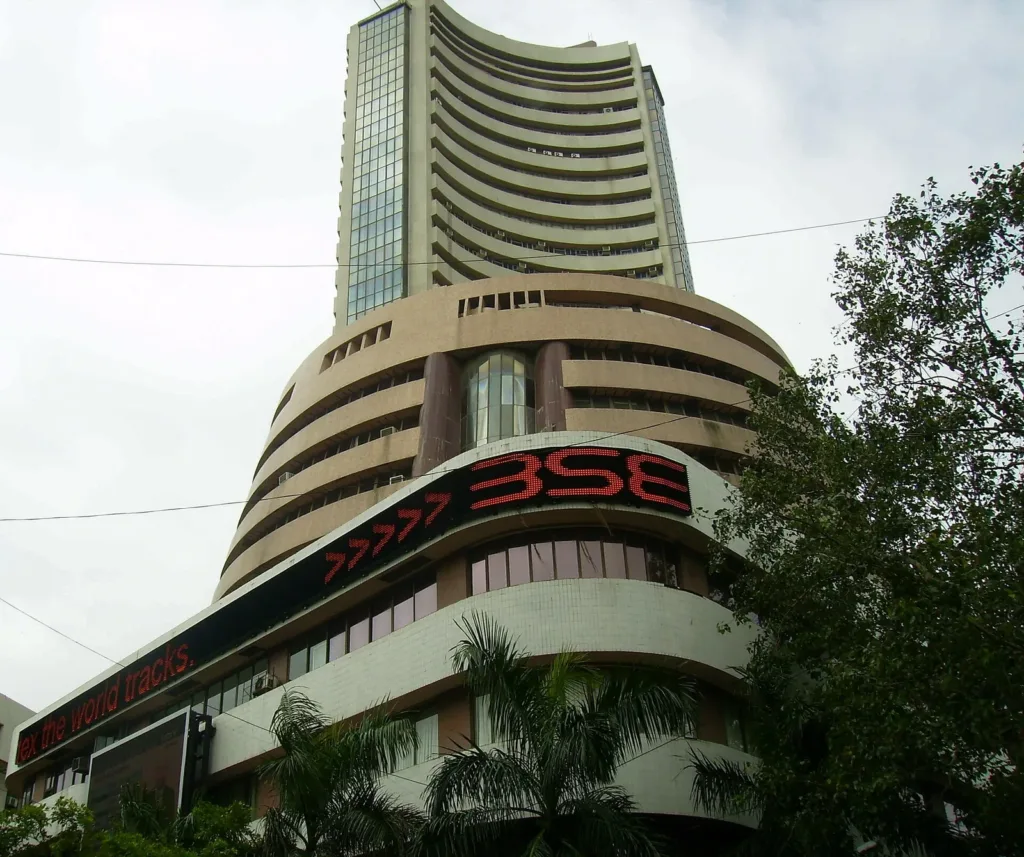
Representative image. Niyantha Shekhar, CC BY 2.0, Wikimedia Commons

Why it matters
Market headlines can use different times and comparison points. Separating the previous close from the opening level helps readers understand how a positive start turned into a smaller daily loss.
The Sensex reversal on 9 November 2026 took Indian shares from a higher opening into early losses, while the Nifty 50 slipped below 25,000. At about 9.27 am IST, the Sensex stood at 80,899.94, down 99.46 points from its previous close, according to India Today. These are morning observations, rather than a closing result.
How the Sensex reversal unfolded after the opening
Both major benchmarks began Monday above their previous closing levels. The Sensex opened at 81,327.29, while the Nifty opened at 25,076.40. Asian News International (ANI), the news agency, also reported those opening figures in its account of the session, before describing a move into negative territory.
By the snapshot reported by India Today, the Nifty 50 was at 24,969.30, down 17.10 points, or 0.07%, from its previous close. The Sensex was lower by 0.12%. A positive opening therefore did not mean that the gains held through the first part of trading.
The distinction matters when reading successive market headlines. An opening gain is measured at one moment; a later loss is measured against the previous session’s close. Both can describe the same morning without contradicting each other. ANI’s headline referred to a roughly 150-point Sensex decline at its own reporting stage.
What the opening-to-snapshot calculation shows
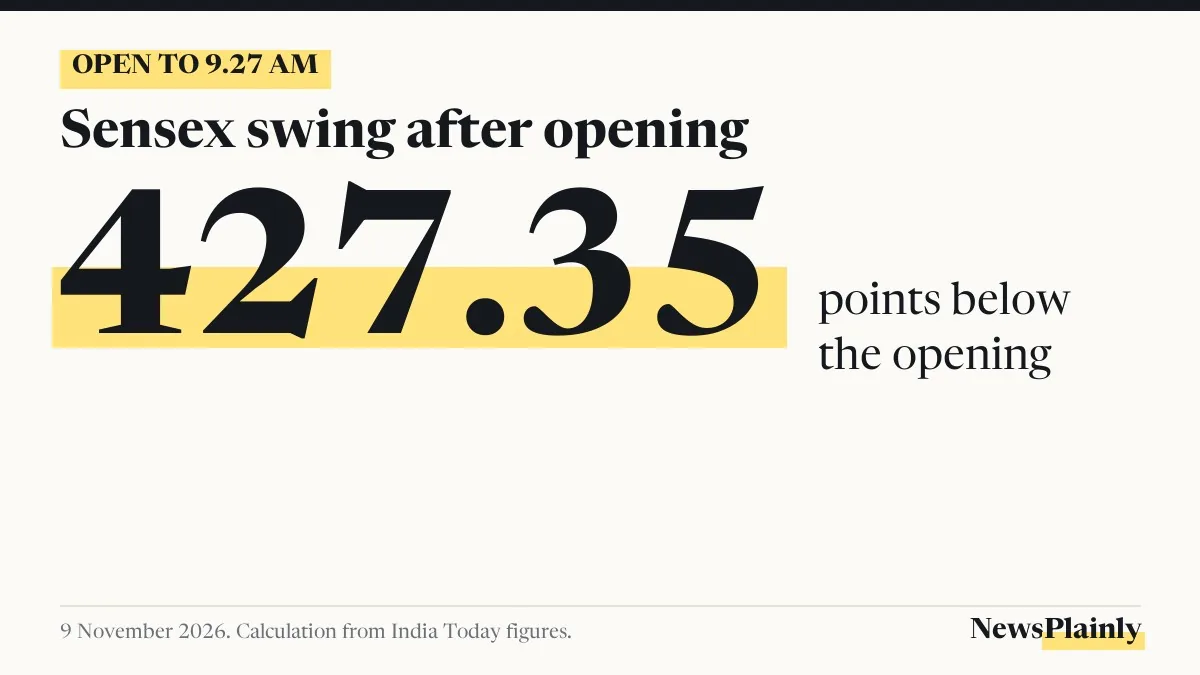
NewsPlainly compared the opening levels with India Today’s approximately 9.27 am readings. The result measures the distance travelled after the opening, rather than the change from the previous close.
| Benchmark | Opening | About 9.27 am | Fall from opening |
|---|---|---|---|
| Sensex | 81,327.29 | 80,899.94 | 427.35 points |
| Nifty 50 | 25,076.40 | 24,969.30 | 107.10 points |
The calculations are 81,327.29 minus 80,899.94 for the Sensex and 25,076.40 minus 24,969.30 for the Nifty. The 427.35-point opening-to-snapshot fall is larger than the reported 99.46-point daily loss because the Sensex began above its previous close of 80,999.40.
For readers following the previous Muhurat session, that earlier closing level is the relevant daily comparison. Comparing Monday’s opening with Monday’s later level answers a different question: how much of the opening strength disappeared.
Technology weakens while banks and pharma offer support
The headline indices did not capture a uniform decline across every industry. In India Today’s morning account, the Nifty IT index was down 0.80%, while the Nifty Pharma index gained 1.51%. The healthcare index rose 1.24% and the public-sector bank index advanced 1%.
Among Sensex constituents, HCL Technologies fell 1.44%, Infosys declined 0.99% and Tata Consultancy Services (TCS) was down 0.77%. Power Grid and Bharti Airtel were also among the shares trading lower. Those moves accompanied the early weakness in the broader benchmark.
Bank shares offered some support. State Bank of India rose 1.39%, HDFC Bank gained 1.17% and ICICI Bank advanced 1.07%, according to the same report. Sun Pharma was also higher. These figures belong to that report’s morning observation; they should not be read as final daily returns.
Mid-sized and smaller-company benchmarks were subdued rather than moving together sharply. India Today reported a 0.17% decline in the Nifty Midcap 100 and a 0.05% fall in the Nifty Smallcap 100. The sector split helps explain why an index-level decline can coexist with gains in individual portfolios.
Why the recent rally remains a separate comparison
India Today’s report put the morning weakness after an 8.6% Nifty gain in the previous week. That weekly advance and Monday’s small early decline cover different periods. One morning snapshot does not establish the outcome of the full session.
V K Vijayakumar, chief investment strategist at Geojit Investments, linked the recent rally to foreign institutional buying, valuations, lower crude prices, declining US bond yields and improving earnings. That is an attributed explanation of the earlier rally, rather than proof of a single cause for every move on Monday.
The session was still in progress in both accounts used here. A later reading or the closing figures are needed to establish whether the early losses persisted. The article preserves the observation times so that readers can compare subsequent reports with the same baseline.
Frequently asked questions
Why is the opening-to-snapshot fall larger than the daily loss?
The Sensex opened above its previous close. The two calculations therefore start from different levels.
Are these the closing figures for 9 November?
No. The article uses an approximately 9.27 am IST snapshot and an ANI morning report.