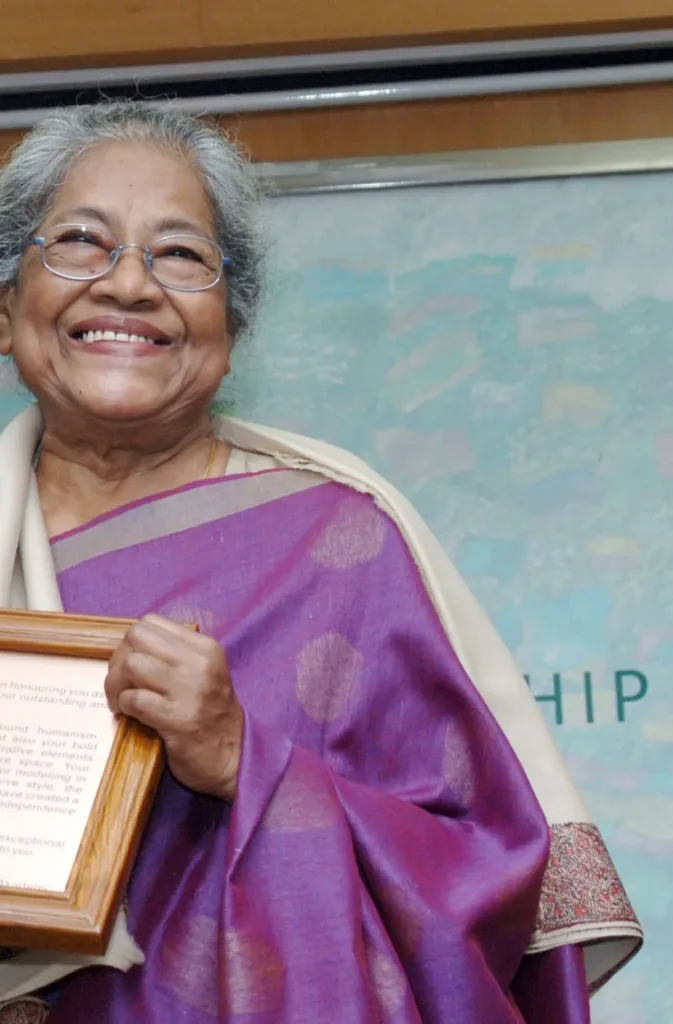
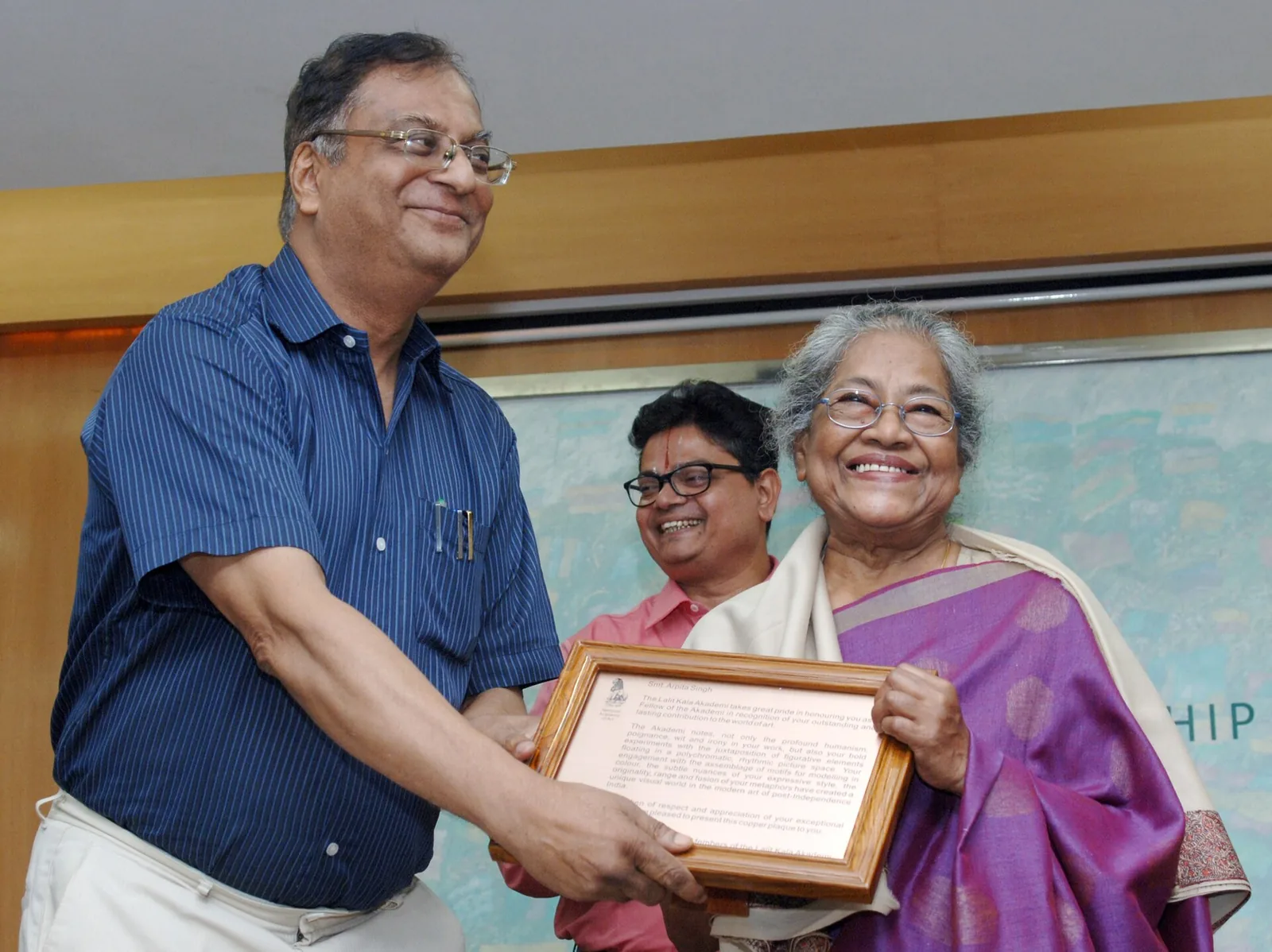
File photo, 10 October 2014: Arpita Singh at her Lalit Kala Akademi fellowship ceremony in New Delhi. Ministry of Culture, GODL-India, Wikimedia Commons Cropped by NewsPlainly.

Why it matters
Singh’s career connects Indian craft traditions with painting shown in major institutions. Her exhibition records give readers a way to explore the range of her work beyond a single signature style.
Arpita Singh, the painter awarded the Padma Bhushan in 2011, died in Delhi on the morning of 9 November 2026. Her husband, artist Paramjit Singh, confirmed her death to the Press Trust of India (PTI). Roshini Vadehra, director of the gallery that represents her, separately confirmed the news to The Indian Express.
Singh’s career connected the close observation of everyday life with images of women, memory and conflict. Her work reached Indian and overseas institutions over several decades, including a major Delhi retrospective in 2019 and an exhibition at London’s Serpentine in 2025.
Arpita Singh’s work placed women at its centre
The Serpentine’s account of her work describes paintings shaped by Bengali folk traditions and Indian stories, alongside experiences of social upheaval and global conflict. Its curators traced both domestic life and women’s experiences beyond the home.
The institution identifies motherhood, the ageing female body, vulnerability and violence among the themes she increasingly explored from the 1990s. These descriptions help explain the range of a practice that moved between intimate subjects and events outside the household, rather than treating the two as separate worlds.
Singh worked in large oil paintings as well as smaller watercolours and ink drawings. Serpentine’s exhibition description also points to her use of figuration, abstraction and Surrealism. Figuration involves recognisable figures; abstraction uses forms that do not simply reproduce an identifiable scene.
Talwar Gallery’s artist profile places particular emphasis on her drawings and predominantly abstract work from 1973 to 1982. It describes the line and textures developed in that period as a foundation for her later paintings. The earlier work gives a wider view of an artist often associated with densely populated figurative canvases.
From Bengal to art school and textile design
According to Serpentine’s institutional biography, Arpita Singh was born in 1937 in Baranagar, in what is now West Bengal. She moved with her family to New Delhi in 1946 and graduated in fine arts from Delhi Polytechnic in 1959.
After graduation she worked as a textile designer at the Weavers’ Service Centre, part of the Handloom Board of India. The Indian Express linked her experience with traditional embroidery, particularly kantha, to the repeated small marks seen in her paintings. Kantha is a stitching tradition associated with Bengal.
The newspaper described the influence of that training without reducing her career to a single movement or technique. Her work used different media and ways of arranging a scene, while its subjects repeatedly returned to people, relationships and the wider pressures around them.
A timeline of study, honours and exhibitions
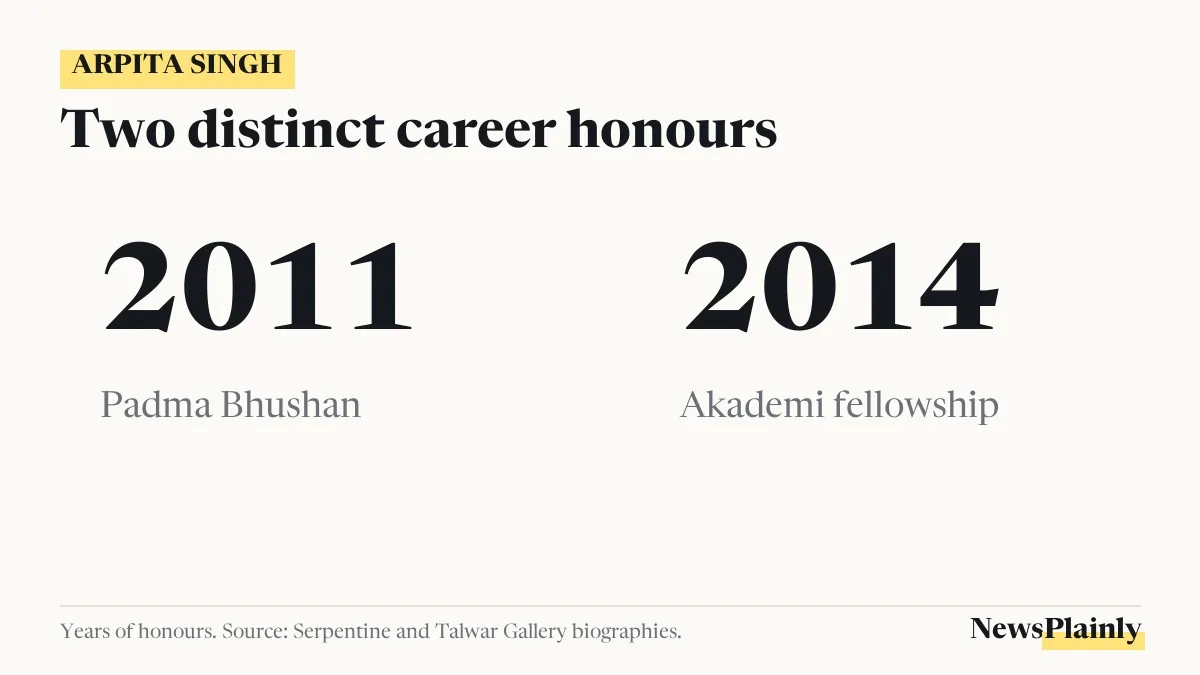
The following chronology joins institutional biographies with the dated exhibitions they record. The two major honours in it are separate: the Padma Bhushan in 2011 and the Lalit Kala Akademi fellowship in 2014.
| Year | Milestone |
|---|---|
| 1937 | Born in Baranagar, according to Serpentine’s biography. |
| 1946 | Moved with her family to New Delhi. |
| 1959 | Graduated from Delhi Polytechnic in fine arts. |
| 2011 | Received the Padma Bhushan. |
| 2014 | Received a Lalit Kala Akademi fellowship. |
| 2019 | Retrospective at the Kiran Nadar Museum of Art in New Delhi. |
| 2025 | Remembering at Serpentine in London. |
The 2019 retrospective was titled Submergence: In the Midst of Here and There. Serpentine identifies Remembering as her first solo institutional exhibition outside India. That qualification matters: it describes a particular kind of exhibition and does not mean she had never shown work overseas before.
Institutions and colleagues remember her practice
The Indian Express reported Vadehra’s recollection of Singh as both an admired artist and a friend whose curiosity and humour influenced those around her. PTI carried tributes from curator Uma Nair and poet Ashok Vajpeyi, who wrote about the narrative power of her paintings and their engagement with contemporary life.
On 9 November, The Indian Express also reported that Unfolding was under way at Talwar Gallery in New York. The reviewed reports give differing funeral dates, so this article does not reproduce a funeral schedule. Its career chronology relies on the institutions that exhibited and represented her.
NewsPlainly’s arts and entertainment coverage follows the people and work behind India’s cultural news.
Frequently asked questions
What was Arpita Singh known for?
Institutional accounts describe figurative paintings, drawings and watercolours engaging with women’s lives, memory and social conflict.
When did she receive the Padma Bhushan?
She received it in 2011. A separate Lalit Kala Akademi fellowship followed in 2014.