
Representative image. DesiBoy101, CC BY 4.0, Wikimedia Commons

Why it matters
The auction records demand for short-term secured funding. Separating this operation from policy-rate decisions prevents its bidding rates being read as a new general interest-rate announcement.
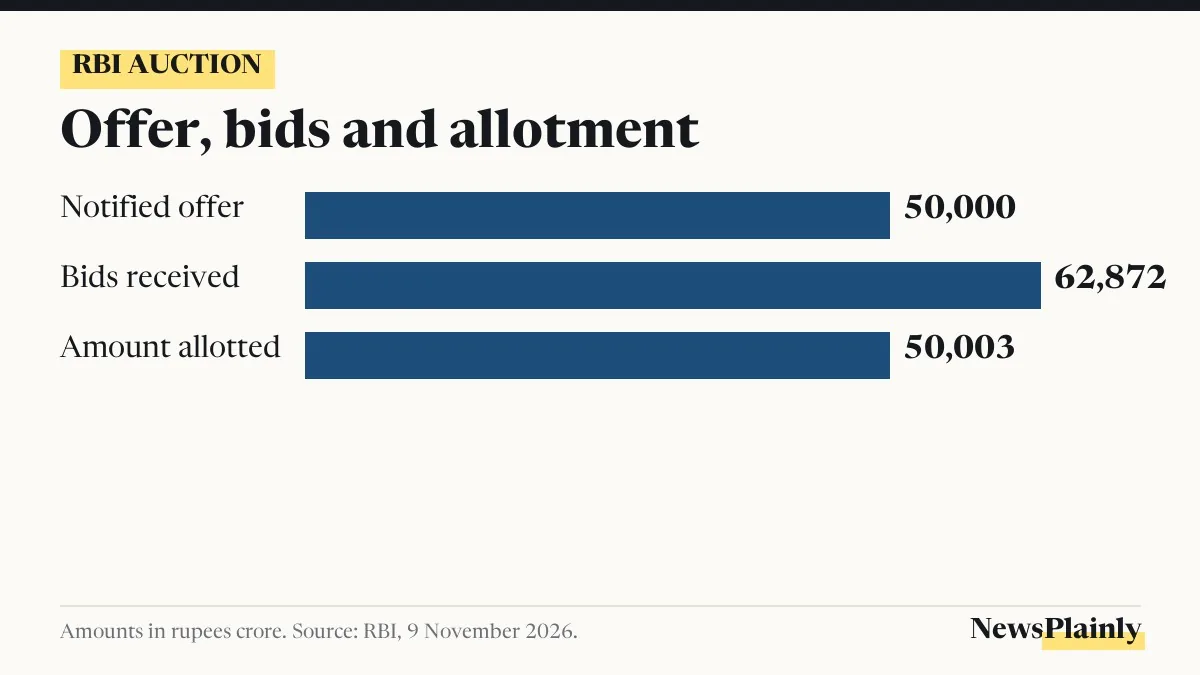
RBI repo auction bids reached ₹62,872 crore on 9 November 2026 against an announced ₹50,000 crore offer for four-day funds. The Reserve Bank of India (RBI) allotted ₹50,003 crore, according to its published result.
The cut-off interest rate was 5.51%, while the weighted average rate was 5.54%. These figures describe a short-term funding auction for eligible financial institutions. They are separate from a decision by the Monetary Policy Committee on the policy interest rate.
What the RBI repo auction figures show
The RBI’s result lists three amounts that should be read separately: the notified amount, the bids received and the amount allotted. The notified amount is what was offered. Bids measure the funds requested in the auction, while the allotment is the amount accepted.
The publication gives the allotment as ₹50,003 crore, compared with the notified ₹50,000 crore. It does not explain that ₹3 crore difference. The figures below retain the published amounts rather than treating the offer and allotment as identical.
| Measure | 9 November result | What it measures |
|---|---|---|
| Notified amount | ₹50,000 crore | Size announced for the auction |
| Bids received | ₹62,872 crore | Total amount requested |
| Amount allotted | ₹50,003 crore | Funds accepted for allotment |
| Tenor | 4 days | Duration of the operation |
NewsPlainly’s calculation shows bids were ₹12,872 crore above the notified offer. Dividing that difference by ₹50,000 crore puts demand 25.74% above the announced amount. The comparison is with this auction’s offer, rather than with bidding on an earlier day.
Two percentages have different denominators
The amount allotted was 79.53% of the amount bid, by NewsPlainly’s calculation: ₹50,003 crore divided by ₹62,872 crore, multiplied by 100. The difference between total bids and the allotment was ₹12,869 crore.
That calculation describes the share of the requested money that was allotted. It does not show the proportion of participating banks that received funds. The result gives amounts and rates, without identifying individual successful institutions.
A separate figure in the RBI repo auction result is 15.18%. It is labelled the partial allotment percentage for bids received at the cut-off rate. Its denominator is that particular group of bids, rather than the entire ₹62,872 crore requested.
Confusing those bases would produce a different account of the auction. The 79.53% is NewsPlainly’s comparison of total amounts; the 15.18% is RBI’s published allocation percentage at the cut-off. Both can appear in the same result because they answer different questions.
How a variable-rate repo supplies short-term funds
A repo is a form of secured borrowing involving securities and an agreement to reverse the transaction later. In RBI’s liquidity operations, eligible government securities support the borrowing. Liquidity here means funds available to meet short-term financial needs.
RBI’s government-securities primer explains that variable-rate repo bids are ordered from higher quoted rates towards lower ones. The cut-off marks the level reached in allocating the notified amount. When multiple successful bids are at that boundary, funds are shared proportionately.
The cut-off and the weighted average also have different jobs. For this auction, 5.51% is the published boundary rate. The 5.54% weighted average summarises accepted rates with their amounts taken into account. Neither number is a forecast for the next auction.
NewsPlainly’s calculation puts the gap between the two published rates at 0.03 percentage points, or three basis points. One basis point is one hundredth of a percentage point. This measures a difference between rates, rather than a change in the amount borrowed.
The policy calendar is a separate decision process
RBI’s monetary-policy overview says the Monetary Policy Committee determines the policy interest rate needed to meet the inflation target. The same overview treats short-term liquidity operations as tools for managing banking-system funding conditions.
Its published meeting calendar lists 2 to 4 December 2026 for the committee’s next scheduled meeting. The four-day auction result does not announce that meeting’s outcome or establish a new policy rate. It records the amounts and rates of one operation on 9 November.
More reporting on rates, banks and markets is available in NewsPlainly’s Business section.
Frequently asked questions
Did this auction change the policy repo rate?
The release reports a four-day funding auction. The Monetary Policy Committee determines the policy interest rate through a separate process.
Does 15.18% mean only that share of all bids received money?
No. RBI labels it the partial allotment percentage for bids at the cut-off rate. The total allotted amount was 79.53% of total bids by NewsPlainly’s calculation.