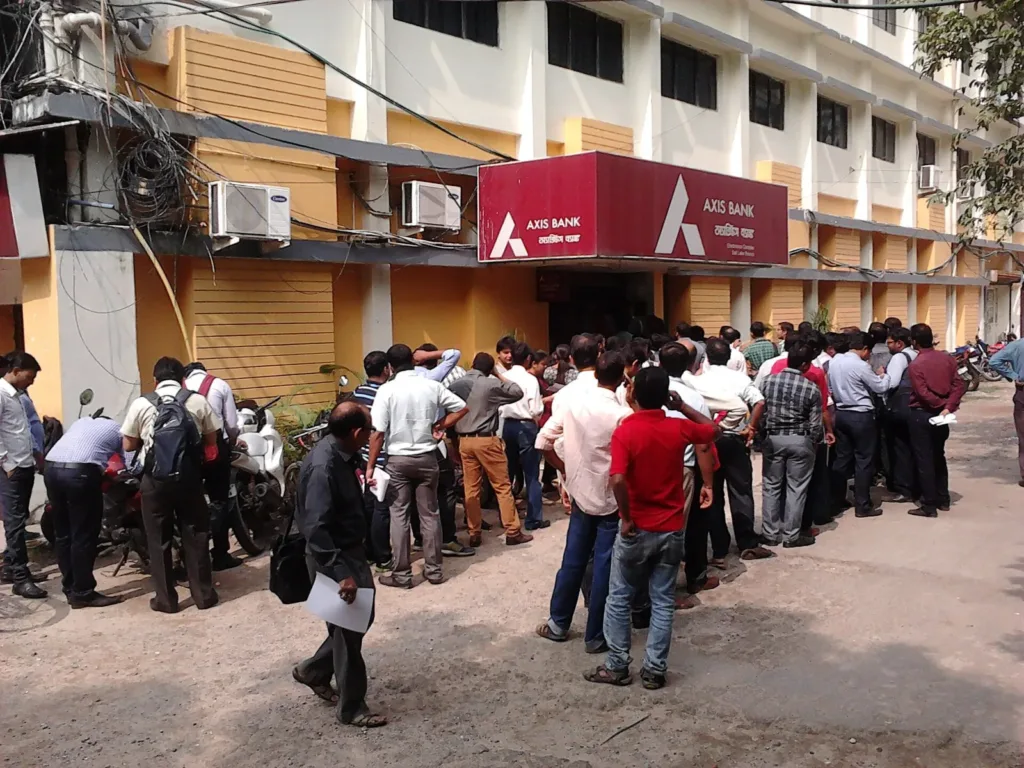
Representative image. Biswarup Ganguly, CC BY 3.0, Wikimedia Commons

Why it matters
Demonetisation was meant to cut cash, black money and fake notes. The RBI's own numbers let readers judge the cash and counterfeit parts: banknote value has more than doubled since 2016, and the ₹500, the note that carries most of India's cash, is also the note most fakes are made of.
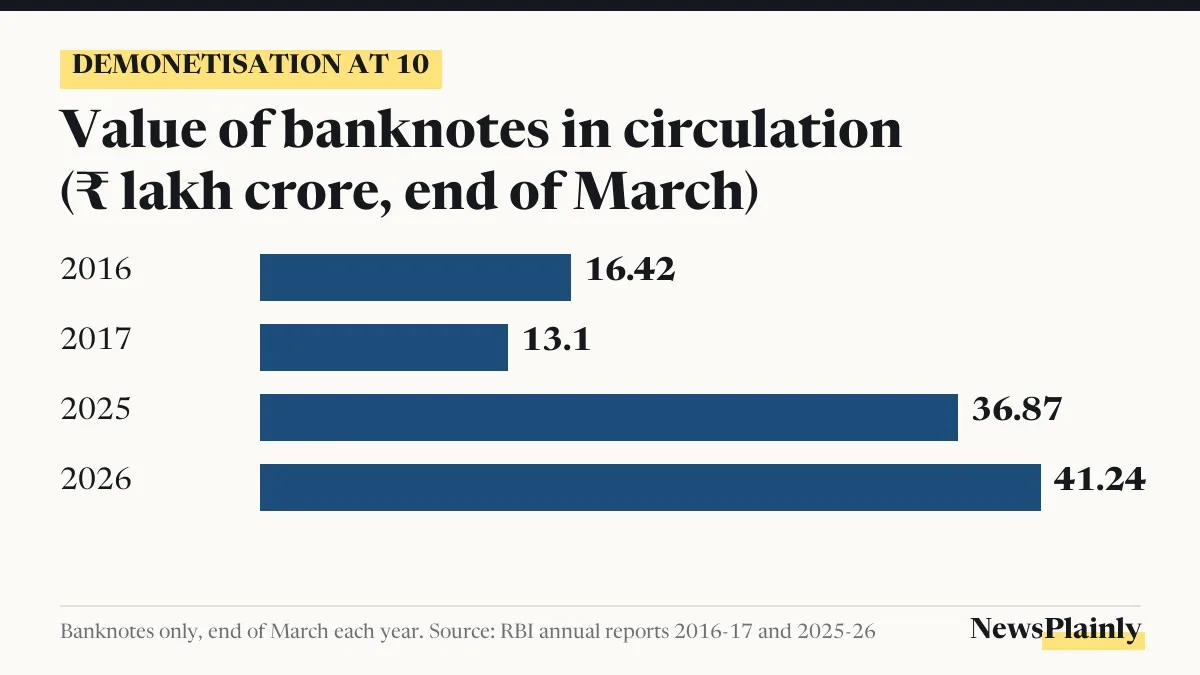
Demonetisation 10 years on, India has more cash in circulation, not less. On the evening of 8 November 2016, Prime Minister Narendra Modi announced that the old ₹500 and ₹1,000 notes would stop being legal tender, taking out nearly 86% of the notes in circulation by value. A decade later, the Reserve Bank of India’s annual report for 2025-26 shows the value of banknotes in circulation at ₹41.24 lakh crore at the end of March 2026, about 2.5 times the ₹16.42 lakh crore of March 2016.
The same RBI data show fake notes detected by banks far below the 2016-17 level, but fake ₹500 notes caught by banks have now risen two years in a row. NewsPlainly compared the RBI’s currency tables from its 2016-17, 2017-18 and 2025-26 annual reports to see what changed.
Demonetisation 10 years on: how much cash is in circulation
At the end of March 2016, eight months before the announcement, banknotes worth ₹16,415 billion (₹16.42 lakh crore) were in circulation, according to the RBI’s 2016-17 annual report. The ban pulled that down sharply: by the end of March 2017 the value had fallen 20.2% to ₹13.10 lakh crore, even though the number of notes rose as the RBI pushed out smaller denominations.
The fall did not last. The RBI’s 2025-26 report puts the value of banknotes at ₹41,23,995 crore at the end of March 2026, up 11.9% from ₹36.87 lakh crore a year earlier. The number of notes rose 10.5% in 2025-26 to 17,13,215 lakh pieces, roughly 1.9 times the March 2016 count.
On NewsPlainly’s calculation, a rise from ₹16.42 lakh crore to ₹41.24 lakh crore over 10 years works out to about 9.6% a year, compounded. These figures cover banknotes only; coins are counted separately, so total cash in circulation is a little higher.
A report by Onmanorama put total cash in circulation at ₹43.46 lakh crore on 15 October 2026. The same report said cash as a share of GDP was 12.1% in 2015-16, dropped to 8.7% in 2016-17, peaked at 14.4% in 2020-21 during the pandemic and was about 12% in 2025-26, close to where it started.
Big notes hold the same share of cash in circulation
The main target of the 2016 move was high-value cash. At the end of March 2016, ₹500 and ₹1,000 notes made up 86.4% of the value of all banknotes, the RBI’s 2016-17 report said. The number of notes in circulation had kept rising right up to 8 November 2016, the same report noted.
Ten years on, one note does almost the same job. The ₹500 note alone accounted for 85.5% of the value of banknotes at the end of March 2026, and 41.2% of all notes by number, the 2025-26 report shows. The ₹10 note is second by number.
The ₹2,000 note, introduced on 8 November 2016, has largely gone. The RBI began withdrawing it on 19 May 2023. By 31 March 2026, 98.45% of the ₹3.56 lakh crore of ₹2,000 notes in circulation at the time of the announcement had come back, leaving ₹5,501 crore outstanding. The notes can still be exchanged or deposited at 19 RBI issue offices, or sent there by India Post for credit to a bank account.
| RBI figure | March 2016 | March 2017 | March 2026 |
|---|---|---|---|
| Value of banknotes | ₹16.42 lakh crore | ₹13.10 lakh crore | ₹41.24 lakh crore |
| Number of notes | 9,02,660 lakh | 10,02,930 lakh | 17,13,215 lakh |
| Share of value in ₹500 and above | 86.4% | 73.4% | 85.6% |
| Fake notes detected in the year to March | 6,32,926 (2015-16) | 7,62,072 (2016-17) | 2,29,746 (2025-26) |
Fake notes: the ₹500 count is rising again
Ending counterfeit currency was one of the stated aims of the 2016 move, along with black money, corruption and terror funding, the news sites ETV Bharat and Onmanorama noted in their anniversary reports.
Banks detected 7,62,072 fake notes in 2016-17, the year of the ban, 20.4% more than the year before, according to the RBI’s 2016-17 report. The count fell to 5,22,783 in 2017-18. In 2025-26 it was 2,29,746, about 70% below the 2016-17 figure on NewsPlainly’s calculation, though slightly up from 2,17,396 in 2024-25.
Among fake notes, the worry is the ₹500 note. Banks found 85,711 fake ₹500 notes in 2023-24, 1,17,722 in 2024-25 and 1,41,907 in 2025-26, a rise of 20.5% in the latest year. On NewsPlainly’s calculation, ₹500 fakes made up about 62% of all fake notes detected in 2025-26. Fake ₹20 notes rose 47.4% from a much smaller base, while fakes of ₹10, ₹50, ₹100, ₹200 and ₹2,000 fell.
Put against the 70,548 million ₹500 notes in circulation at the end of March 2026, the fakes detected in 2025-26 come to about two for every million genuine ₹500 notes. That is NewsPlainly’s calculation and a rough guide only, because the RBI counts fakes found during the year and real notes on one date. The RBI’s figures also leave out counterfeits seized by the police and other agencies.
The RBI’s 2025-26 report, released on 29 May 2026, said a phased roll-out of banknotes with new or upgraded security features was expected to start from the middle of 2026.
Where the old notes went, and why people still hold cash
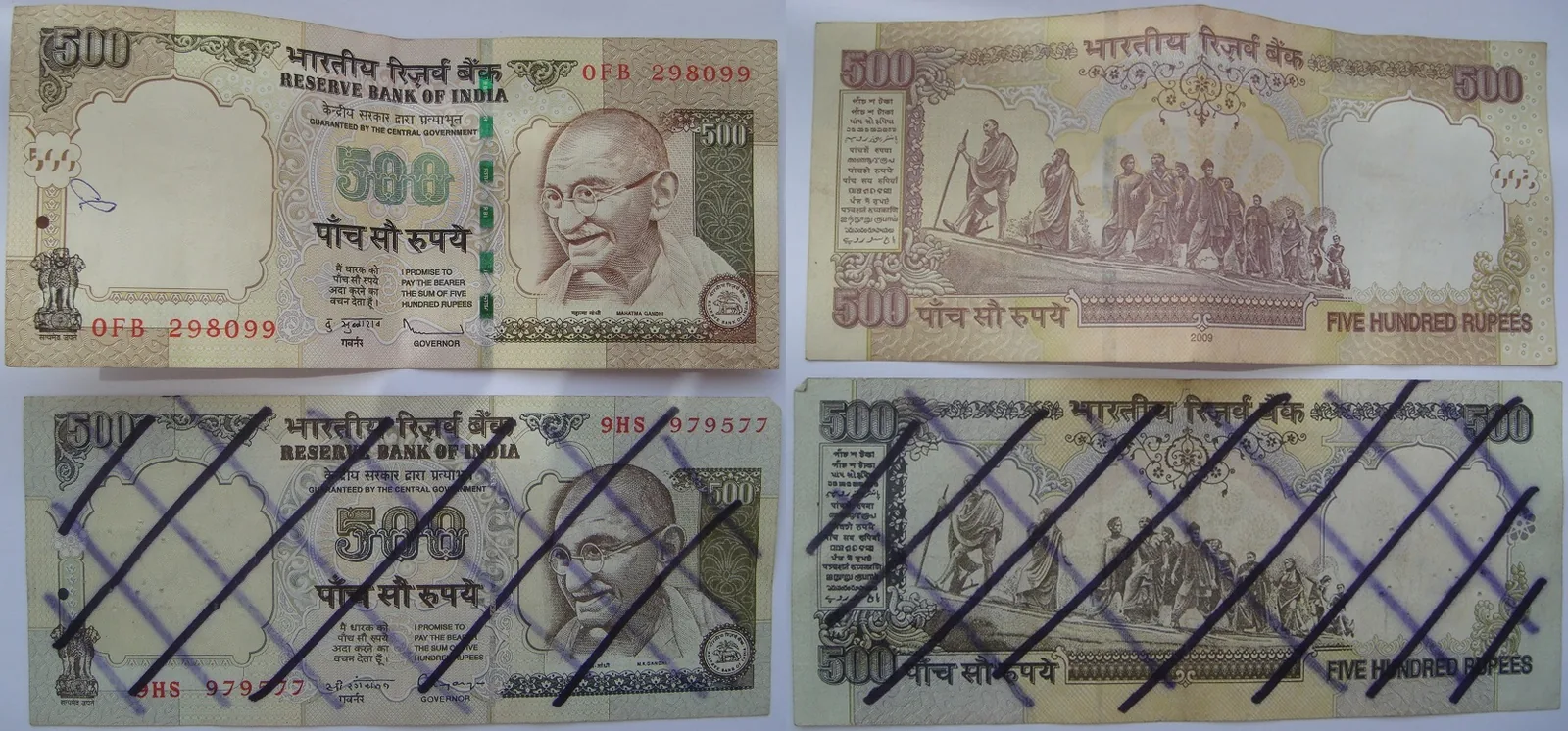
Almost all the withdrawn money came back. The RBI’s 2017-18 annual report said ₹15,310.73 billion (₹15.31 lakh crore) of the old notes were returned after processing. ETV Bharat, citing RBI data, put this at 99.3% of the ₹15.42 lakh crore that had been in circulation. The deposit window ran from 10 November to 30 December 2016.
The economic cost was debated from the start. The Economic Survey 2016-17 estimated a loss of a quarter to half a percentage point of GDP growth against a baseline of about 7%, ETV Bharat reported.
Digital payments have grown fast since then, led by the Unified Payments Interface (UPI), the phone-based bank transfer system. Cash has not gone away, the RBI annual report for 2025-26 suggests. During the year the RBI surveyed the payment habits of individuals and small retail sellers, and the report said the results showed a continued strong preference for cash. The RBI’s digital rupee (e₹) stood at ₹771.7 crore at the end of March 2026, down from ₹1,016.5 crore a year earlier.
For more on banks, prices and the RBI, see NewsPlainly’s business section.
Frequently asked questions
When was demonetisation announced?
Prime Minister Narendra Modi announced it on the evening of 8 November 2016. Old ₹500 and ₹1,000 notes stopped being legal tender, and people could deposit them in banks until 30 December 2016.
How much cash is in circulation in India now?
Banknotes worth ₹41.24 lakh crore were in circulation at the end of March 2026, according to the RBI's 2025-26 annual report, compared with ₹16.42 lakh crore at the end of March 2016.
Did the old notes come back to the RBI?
Almost all did. The RBI's 2017-18 annual report said ₹15.31 lakh crore of the old notes were returned. ETV Bharat, citing RBI data, put this at 99.3% of the notes in circulation.
Are fake ₹500 notes increasing?
Yes, by the RBI's count. Banks detected 1,41,907 fake ₹500 notes in 2025-26, up 20.5% from 1,17,722 a year earlier and up from 85,711 in 2023-24.